



Audio By Vocalize
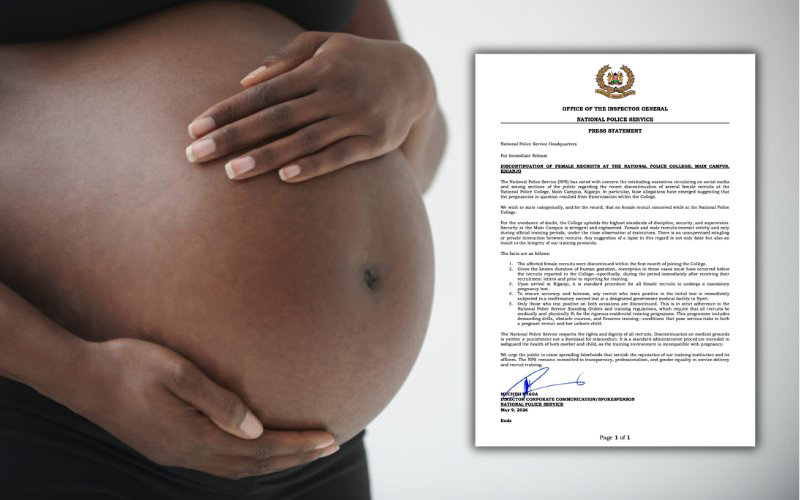
Fifty-four police recruits, among them 18 pregnant women, have been expelled from Kiganjo Police Training College, where they have been since December 2025. Their expulsion has not only raised eyebrows but also sparked national debate. The other recruits were dismissed for various reasons: 10 were found to have criminal records, 18 were accused of presenting forged academic certificates during recruitment, and 2 reportedly used fake identification documents.
The National Police Service quickly explained that no recruit conceived while in college, and that standard tests conducted three months after recruitment detected the pregnancies. That explanation raises more questions than answers.
The National Police Service Commission recruitment advertisement states that female candidates must not be pregnant at recruitment or during the entire training period. The real question, therefore, is not whether the pregnancies occurred at Kiganjo, but how 18 pregnant women were cleared to join Kiganjo. Do the police conduct medical and pregnancy tests during their recruitment exercises? If so, why does it take months to discover that the recruits are pregnant? A pregnancy can be detected between four and six weeks after conception, and if pregnancy tests were conducted, a good number of the 18 pregnant women would have been turned away early enough. Early screening would have spared the public the cost of training these recruits.
The same logic applies to the other dismissals. The police are the principal custodians of criminal records. How then did 10 recruits with criminal pasts pass through a vetting process administered by the very institution that maintains those records? How did fake academic certificates and false identity documents survive scrutiny during recruitment considering that the government is the custodian of these records? Either the screening was deliberately ignored, or someone looked the other way.
Either way, the procedure that was supposed to be airtight clearly was not. Coincidences of this magnitude do not happen when supervision holds.
There is also the question of personal responsibility. The National Gender and Equality Commission (NGEC) has raised concern that where recruitment criteria and consequences are not clearly defined, publicly communicated, consistently applied, and constitutionally tested, affected individuals may perceive administrative decisions as arbitrary or discriminatory. That concern, while valid, should not override accountability. Recruiters who might have failed in their duty must face consequences.
Senator Samson Cherargei has argued that pregnancy is not an offence and has called for the affected recruits to be granted maternity leave and allowed to resume training after delivery. That is a reasonable position. These women passed competitive interviews, earned their places, and deserve re-admission.
There is a need for investigation to establish why the screening process fell short. Those found culpable must be punished.
Support Independent Journalism
Stand With Bold Journalism.
Stand With The Standard.
Continue
→
Pay via
Secure Payment
Kenya’s most trusted newsroom since 1902
Follow The Standard on
Fifty-four police recruits, among them 18 pregnant women, have been expelled from Kiganjo Police Training College, where they have been since December 2025. Their expulsion has not only raised eyebrows but also sparked national debate. The other recruits were dismissed for various reasons: 10 were found to have criminal records, 18 were accused of presenting forged academic certificates during recruitment, and 2 reportedly used fake identification documents.
The National Police Service quickly explained that no recruit conceived while in college, and that standard tests conducted three months after recruitment detected the pregnancies. That explanation raises more questions than answers.
The National Police Service Commission recruitment advertisement states that female candidates must not be pregnant at recruitment or during the entire training period. The real question, therefore, is not whether the pregnancies occurred at Kiganjo, but how 18 pregnant women were cleared to join Kiganjo. Do the police conduct medical and pregnancy tests during their recruitment exercises? If so, why does it take months to discover that the recruits are pregnant? A pregnancy can be detected between four and six weeks after conception, and if pregnancy tests were conducted, a good number of the 18 pregnant women would have been turned away early enough. Early screening would have spared the public the cost of training these recruits.
The same logic applies to the other dismissals. The police are the principal custodians of criminal records. How then did 10 recruits with criminal pasts pass through a vetting process administered by the very institution that maintains those records? How did fake academic certificates and false identity documents survive scrutiny during recruitment considering that the government is the custodian of these records? Either the screening was deliberately ignored, or someone looked the other way.
Either way, the procedure that was supposed to be airtight clearly was not. Coincidences of this magnitude do not happen when supervision holds.
There is also the question of personal responsibility. The National Gender and Equality Commission (NGEC) has raised concern that where recruitment criteria and consequences are not clearly defined, publicly communicated, consistently applied, and constitutionally tested, affected individuals may perceive administrative decisions as arbitrary or discriminatory. That concern, while valid, should not override accountability. Recruiters who might have failed in their duty must face consequences.
Senator Samson Cherargei has argued that pregnancy is not an offence and has called for the affected recruits to be granted maternity leave and allowed to resume training after delivery. That is a reasonable position. These women passed competitive interviews, earned their places, and deserve re-admission.
There is a need for investigation to establish why the screening process fell short. Those found culpable must be punished.
By Editorial