



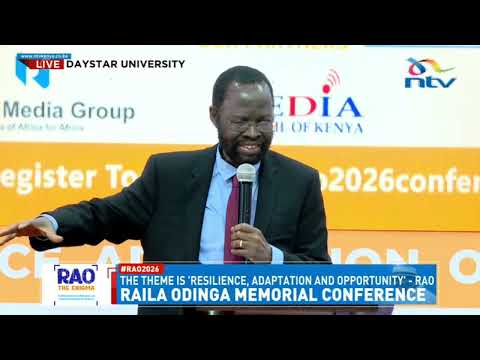
Leaders attending the RAO2026 Memorial Conference have celebrated the late Raila Odinga’s approach to election cycles, describing his democratic ethic as one that prioritised the preservation of the republic over personal victory.
At the same time, county governments were challenged to honour Raila’s legacy by bringing services closer to the people.
Kisumu Governor Anyang’ Nyong’o said Mr Odinga’s political journey offered lessons on democratic restraint and the responsibility of leaders to protect national institutions even when electoral contests did not end in their favour.
“Raila’s ethic of democracy is not the art of winning every contest, but the discipline of refusing to destroy the republic when you are not declared the winner,” Prof Nyong’o said during a lecture on communication and politics on the second day of the conference at Daystar University.
He said devolution, one of the central pillars of the constitutional reforms that Odinga championed, was intended to correct regional imbalances, distribute resources more equitably and ensure citizens could access essential services without travelling long distances to public offices.
The county boss urged leaders to reflect on whether the country had fulfilled the promise of devolution, arguing that the true measure of democracy lay in whether citizens enjoyed the benefits of citizenship beyond the ballot.


A supporter holds a portrait of the late former Prime Minister Raila Odinga alongside a lit candle during a memorial ceremony in his honour at Uhuru Park, Nairobi, on October 2, 2026.
“Today we have the 47 county governments. This was born out of many years of struggle for devolution led by none other than Raila Amolo Odinga,” Prof Nyong’o said at the conference.
“Devolution was meant to bring about regional development, balance the distribution of resources, and bring the services closer to the people. As we commemorate Raila, we must ask ourselves as leaders; what has been achieved? Have we lived the true vision of devolution?”
He challenged the leaders to address the concerns that Kenyans have raised.
“The true test of democracy is not whether a citizen votes but whether they experience the true meaning of citizenship, which means having services closer to them,” he added.
His remarks at the conference placed the spotlight on devolution, a governance model introduced under the 2010 Constitution after decades of demands for greater regional autonomy and a more equitable distribution of national resources.
Dagoretti South MP John Kiarie recalled his early political association with Raila, describing him as an influential mentor whose oratory and personal experiences gave credibility to the causes he championed.

Dagoretti South MP John Kiarie.
Mr Kiarie said he was appointed president of the ODM youth league at a young age and later entrusted with coordinating Raila’s campaigns in Lang’ata, an experience he said shaped his understanding of political leadership and mobilisation.
Read: How Raila anniversary plans have turned into 2027 campaign battlefield
“I was appointed to lead his campaigns in Lang’ata, and I did it wholeheartedly as a young leader. I learned a lot from him,” he said.
He described Raila as an exceptional communicator who could command the attention of crowds even before delivering the substance of his message, but said his influence went beyond his ability to speak.
“He was a true orator who would move crowds even when the audience had not heard what he uttered, they would move with him,” Mr Kiarie said.
Read: Raila Odinga, Muse of the Lake……His spirit lives on
The MP said Raila’s history of arrest and detention during Kenya’s authoritarian era helped audiences connect with his calls for freedom, giving his political messages a personal dimension that resonated with supporters.
“When he spoke about freedom, we all connected to his arrest and detention and what he went through,” he said.
Raila’s daughter Rosemary said the life of his late father was experienced differently by his family and the millions who followed his career.

Ms Rosemary Odinga.
“Many of you knew him as Baba but at home we called him Dad,” she said.
She recalled a father who made time to sit with his children, ask about their lives and remain involved in their personal affairs despite the demands of public office.
“We knew the father who came, sat with us and wanted to know what was happening in our lives,” she said.
She said her father’s public profile meant that even ordinary family moments could be interrupted by his constant presence on television, while his national prominence ensured that people across the country developed their own understanding of who he was.
“We would switch on the television and see him. Everybody had a story about him. Each person knew a different version of himself,” she said.
She also thanked the organisers and participants for choosing to remember her father through the conference, noting that despite his decades in public life, aspects of his personality and legacy remained difficult for many people to fully understand.
“His life still remains a mystery to so many people,” she said. “On behalf of my mother and my family, thank you for welcoming us and remembering our dad.”
The late former Prime Minister was among the prominent political figures who advocated for devolution, which transferred substantial administrative and service-delivery responsibilities from the national government to 47 county governments following the 2013 General Election.
Read: RAO: Resilience, adaptability, opportunity
The conference, themed around resilience, adaptation and opportunity, has brought together political leaders, scholars and media practitioners to reflect on Raila’s contribution to Kenya’s democratic development and consider the lessons his political journey offers for the country’s future.
The two-day meeting, organised by Daystar University, with Nation Media Group, the Media Council of Kenya and St John Ambulance as partners, has also examined Raila’s influence on political communication, democratic reform and public participation.
His political career was marked by years of opposition to one-party rule, imprisonment and detention without trial, followed by a central role in the push for multiparty democracy and subsequent constitutional reforms. His political influence continued through successive presidential contests, coalition negotiations and his engagement with governments across different administrations.
His ability to mobilise supporters and communicate political grievances became a defining feature of his career, allowing him to remain a central figure in national politics even though he never attained the presidency.
The reflections on Friday followed the first day of the memorial conference, during which speakers considered Raila’s place in Kenya’s democratic journey, his contribution to political reform and the reasons he remained influential despite repeatedly failing to win the presidency.
Follow our WhatsApp channel for breaking news updates and more stories like this.