

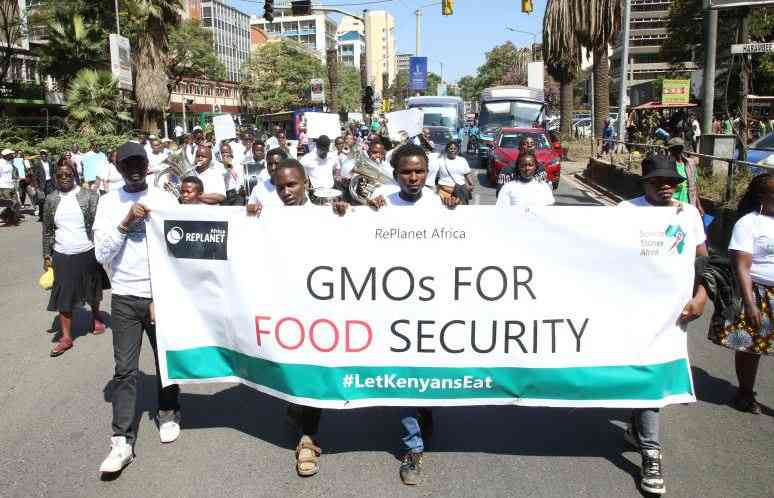
The government has pledged to strengthen public education and combat widespread misinformation around genetically modified organisms (GMOs), as it launched the National Biosafety Authority (NBA) Strategic Plan 2023–27 on Monday.
One of the key objectives of the plan is to improve public awareness of biosafety and GMO-related science, especially among farmers and consumers, many of whom remain skeptical or misinformed about the safety and benefits of biotechnology.
Speaking during the launch in Nairobi, Agriculture Principal Secretary Kipronoh Ronoh said misinformation on GMOs continues to be a major barrier to public acceptance and adoption.
He said the new strategic plan outlines key measures to enhance public awareness and education on biosafety.
“I wish to assure Kenyans that the country has a robust legal, regulatory and institutional capacity to ensure and assure safety of GMOs and their derived products,” said Dr Ronoh.
He emphasised the government’s commitment to modern biotechnology as a tool for national development, food and nutrition security, and agricultural transformation, adding that Kenya’s regulatory systems were robust enough to ensure the safe application of GMOs.
“The NBA is mandated to supervise and control the transfer, handling, and use of GMOs to ensure the safety of human and animal health and protection of the environment.”
One of the plan’s eight key result areas focuses specifically on public education and awareness, aiming to counter myths and disinformation about GMOs that have spread across digital platforms and communities.
The plan also emphasises compliance and enforcement, biosafety assessments, international collaboration, and institutional efficiency.
Professor Douglas Miano, a plant virologist and biotechnology expert at the University of Nairobi, underscored the need for scientifically-backed solutions to threats facing key crops like cassava.
He warned that without embracing modern genetic technologies, such as genetic engineering, vital food crops could be wiped out by diseases such as Cassava Brown Streak Disease (CBSD) — a virus that has devastated cassava yields in East Africa for decades.
“I’ve worked on cassava for years, especially to protect it from virus diseases,” Prof Miano said. “Cassava brown streak disease has been a regional menace from Mozambique and Tanzania to Kenya’s coast since the 1930s.
“But around 2004, it spread to western Kenya and Uganda—regions that account for over 60 per cent of the country’s cassava production. The damage was catastrophic.”
He said traditional breeding approaches were insufficient to tackle CBSD, as scientists found no resistant varieties in either cultivated or wild cassava relatives.
This forced researchers to turn to genetic engineering, a modern method of inserting a piece of the virus’ genetic material into the plant to trigger its natural immune response—a process he compared to immunisation in humans.
“You can’t inject every cassava plant like you do a vaccine in a human,” he explained. “So we transfer a small piece of genetic material into the plant, helping it fight off the virus itself. It’s like giving the plant the tools to defend itself — a very natural mechanism.”
Miano said there’s a big gap in public understanding. “We’ve done public awareness campaigns, advertised in newspapers, and involved media, but we still haven’t reached everyone.
“Even now, many people don’t understand what genetic modification really is.”
This misinformation, he said, has delayed not only acceptance of genetically modified cassava but also its commercialisation.
While Kenya has made progress in developing virus-resistant cassava using biotechnology, the path to national rollout remains blocked by public fear and lack of clarity.
“Public awareness must go beyond just the consumer,” he said. “Farmers want to know the product is safe and that it offers better yields.
“Consumers care about health, environmentalists about biodiversity, and traders about market access. Each part of the value chain needs tailored information.”
He also dismissed fears that using biotechnology in cassava threatens indigenous varieties with extinction. On the contrary, Miano argued that failing to act would accelerate the loss of traditional varieties due to disease.
“Many traditional cassava types are already disappearing because farmers stop growing them when they’re too vulnerable,” he said.
“We have more than 500 cassava varieties in Kenya, each with different uses. Creating one resistant GMO variety doesn’t make the others extinct—it helps preserve them.”
Implementation of the Strategic Plan 2023–2027 is projected to cost Sh 1.94 billion over the five-year period.
The government has pledged to strengthen public education and combat widespread misinformation around
genetically modified organisms
(GMOs), as it launched the National Biosafety Authority (NBA) Strategic Plan 2023–27 on Monday.
One of the key objectives of the plan is to improve
public awareness of biosafety
and GMO-related science, especially among farmers and consumers, many of whom remain skeptical or misinformed about the safety and benefits of biotechnology.
Speaking during the launch in Nairobi, Agriculture Principal Secretary Kipronoh Ronoh said misinformation on GMOs continues to be a major barrier to public acceptance and adoption.
He said the new strategic plan outlines key measures to enhance public awareness and education on biosafety.
“I wish to assure Kenyans that the country has a robust legal, regulatory and institutional capacity to ensure and assure safety of GMOs and their derived products,” said Dr Ronoh.
He emphasised the government’s commitment to modern biotechnology as a tool for national development, food and nutrition security, and agricultural transformation, adding that Kenya’s regulatory systems were robust enough to ensure the
safe application of GMOs
.
“The NBA is mandated to supervise and control the transfer, handling, and use of GMOs to ensure the safety of human and animal health and protection of the environment.”
One of the plan’s eight key result areas focuses specifically on public education and awareness, aiming to counter myths and disinformation about GMOs that have spread across digital platforms and communities.
The plan also emphasises compliance and enforcement, biosafety assessments, international collaboration, and institutional efficiency.
Professor Douglas Miano, a plant virologist and biotechnology expert at the University of Nairobi, underscored the need for scientifically-backed solutions to threats facing key crops like cassava.
He warned that without embracing modern genetic technologies, such as genetic engineering, vital food crops could be wiped out by diseases such as Cassava Brown Streak Disease (CBSD) — a virus that has devastated cassava yields in East Africa for decades.
“I’ve worked on cassava for years, especially to protect it from virus diseases,” Prof Miano said. “Cassava brown streak disease has been a regional menace from Mozambique and Tanzania to Kenya’s coast since the 1930s.
“But around 2004, it spread to western Kenya and Uganda—regions that account for over 60 per cent of the country’s cassava production. The damage was catastrophic.”
He said traditional breeding approaches were insufficient to tackle CBSD, as scientists found no resistant varieties in either cultivated or wild cassava relatives.
Stay informed. Subscribe to our newsletter
This forced researchers to turn to genetic engineering, a modern method of inserting a piece of the virus’ genetic material into the plant to trigger its natural immune response—a process he compared to immunisation in humans.
“You can’t inject every cassava plant like you do a vaccine in a human,” he explained. “So we transfer a small piece of genetic material into the plant, helping it fight off the virus itself. It’s like giving the plant the tools to defend itself — a very natural mechanism.”
Miano said there’s a big gap in public understanding. “We’ve done public awareness campaigns, advertised in newspapers, and involved media, but we still haven’t reached everyone.
“Even now, many people don’t understand what genetic modification really is.”
This misinformation, he said, has delayed not only acceptance of genetically modified cassava but also its commercialisation.
While Kenya has made progress in developing virus-resistant cassava using biotechnology, the path to national rollout remains blocked by public fear and lack of clarity.
“Public awareness must go beyond just the consumer,” he said. “Farmers want to know the product is safe and that it offers better yields.
“Consumers care about health, environmentalists about biodiversity, and traders about market access. Each part of the value chain needs tailored information.”
He also dismissed fears that using biotechnology in cassava threatens indigenous varieties with extinction. On the contrary, Miano argued that failing to act would accelerate the loss of traditional varieties due to disease.
“Many traditional cassava types are already disappearing because farmers stop growing them when they’re too vulnerable,” he said.
“We have more than 500 cassava varieties in Kenya, each with different uses. Creating one resistant GMO variety doesn’t make the others extinct—it helps preserve them.”
Implementation of the Strategic Plan 2023–2027 is projected to cost Sh 1.94 billion over the five-year period.
By Maryann Muganda