



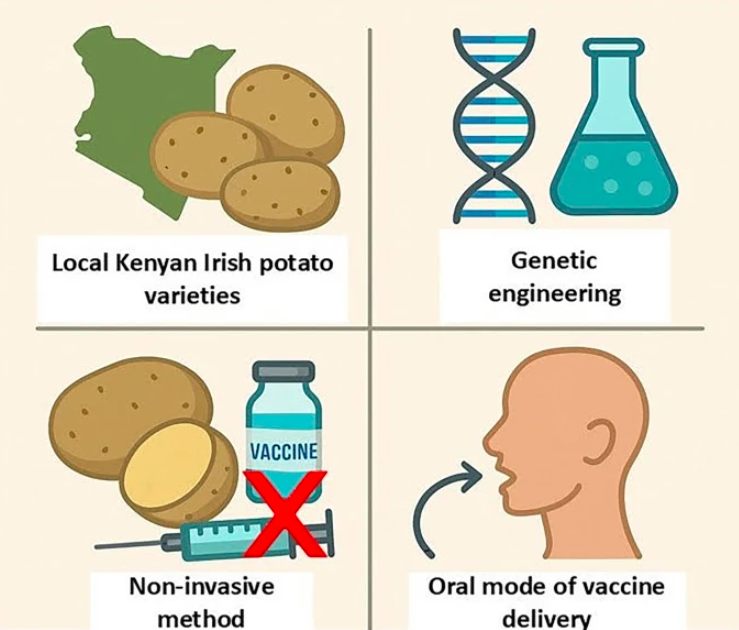
Plant-based edible vaccines are environmentally sustainable, safe, with high scalability and have the potential for bulk production at reduced costs and time.
The full article –
Insights into the world of edible vaccines: From lab to reality –
is published in the latest issue of Current Research in Biotechnology journal, and can be accessed
here
.
Despite vaccines
efficacy, nearly 14.5 million infants remained unvaccinated in 2023, with 60 per cent from developing nations, highlighting the lack of
access to immunization and healthcare facilities.
Immunisation
possesses significant drawbacks such as inadequate research, production costs,
distribution, storage, delivery and a lack of administering infrastructure.
Certain DNA vaccinations against specific diseases are unreliable, expensive
and result in adverse immunological responses.
These vaccines include high price tags and pose
challenges in storage and transportation due to their refrigeration
requirements. Consequently, the lack of storage facilities and high
manufacturing costs of vaccines impede their ability to protect millions of
lives worldwide.
Therefore, it is essential to investigate easily
administered, storable, and widely accessible vaccination strategies and
delivery techniques, particularly in resource-limited countries.
In this
context, ‘edible vaccines’ serve as an efficient alternative and can annihilate
the restrictions incurred with conventional vaccines. The oral administration
of therapeutic agents such as vaccines is advantageous because of their
self-administration ability, safety, better patient compliance and ease of
distribution.
Progressive advancements in natural sciences, plant
biotechnology, and genetics have significantly enhanced our understanding of
infectious diseases and enabled the creation of plant-based edible vaccines.
Developing plant-based edible vaccines (food, oral,
subunit, and green vaccines) offers a promising and innovative approach with
numerous advantages. These are subunit vaccines that incorporate stable gene
expression into the nucleus or chloroplast regions of the genome of suitable
vegetables or fruits, including potatoes, bananas, and tomatoes.
It
facilitates the production of complex recombinant proteins with proper folding
while easing their transformation, expression, functional stability, and
purification. These plants are engineered to express specific antigens,
necessitating a basic understanding of agriculture and plant cultivation.
Notably, edible vaccines eliminate the need for purification
and downstream processing, which are the cost drivers in conventional vaccine
production.
These edible vaccines are currently under
development for various human diseases, including hepatitis B, C, and E,
measles, cholera, and foot-and-mouth disease. Additionally, ongoing research is
exploring the potential of this innovative technique to mitigate severe
SARS-COV-2 infections.
Furthermore, plant-based edible vaccines are
environmentally sustainable, safe, with high scalability and have the potential
for bulk production at reduced costs and time. Their significance lies in
eliminating downstream processes, refrigeration during storage and the need for
qualified medical staff for delivery.
In
conclusion, edible vaccines hold immense potential to revolutionise the field
of immunisation and disease prevention. They provide numerous benefits compared
to conventional immunisations by employing genetically engineered plants and
novel delivery techniques.
Nonetheless, addressing safety concerns, regulatory
considerations, and public acceptance are critical for the successful
implementation of this groundbreaking technology.
Although edible vaccinations are not currently
accessible, progress in agriculture and biotechnology suggests a future where
immunisation could be administered
through the consumption of tomatoes.
Although traditional vaccines have a crucial role
in improving global health, their production in large quantities is expensive
and time-consuming. Developing edible vaccines offers a potential solution to
these challenges.
This innovative approach holds the promise of
delivering enhanced, safer, and more effective immunization and disease
prevention measures, particularly for life-threatening diseases that impact a
significant portion of the global population, such as dengue, malaria, AIDS,
heart diseases and respiratory disorders.
Moreover, in future, the crossing of two different
generation plants with varying types of gene expressing clinically relevant
antigens could yield a multi-component vaccine with adjuvant properties.
Since the completion of the initial human clinical
trials for plant-based vaccines, various challenges have emerged, including the
need to optimise expression levels and ensure
stability during post-harvest storage.
The
long-term effects of edible vaccines have yet to be fully determined, including
the possibility of undiscovered delayed reactions. Additionally, the inclusion
of a specific adjuvant, either fused with the candidate gene or administered
separately, can enhance the immunogenicity of orally delivered edible vaccines.
Ongoing research and development will assess
whether edible vaccines can meet the quality standards set by the World Health
Organization (WHO), including potency, efficacy, purity, and safety. If
successfully developed, these vaccines could offer a single-shot solution to
prevent widespread diseases worldwide.