

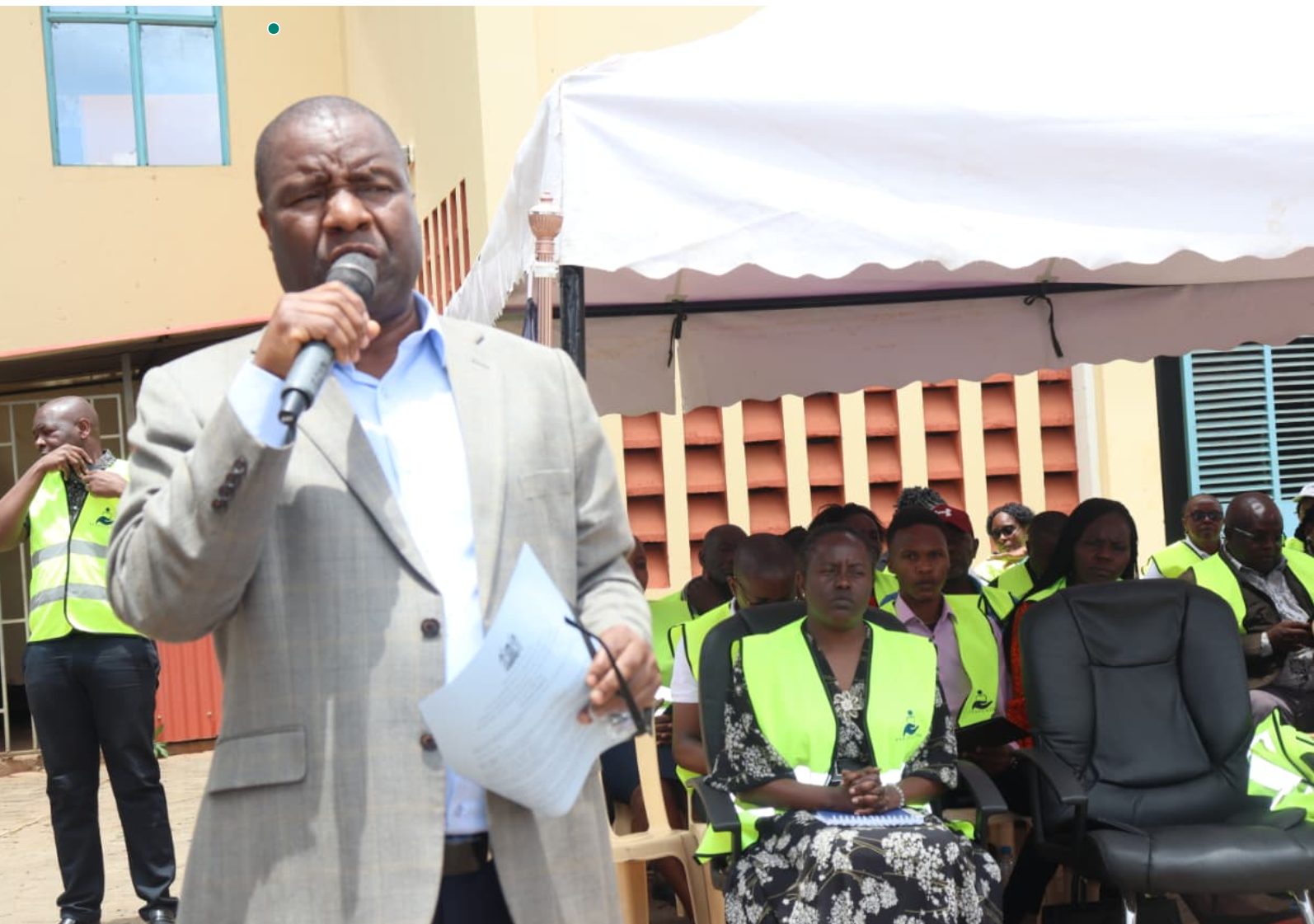
James Ntabo, Director of Administration at the Ministry of Health, during the event.More than 800,000 Kenyans need palliative care every year,
but only 29,016 received it in 2023, a gap the Ministry of Health says it is
determined to close.
Speaking during the World Hospice and Palliative Care Day
celebration held on October 8 at Embu Level 5 Hospital, the Director of
Administration at the Ministry of Health, James Ntabo, who represented
Principal Secretary Dr. Ouma Oluga, said the figures highlight the urgent need
to scale up compassionate care across the country.
“Over 800,000 Kenyans need palliative care annually, but
only a fraction — 29,016 — received services in 2023. Children remain
disproportionately underserved, with less than 5 percent accessing care,” he
said. “The burden of serious health-related suffering continues to rise, driven
by cancer, HIV, stroke, congenital conditions among others. Families in rural
and underserved areas still face catastrophic health expenditures.”
The remarks were made as Kenya joined the world in marking
this year’s event under the theme “Achieving the Promise: Universal Access to
Palliative Care.”
Ntabo told participants that Kenya had made bold strides
toward ensuring that all patients with life-limiting illnesses live with
dignity and minimal pain.
“We recognize palliative care as a human right, anchored in
our Constitution and embedded in our Universal Health Coverage agenda,” he
said. “The launch of the Kenya Palliative Care Policy 2021–2030 has provided a
national framework for action.”
He noted that the Ministry had established a dedicated
Palliative Care Division in 2023 and a Technical Working Group in 2024 to guide
its rollout. The network of facilities providing such services has grown from
40 in 2014 to more than 120 today, reaching hospitals, communities, and homes.
“Community Health Promoters are now sensitized to deliver
basic palliative care, ensuring grassroots access. Oral morphine is centrally
procured and distributed, improving pain relief for adults and children,” Ntabo
said.
He added that palliative care is now covered under the
Social Health Authority through the Emergency Chronic and Critical Illness
Fund, easing the financial burden for families. The package covers medicines,
consultations, and hospital bed support in facilities from Level 4 to 6.
Even so, Ntabo admitted that Kenya still has work to do to
ensure equitable coverage.
“Recognizing the importance of expanding care to lower-level
facilities, especially community-based home care, this area remains a key focus
for improvement,” he said. “Future enhancements to the benefit package will be
guided by the Benefit Package Technical Advisory Panel, in line with their
mandate.”
Globally, the crisis mirrors Kenya’s struggle. According to
the World Health Organization, more than 60 million people require palliative
care annually, yet less than 15 percent receive it. Experts warn that without
greater investment and integration into national health systems, millions will
continue to endure unnecessary pain and suffering.
The Embu event was jointly organized by the Ministry of
Health, Embu County Government, and partners including the National Cancer
Institute of Kenya, the Kenya Hospices and Palliative Care Association
(KEHPCA), and Beyond Zero. The commemoration featured an awareness walk through
Embu town, health screening booths for blood pressure and cancer checks, and
community forums aimed at demystifying palliative care.
“Palliative care is not a privilege — it is a promise. A
promise we must keep. It is the measure of our compassion, the strength of our
health systems, and the soul of our society,” Ntabo told participants.
He said the government was committed to operationalizing the
national policy with dedicated funding, integrating palliative care into
primary health services, and expanding access to oral morphine in both public
and private facilities. The Ministry also plans to strengthen data systems and
research to guide policy and to “build a national movement of champions to
raise awareness and demand.”
The day’s theme, “Achieving the Promise,” echoed through
speeches from county leaders, healthcare workers, and patient groups who called
for stronger partnerships and community education.
Embu County health officials showcased local initiatives
that link terminally ill patients with community health promoters and
faith-based volunteers trained in basic palliative care.
The Ministry’s concept note on the event emphasizes that
palliative care “optimizes quality of life and mitigates health-related
suffering among adults and children with serious illnesses, and their carers.”
It also notes that palliative care is a major unmet need globally, and that
“universal health coverage cannot be achieved without integrating palliative
care into healthcare systems worldwide.”
As the speeches ended, participants observed a moment of
reflection for families who have lost loved ones to cancer and chronic illness
without adequate pain relief or support.
“Let us leave no one behind,” Ntabo urged. “Let us ensure
that every Kenyan — regardless of age, income, or location — has access to
palliative care that is timely, affordable, and dignified. Kenya stands ready
to lead, to listen, and to learn. Together, let us achieve the promise.”