

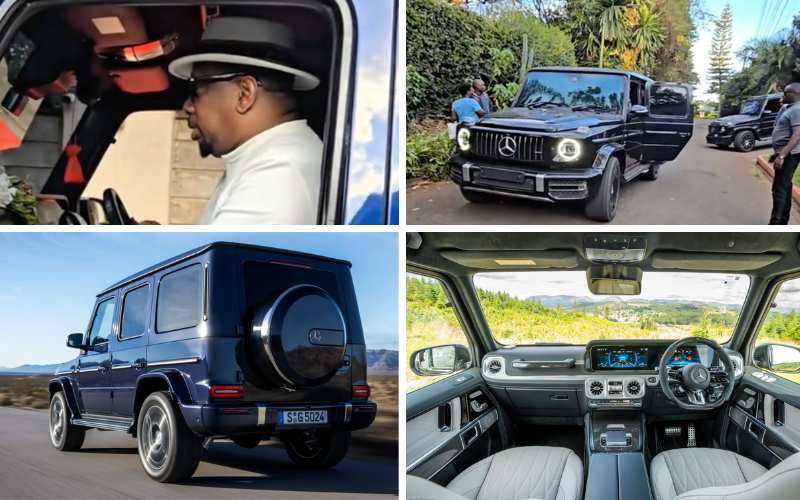
Mike Sonko has never been a stranger to money, power, or over-the-top luxury.
His aesthetic alone could earn him a place as a fashion or luxury-lifestyle critic, judging by the gold-trimmed excess that saturates his palatial home; from cups and seats to door frames and wall inlays, all dripping in gold.
Sonko’s casual flaunting of stacked dollar bills often evokes the image of a cartel king lifted straight from a scene in M.A. Fortin and Joshua John Miller’s Queen of the South.
But has the former Nairobi governor reached the zenith of extravagance? Probably not.
In one of his latest public appearances, Sonko was spotted in a convoy of three immaculate, plateless, high-end SUVs, each as imposing as the speculation they stirred online.
A video seen by TNX Africa shows Sonko stepping into one of them: a deep-blue Mercedes-Benz G-Wagon, a machine synonymous with wealth, power, and status.
Kumbe the two now three G Wagons zinatembea pamoja ni za Sonko pic.twitter.com/21jCFIfB4O
— Bane (@MisterAlbie) November 17, 2025
Dressed head-to-toe in his signature all-white ensemble, Sonko was ushered into the vehicle by a sharply poised close-protection officer who stood fiercely by the passenger door.
The interior, briefly shown in the video, featured ivory leather seats, clean, bright, and unmistakably luxurious.
Ahead of his car was another black G-Wagon with a third following closely behind.
None bore number plates.
The trio rolled out of what appears to be a vast, palatial residence, with manicured lawns, towering trees, and a neatly tarmacked estate road completing the picture.
Why the G-Wagon is a true luxury icon
Manufactured from 1979 as a utilitarian military truck, the modern G-Class, especially the G63, has evolved into one of the world’s most recognisable luxury SUVs.
Its appeal lies in its rare duality: an old-school, body-on-frame structure and three locking differentials that deliver unmatched off-road capability.
Yet inside, the G-Wagon transforms into a sanctuary of handcrafted Nappa leather, polished wood and metal trims, cutting-edge MBUX technology, and premium sound design by Burmester.
It is this blend of rugged military heritage and plush, first-class comfort that has cemented the G-Wagon as a global status symbol.
Under the hood, the standard G63 carries a 4.0-litre twin-turbo V8 engine that produces 577hp and 850Nm of torque, huge power for a box-shaped SUV.
“Thundering V-8 delivers brutal acceleration, more capable off-road than other performance utes, passers-by suspect you might be a professional athlete,” Automotive review website caranddriver notes.
However, one of the Mercedes-Benz G wagons captured in Sonko’s videos is not just any G63. From the looks, it appears to be a Brabus edition.
While facelifts exist in the market, in a legitimate Brabus, the famed German high-performance tuner takes the already potent G63 and pushes it into supercar territory, dialling up the power figures to 800hp and 1,000nm.
The Widestar body kit, wide fenders, bespoke wheels, and lavish interior touches all contribute to a look that is both aggressive and couture.
While the normal G63 hits 0–100km/h in 4.5 seconds, Brabus versions like the Black Ops and Shadow do it in just 4.1 seconds, considered incredibly fast for such a heavy SUV.
The price equally reflects that power.
At a base price hovering at over Sh41 million for the Brabus Black Ops, and Sh49 million for the Shadow, these machines are as exclusive as they are expensive.
Used G63 units already fetch over Sh25 million locally and internationally, but Brabus variants sit far above that bracket.
But as jaw-dropping as Sonko’s convoy was, it also raised questions, chief among them the legality of the trio being driven without plates.
Section 12(1) of the Traffic Act unequivocally states that no registered motor vehicle may be used on a public road without prescribed identification plates affixed in the proper manner.
Violations include missing plates, obscured or defaced plates, plates not meeting design and colour standards, or plates improperly attached.
The absence of plates not only constitutes a direct offence but also hinders law enforcement’s ability to identify and track vehicles, one of the core reasons the law exists.
Typically, on-the-spot enforcement by NTSA attracts a fixed penalty of Sh10,000.
However, if the matter escalates to court, the penalties steepen significantly: fines of up to Sh300,000, imprisonment for up to 12 months, or both.