

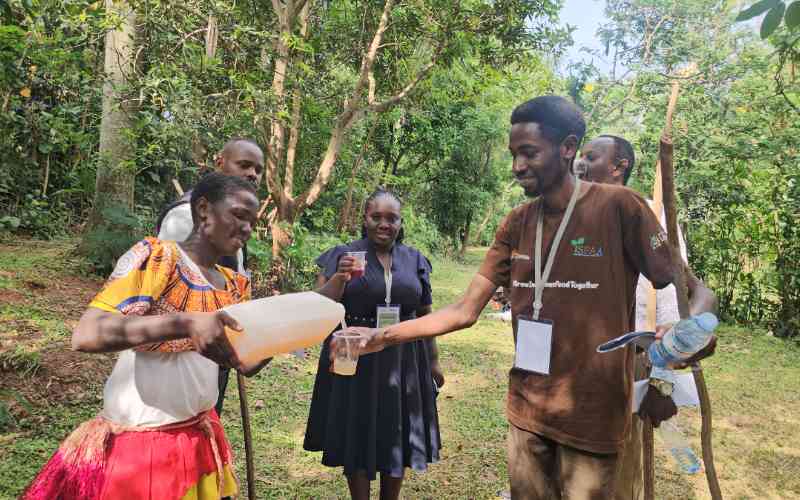
Delegates from seven East African countries have endorsed a declaration to advance cross-border trade for agroecological produce.
This comes at a time when many people are gradually embracing agroecologically produced food, amid increasing cases of non-communicable diseases such as cancer, which is often linked with synthetic farm inputs.
At a conference recently held in Jinja, Uganda, representatives from seven East African Countries, including Kenya, Uganda, Tanzania, Rwanda, Burundi, the Democratic Republic of Congo (DRC), and South Sudan, affirmed that Africa’s resilience and food sovereignty are deeply rooted in the continent’s heritage, its people, its seeds, and its soils.
Agroecological trade, they said, honours this heritage by placing farmers, women, youth, and Indigenous communities at the heart of economic activity.
Follow The Standard
channel
on WhatsApp
According to the declaration, regional integration cannot be realised without strong territorial markets, fair cross-border linkages, and locally grounded food systems that reduce reliance on imports and promote sustainable production.
The conference was organised by the Alliance of Food Sovereignty in Africa (AFSA) to seek ways to place agroecological and resilient food systems trade at the heart of the East African Community (EAC) integration agenda.
“Africa is well endowed with a diversity of both seeds and foods, which are not just nutritious but deeply embedded in the cultures. We must protect and promote the continent’s food sovereignty,” said Dr Million Belay, general coordinator, AFSA.
He called for collective action towards promoting agroecology on the continent, saying that farmers should produce healthy and nutritious food, which is culturally right and promotes environmental conservation.
Policy makers, he added, should ensure fairness and justice in the food systems, while scientists should work in collaboration with farmers to ensure access to appropriate seeds.
Dr Belay called for investment in women and youth, saying they are key players in the food systems.
At the conference, delegates highlighted challenges that still hinder agroecological trade across the EAC. They pointed out that small-scale producers, especially women, continue to face high tariffs, multiple unofficial fees, and lengthy bureaucratic procedures that increase trading costs. Persistent non-tariff barriers and complex certification requirements for sanitary and phytosanitary standards make it even harder for smallholders to compete.
According to Miriam Babu, the chairperson of Busia Women Cross-Boarder Cooperative, women are often faced with numerous challenges, especially because they barely understand their rights.
“Most perpetrators of gender-based violence against women traders take advantage of ignorance. Therefore, there is a need to engage women in the policy process from formulation to implementation,” said Mariam.
A trader, Mariam, imports potatoes from Bomet, Nakuru and Meru to Uganda and exports eggs from Uganda to Kenya. She called for harmonised policies, saying that this would ease cross-border trade.
“We also need to have facilitation for pathways for bikes and carts as the current design of the border point does not allow this,” she said. Currently, riders have to push their bikes while ferrying produce, and this increases the cost of transport, thus affecting the price at the consumer level and profit margins for traders.
Lack of cold storage, aggregation centres, traceability mechanisms, and proper labelling systems further weakens the ability of agroecological producers to access premium markets.
Participants emphasised that these barriers are not just technical but also structural and political, rooted in imbalanced power relations and the dominance of industrial agriculture. They called for transformative policy shifts, noting that this was the way to ensure agroecological trade thrives.
Further, the delegates called for stronger traceability and participatory guarantee systems to build consumer trust, alongside improved logistics, cold storage, and public infrastructure to support small-scale enterprises. They also stressed the importance of harmonising sanitary and phytosanitary standards across member states and integrating agroecology into all relevant trade, climate, and agricultural frameworks.
Moraa Ratemo, participatory Ecological Land Use Management (PELUM) Kenya programmes officer, noted that the use of different currencies affects trade amid exchange rate and inflation dynamics.
She also called for the establishment of an online portal where traders can access certification services at the click of a button.
“There is also a need to have policies that support agroecology trade. Stakeholders also need to have a standard that can be adopted across the EAC to define what an agroecological produce is,” said Moraa
Through the joint declaration, the participants urged the EAC and its partner states to eliminate non-tariff barriers, streamline customs processes, and invest in dedicated market spaces for agroecological produce.
Follow The Standard
channel
on WhatsApp
Delegates from seven East African countries have endorsed a declaration to advance cross-border trade for agroecological produce.
This comes at a time when many people are gradually embracing agroecologically produced food, amid increasing cases of non-communicable diseases such as cancer, which is often linked with synthetic farm inputs.
At a conference recently held in Jinja, Uganda, representatives from seven East African Countries, including Kenya, Uganda, Tanzania, Rwanda, Burundi, the Democratic Republic of Congo (DRC), and South Sudan, affirmed that Africa’s resilience and food sovereignty are deeply rooted in the continent’s heritage, its people, its seeds, and its soils.
Agroecological trade, they said, honours this heritage by placing farmers, women, youth, and Indigenous communities at the heart of economic activity.
Follow The Standard
channel
on WhatsApp
According to the declaration, regional integration cannot be realised without strong territorial markets, fair cross-border linkages, and locally grounded food systems that reduce reliance on imports and promote sustainable production.
The conference was organised by the Alliance of Food Sovereignty in Africa (AFSA) to seek ways to place agroecological and resilient food systems trade at the heart of the East African Community (EAC) integration agenda.
“Africa is well endowed with a diversity of both seeds and foods, which are not just nutritious but deeply embedded in the cultures. We must protect and promote the continent’s food sovereignty,” said Dr Million Belay, general coordinator, AFSA.
He called for collective action towards promoting agroecology on the continent, saying that farmers should produce healthy and nutritious food, which is culturally right and promotes environmental conservation.
Policy makers, he added, should ensure fairness and justice in the food systems, while scientists should work in collaboration with farmers to ensure access to appropriate seeds.
Dr Belay called for investment in women and youth, saying they are key players in the food systems.
At the conference, delegates highlighted challenges that still hinder agroecological trade across the EAC. They pointed out that small-scale producers, especially women, continue to face high tariffs, multiple unofficial fees, and lengthy bureaucratic procedures that increase trading costs. Persistent non-tariff barriers and complex certification requirements for sanitary and phytosanitary standards make it even harder for smallholders to compete.
According to Miriam Babu, the chairperson of Busia Women Cross-Boarder Cooperative, women are often faced with numerous challenges, especially because they barely understand their rights.
“Most perpetrators of gender-based violence against women traders take advantage of ignorance. Therefore, there is a need to engage women in the policy process from formulation to implementation,” said Mariam.
A trader, Mariam, imports potatoes from Bomet, Nakuru and Meru to Uganda and exports eggs from Uganda to Kenya. She called for harmonised policies, saying that this would ease cross-border trade.
“We also need to have facilitation for pathways for bikes and carts as the current design of the border point does not allow this,” she said. Currently, riders have to push their bikes while ferrying produce, and this increases the cost of transport, thus affecting the price at the consumer level and profit margins for traders.
Stay informed. Subscribe to our newsletter
Lack of cold storage, aggregation centres, traceability mechanisms, and proper labelling systems further weakens the ability of agroecological producers to access premium markets.
Participants emphasised that these barriers are not just technical but also structural and political, rooted in imbalanced power relations and the dominance of industrial agriculture. They called for transformative policy shifts, noting that this was the way to ensure agroecological trade thrives.
Further, the delegates called for stronger traceability and participatory guarantee systems to build consumer trust, alongside improved logistics, cold storage, and public infrastructure to support small-scale enterprises. They also stressed the importance of harmonising sanitary and phytosanitary standards across member states and integrating agroecology into all relevant trade, climate, and agricultural frameworks.
Moraa Ratemo, participatory Ecological Land Use Management (PELUM) Kenya programmes officer, noted that the use of different currencies affects trade amid exchange rate and inflation dynamics.
She also called for the establishment of an online portal where traders can access certification services at the click of a button.
“There is also a need to have policies that support agroecology trade. Stakeholders also need to have a standard that can be adopted across the EAC to define what an agroecological produce is,” said Moraa
Through the joint declaration, the participants urged the EAC and its partner states to eliminate non-tariff barriers, streamline customs processes, and invest in dedicated market spaces for agroecological produce.
Follow The Standard
channel
on WhatsApp
By Rachel Kibui