



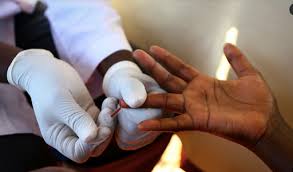
At least 1.4 million Kenyans live with HIV, and about 1.1 million are on retroviral treatment.
Kenya has promised to increase its domestic funding for HIV,
but only modestly. According to a new Unaids report, Kenya plans just a five to
10 per cent increase in its HIV budget in 2026.
At the same time, Kenya did not make any fresh commitment at
last Friday’s Global Fund replenishment summit, raising concerns it may
struggle to fill widening gaps.
The Unaids report was released ahead of World Aids Day
to be marked on December 1. It is titled Overcoming Disruption: Transforming the
Aids Response.
It warns that sharp donor cuts are destabilising prevention,
treatment and community programmes across low- and middle-income countries, including Kenya.
For instance, Kenya’s biggest financier US President’s
Emergency Plan for Aids Relief (Pepfar), is expected to reduce funding through the
America First Global Health Strategy.
Winnie Byanyima, the Unaids Executive Director, said in a
separate statement: “The funding crisis has exposed the fragility of the
progress we fought so hard to achieve. Behind every data point in this report
are people—babies and children missed for HIV screening or early HIV diagnosis,
young women cut off from prevention support, and communities suddenly left
without services and care. We cannot abandon them. We must overcome this
disruption and transform the Aids response.”
Kenya enters the funding crisis heavily reliant on external
funders. According to recent national analyses, only about 34 per cent of
Kenya’s HIV response is financed domestically, while 63.5 per cent comes from
external partners, including Pepfar and the Global Fund.
For HIV care and treatment specifically, Unaids-supported National Aids Spending Assessment data from 2022 showed that 84 per cent of
expenditure in this category in Kenya came from external sources.
This makes the country extremely vulnerable to sudden cuts
in international aid.
Kenya did not announce any new financial pledge during last
Friday’s Global Fund replenishment summit. The Global Fund’s replenishment
raised USD 11.34 billion globally, almost hitting the $15 billion target.
The Unaids report outlines how several African countries are
scrambling for ways to respond to shrinking donor support.
It says: “A review of domestic resource mobilisation
strategies in seven African countries (Ethiopia, Kenya, Malawi, Nigeria, United
Republic of Tanzania, Zambia, Zimbabwe) found that countries are pursuing a
range of strategies to mitigate the effects of potential reductions in donor
support, including increased domestic financing, concessional loans,
public–private partnerships and earmarked taxes.”
Kenya is also trying to strengthen the efficiency of its HIV
response through improved data systems. According to the report:
“HIV sustainability roadmaps prioritise improved management
and use of data to enhance the efficiency and impact of national responses. To
move towards a ‘single, unified national health information system’, for
example, Kenya is prioritising an assessment and mapping of HIV data tools,
electronic medical records and reporting systems nationwide and creation of a
national consensus for a ‘unified, government-owned, interoperable national
data ecosystem and infrastructure’.”
Officials say a unified system could reduce duplication, improve
value for money and ensure that every shilling spent yields maximum impact.
The Unaids report says innovations, such as long-acting
HIV prevention and treatment drugs, could dramatically reduce new infections in
high-burden countries.
Partnerships launched this year aim to ensure widespread
access to affordable generic formulations of the long-acting ARV medicines,
costing as little as $40 per person per year in some settings.
“We know what works—we have the science, tools, and proven
strategies,” Byanyima said. “What we need now is political courage. Investing
in communities, in prevention, in innovation and in protecting human rights as
the path to end Aids.”
At least 1.4 million Kenyans live with HIV, and about 1.1
million are on retroviral treatment.
Unaids warns that failing to support countries like Kenya
could undo decades of progress. Domestic budgets are rising too slowly to
compensate for rapid donor withdrawals, and international financing remains
essential.
Byanyima said. “We can allow these shocks to undo decades of
hard-won gains, or we can unite behind the shared vision of ending Aids.
Millions of lives depend on the choices we make today.”