



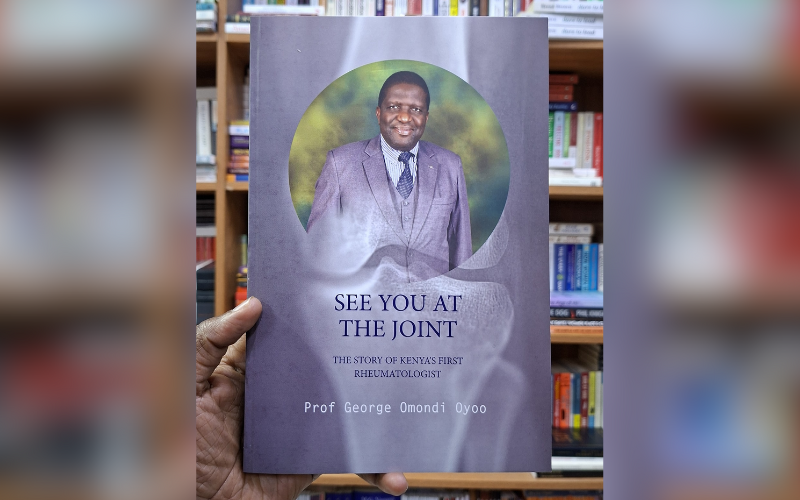
Rheumatism is a rare body joint disease and a public health concern in Kenya today, with an estimated nine million people affected. Prof George Omondi Oyoo’s autobiography, See You at the Joint (2025), narrates the efforts made towards taking care of Kenyan patients of rheumatic disorders, including training of doctors, acquisition of diagnostic equipment, civic and outreach activities, and the setting up of rheumatic treatment centres across the country.
Prof Omondi, as the pioneer physician of rheumatic treatment in Kenya, played a central role in all these efforts.
The author writes with enviable clarity, intentionality and intellectual depth. Readers will find it fascinating how he fuses the complicated history of Kenya and its postcolonial politics into his life story.
From the vestiges of colonial authoritarianism evident in post-independence Kenya; the politics of confrontation between President Jomo Kenyatta and Jaramogi Oginga Odinga; extra-judicial killings of renowned political figures such as Pio Gama Pinto, Tom Mboya, JM Kariuki, and Robert Ouko; traumas occasioned by the failed 1982 coup attempt; the clamour for multi-party democracy, subversions and betrayals that marred President Mwai Kibaki’s reign, to the political intrigues which characterised the Jubilee leadership under President Uhuru Kenyatta.
Through this carefully woven personal-cum-national story, the writer shows us that, at times, national issues not only strain the personal but also set the personal on a collision path with the national, particularly when personal ethos is at variance with our national leaders’.
His story urges us to remain true to our convictions and ideals regardless of external pressures. As recounted, education played a crucial role in shaping the doctor into the person he is today.
Reading the book, I lost count of the number of times the writer invoked the names of Alliance Boys and Sawagongo Secondary School, which inculcated in him virtues of determination, hard work, focus and resilience. He, however, decries how politics has not only infiltrated but also wrecked the Kenyan education system. He urges that there is need to entrench sound management practices for education to achieve its goals.
The author uses two women, his step-grandmother, Jane Agina, and his own mother, Florence Muyoga, to decry repugnant cultural practices. Among the Luo, the practice of widow inheritance, known as lako or tero, is a traditional custom where a widow is inherited by a brother or close relative of her deceased husband.
This cultural practice was intended to provide the widow and her children with social and financial support and protect her and the family’s homestead, yet the author’s mother was brave enough to reject the practice.
On one hand, Omondi’s step-grandmother, Jane Agina, kept welcoming one man after another following the death of the author’s grandfather. On the other hand, Omondi’s mother, Florence Mugoya, refused to be inherited upon the demise of her husband. She ran away from her matrimonial home as her house was demolished by her brothers-in-law.
life. Widow inheritance extends beyond simply being a devastating personal tragedy for the author to a tool of oppression for widows and their vulnerable children.
In what could be seen as stylistic ingenuity, in the course of the narrative, the author breaks from the narrative mode into conversations, which sometimes become tete-a-tetes, in the presentation of his life story.
This conversational mode breathes life into the narrative, creates authenticity and immerses readers into the ordinariness of the story. The author also integrates folktales from his community into his personal story, which not only makes the story a captivating read but also provides perspective for the author to comment on various social ills.
In a disguised form, the author repurposes the Ojwajni folktale from his community as a tool to laugh at corruption, misuse and abuse of power by the political elite. Stylistic ingenuity is further exemplified in how the author infuses recurring everyday life practices in the Kenyan society into his life story. In their daily routines, Kenyans ask each other to “meet at the joint” to share their daily stories over a cup of coffee, a bottle of beer, chicken wings and nyama choma.
It is at the joint where people pour out to each other, recount their successes as well as register life’s frustrations. “The joint”, therefore, serves multiple functions in the Kenyan social imaginary such as the therapeutic role.
Cognisant of this social function, Omondi titles his book, See You at the Joint, as a hook not only to gesture towards outpouring his personal story to readers but the therapy he provides to patients suffering from rheumatism. By using this everyday practice, the writer makes his autobiography appeal to ordinary Kenyans.
Overall, Prof Omondi succeeds in providing thought-provoking and unified ways in which the history of the nation and that of the community intersect with personal life stories, which have hitherto been studied in isolation.
He offers compelling insights from his personal experiences that emphasise important continuities in the history of the community and the nation alongside the quest for personal growth.
I am certain that literary scholars and students, particularly those interested in life writing, will cherish this book.
– Dr Charles Kebaya teaches Literature at Machakos University. The book will be launched on November 30, 2025 at Sankara Hotel, Nairobi.