



The road to Taita Taveta is a gentle descent into a world where time behaves differently.
Hills rise and fold softly into one another, ancient, weathered, and knowing.
Unlike the dramatic cliffs of Kenya’s north or the flat savannahs stretching toward the coast, Taita’s landscape carries a quiet dignity. It does not shout beauty – it whispers it.
Taita Taveta is a place where the sky stretches wide and the land carries the memory of kingdoms older than maps.
Here, the stones rise like guardians: ancient, sculpted by wind, rain, time, and perhaps, if you listened closely enough, you would hear the whispered prayers of ancestors.
There’s a moment on this drive, every traveller feels it, where your body shifts from movement to presence.
Mine happened just after Voi. The air cooled. The wind changed, not just in temperature but in tone.
Suddenly, it felt as though the land itself was watching as I checked into Boma Shimba Safari Lodge’s A-frame cabins, a simple retreat perched on a ridge overlooking valleys stitched with terraced farms and wild shrubs.
The staff greeted me not with rehearsed hospitality, but with a softness that felt generational, like kindness was something grown here.
The following day, after a breakfast of sweet tea, mandazi, and the kind of eggs only village chickens lay, I set out to meet the stones.
Locals call them many things depending on the village, clan, or history. Some refer to them simply as “the Old Rocks.” Others give them names – names that carry stories.
My guide, Tony Mshimba, paused beside a towering boulder shaped like a crouching lion and smiled: “Here, stones are not objects. They are ancestors.”
He told of weddings once held under these formations, of elders who came to seek wisdom or blessing, of clans who believe the stones protect, not by force but by memory.
“Every hill,” he said, tapping his walking stick against granite, “has a story. Every story carries a responsibility.”
There was no rush. No tourist pressure. No scripted itinerary. Just walking. Just listening. And somewhere between silence and footsteps, the landscape revealed its secret: this was not a destination, it was a relationship.
Later, sitting atop a warm rock plateau overlooking the valley, I understood why travellers come here and stay longer than planned. The stillness is not empty – it is full.
Full of wisdom, full of age. Full of a kind of peace that modern life rarely grants.
And as the sun slipped behind the hills, painting the stones honey gold, I realised something that stayed with me long after I left: some places ask you to look, others ask you to remember.
Taita asks you to listen.
Kakamega Forest
Leaving Taita behind felt like leaving a conversation unfinished – one of those soulful ones where silence carried more meaning than words.
But travel has its rhythm, and Kenya, in all her moods and landscapes, demands movement.
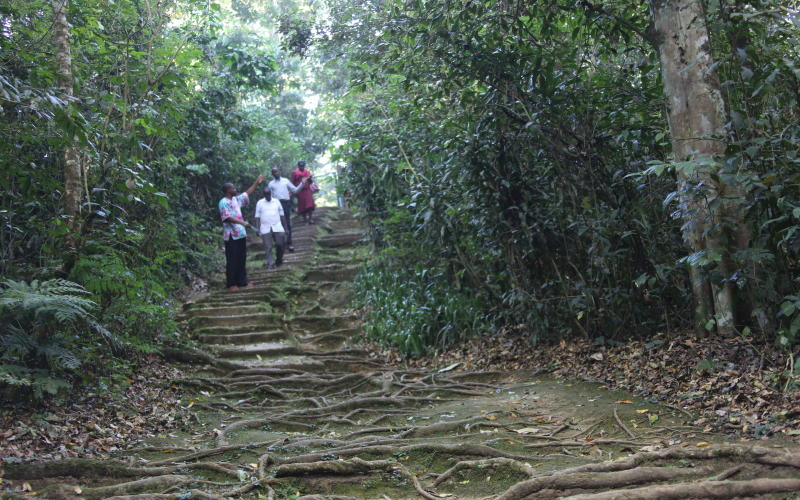
The road to Kakamega is less poetic and more practical: highways, towns, sugarcane farms, boda-boda riders flying like thoughts you cannot catch. Yet somewhere past Kisumu, something shifts. The air thickens, greens change tone, from cultivated to wild, from decorative to ancient.
Then, suddenly, you are here – Kakamega Forest, a cathedral not built by human hands. The first thing you notice is not what you see. It is what you hear.
Birdsong layered like a choir. Rustling leaves that sound like whispers. The hum of life beneath and above. And if you are still enough, you will feel the heartbeat of a forest that has stood long before Kenya was called Kenya.
My guide, Thomas Wanyonyi, a patient man with the posture of someone who has spent more time outdoors than indoors, turned to me and said: “Here, we walk slowly because everything is alive.”
And so we did. I saw centuries-old trees with trunks as wide as meeting halls, trees that hold history in rings and roots. I saw butterflies that looked painted, colobus monkeys with aristocratic confidence, and medicinal plants whispered about like guarded secrets.
Every turn of the trail revealed something new – a fallen leaf the size of a child’s kite, moss soft enough to sleep on.
A shaft of golden light breaking through the foliage like a revelation.
There was a moment, a memory to recall, when the forest felt like it was breathing with me.
When my footsteps softened. When my mind quieted. When I felt small but not insignificant.
Small in the way one feels when standing in the presence of wisdom older than language.
Halfway through the hike, we reached a clearing known to birders, a giant old fig tree that locals believe connects worlds – ancestors, present travellers, future generations.
Wanyonyi placed his hand on its bark gently and said: “This tree has seen everything – from war, peace, storms, drought, and generations. But it still stands. We come here to remember that we, too, can endure.”
As we walked back toward the forest edge, drums began in the distance – not a performance, just community. Children laughing. Women singing. The rhythm of a place still rooted in spirit.
By the time the trail ended, the forest had done what wild spaces do best. It had restored something I didn’t know I had lost.
At the end of my travel, I had experienced two journeys but one realisation. Taita whispered.
Kakamega breathed.
But both asked the same question: “When was the last time you paused long enough to belong somewhere?”
Travel, real travel, is not about ticking destinations off a list. It is about remembering.
Remembering silence, beauty, remembering that the world is older, wiser, and far more patient than we are.