



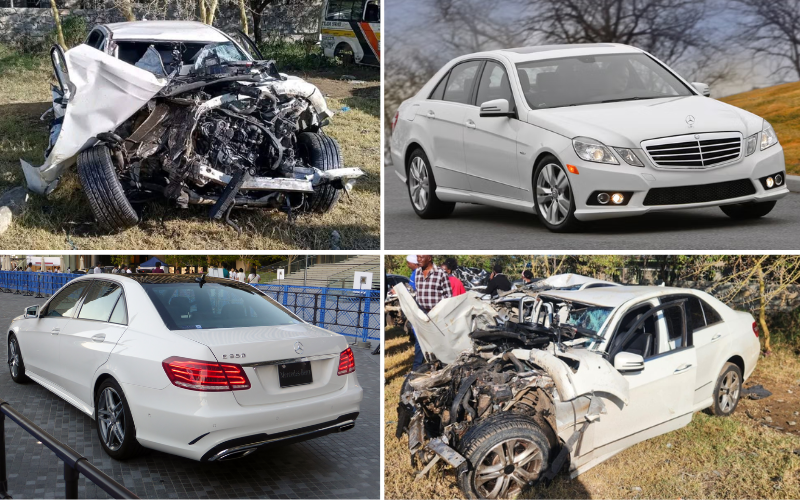
For a man of Cyrus Jirongo’s stature, luxury was never merely an option; it was a way of life.
Jirongo savoured his whiskey with the same appreciation he held for the supple, soft-touch leather cladding the electrically adjustable driver’s seat of his ill-fated Mercedes-Benz E350.
Tragically, he would meet his death in the very manner he had aspired to live: at the wheel of one of Germany’s most revered sedans.
Renowned for its exceptional luxury, Mercedes-Benz engineered the W212 E350 as the quintessential fusion of executive comfort and practical versatility.
Safety, too, was paramount in this distinguished model.
Inside the E350
The Mercedes-Benz E350 W212 represents the fourth generation of the illustrious E-Class, manufactured between 2009 and 2016.
It swiftly established itself as an emblem of executive refinement, seamlessly integrating luxury, performance, and sophisticated safety features.
The E350, like Jirongo’s, was equipped with a 3.5-litre V6 petrol engine delivering approximately 272 to 306 horsepower, dependent on the model year, mated to a refined 7-speed automatic transmission.
This formidable combination yielded a vehicle that exuded both power and composure, capable of confident acceleration whilst delivering a tranquil, supremely comfortable driving experience, attributes that have long distinguished it as the preferred choice among business magnates and blue-chip CEOs.
The interior of the W212 is unmistakably reminiscent of Mercedes-Benz craftsmanship.
Soft-touch materials, premium leather upholstery, and meticulous attention to detail converge to create a cabin that epitomises luxury.
Multi-zone climate control, adjustable heated and ventilated seats, and the sophisticated COMAND infotainment system featuring navigation and smartphone connectivity ensure that both driver and passengers travel in consummate comfort and convenience.
The vehicle’s hushed, meticulously insulated interior further enhances its appeal, rendering it ideal for extended journeys or executive chauffeur service.
“Both front seats move electrically in virtually every conceivable direction, and the side bolsters, lumbar cushion and seat squab are pneumatically adjustable to improve support,” writes Tony of Drive.com.
But what of safety?
During its production, safety was a fundamental priority for the W212.
Upon its introduction, it garnered a prestigious five-star Euro NCAP rating, testament to its robust body structure constructed from high-strength steel and its sophisticated multi-stage crumple zones engineered to absorb impact energy.
According to Drive.com, Mercedes-Benz placed considerable emphasis on collision avoidance in the 2010 E-Class, equipping the E350 with a comprehensive suite of active safety systems complementing standard ABS, electronic brake-force distribution, stability control, and traction control.
The E350 incorporates features such as lane-keeping cameras that gently vibrate the steering wheel when the driver inadvertently deviates from their lane, whilst rear-mounted radar sensors alert the driver to adjacent vehicles through illuminated indicators in the wing mirrors accompanied by audible warnings.
The Attention Assist system continuously monitors steering inputs, acceleration patterns, and braking behaviour to detect driver fatigue, issuing timely warnings should it detect drowsiness or erratic driving behaviour.
Beyond these standard systems, the E-Class offers advanced collision-mitigation technologies including Distronic Plus radar-guided adaptive cruise control, which autonomously adjusts velocity or applies braking to maintain safe following distances and minimise collision impact through pre-emptive braking intervention.
Night View Assist PLUS employs infrared technology to identify and highlight pedestrians in low-light conditions, whilst passive safety provisions are equally comprehensive, encompassing front and rear side airbags, curtain airbags, knee airbags, anti-whiplash headrests, and Mercedes-Benz’s innovative Pre-Safe system.
This sophisticated Pre-Safe technology optimises seat and restraint positions whilst automatically closing windows during emergencies—measures meticulously designed to substantially enhance crash survivability.
The system can anticipate imminent collisions and implement protective measures by tensioning seatbelts, adjusting seat positions, and priming airbag deployment systems.
Yet, despite its reputation for safety, no car is invincible.
While the full inquest into Jirongo’s fatal crash is yet to be released, photos of the mangled Mercedes-Benz showed no signs of airbag deployment, raising concerns among netizens.
“Airbag didn’t deploy? Ama sensors had done that thing?” asked tweep Shoba Gatimu on X.
Airbags, while highly effective, deploy only when sensors detect a collision of sufficient severity and angle.
There have been rare instances worldwide, and reports from owners of some W212 models, where airbags failed to deploy even in serious impacts.
The fatal sequence of events
At around 2:15 am on Saturday, December 14, Jirongo, driving alone in his white Mercedes-Benz, entered Eagle Petrol Station in Karai, Naivasha, along the busy Nairobi-Nakuru highway.
The politician, who was travelling towards Nairobi, turned into the petrol station from the opposite direction and steered his car towards a fuel pump. However, instead of refuelling, he turned back and rejoined the highway.
It was at this point that the former MP made a fatal error, according to a reconstruction of events by witnesses.

Upon re-entering the highway, Jirongo reportedly continued driving in the lane reserved for oncoming traffic—vehicles heading from Nairobi towards Nakuru.
Jirongo’s Mercedes-Benz collided head-on with a bus belonging to Climax Company, which was travelling from Nairobi towards Nakuru.
The former minister’s car was dragged several metres from the point of impact before the bus eventually came to a halt, a petrol station attendant explained to Daily Nation.
Tirus Kamau, the driver of the bus involved in the accident, detailed the incident, saying that Jirongo’s Mercedes-Benz was heading towards Nairobi.
Shortly before the crash, he said, there had been a minor traffic jam in his lane.
Kamau stated that Jirongo attempted to overtake but swerved into his lane, causing the collision.
The bus driver, who has more than eight years’ experience, said he was carrying 65 passengers, while Jirongo was alone in his car.
“I was heading to Busia from Nairobi, and the Mercedes-Benz was coming from the opposite direction. The driver did not give way; he was attempting to overtake another vehicle when the collision occurred,” Kamau said.
Rift Valley Regional Traffic Commander Sara Chumo officially confirmed the incident.
The former MP’s remains were initially conveyed to Naivasha Sub-County Hospital mortuary before being transferred to Lee Funeral Home in Nairobi.
Both vehicles were impounded and transported to Naivasha Police Station, where they remain under secure custody pending forensic examination.
At the station, the wreckage of the Mercedes-Benz was cordoned off and sealed, with detectives expected to continue with investigations.
Jirongo was eulogised as an intrepid politician by his longtime friend and President William Ruto, with whom he shared an extensive political history.
“I am deeply saddened by the passing of my friend, former Lugari MP Cyrus Jirongo. Jirongo was a relentless go-getter, a seasoned businessman, and a consummate politician who refused to be defined, let alone defeated, by life’s challenges,” the President said.