



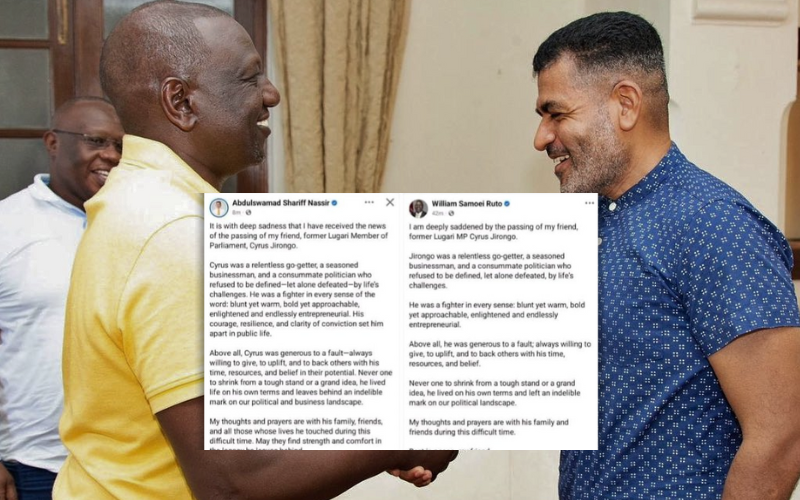
President William Ruto and Mombasa Governor Abdulswamad Nassir have come under online scrutiny over the alleged use of artificial intelligence after Kenyans noticed striking similarities between their social media posts.
Both leaders had posted messages mourning the death of veteran politician and businessman Cyrus Jirongo, who died in a road accident.
However, social media users were quick to point out that President Ruto’s message closely mirrored Governor Nassir’s earlier post, sparking debate on whether AI tools were used to generate the statements.
Placed side by side, the two messages appeared nearly identical, raising eyebrows among netizens.
President Ruto’s message read:
“Jirongo was a relentless go-getter, a seasoned businessman, and a consummate politician who refused to be defined, let alone defeated, by life’s challenges. He was a fighter in every sense: blunt yet warm, bold yet approachable, enlightened and endlessly entrepreneurial.”

Governor Nassir’s original message stated:
“Cyrus was a relentless go-getter, a seasoned businessman, and a consummate politician who refused to be defined — let alone defeated — by life’s challenges. He was a fighter in every sense of the word: blunt yet warm, bold yet approachable, enlightened and endlessly entrepreneurial. His courage, resilience, and clarity of conviction set him apart in public life.”
The Mombasa Governor later edited his post on X at 11:10 am, replacing it with a revised message that read:
“Cyrus was a force of nature — fearless, driven, and unapologetically authentic. A sharp political mind and an astute businessman, he met life head-on and refused to be boxed in by circumstance or convention.”

Unlike Facebook, X visibly indicates when a post has been edited and timestamps the changes accordingly.
The similarities between the two condolence messages reignited debate on the growing use of artificial intelligence in public communications, with critics questioning the role and effectiveness of communications teams attached to top government offices.
One X user remarked:
“I wonder why they have communication personnel. If all they do is ChatGPT condolences.”
Another added:
“They’re both heads of governments and even generating prompts bado ni ngumu.”
“This is beyond plagiarism,” wrote another critic.
AI text generators rely on large language models (LLMs) and natural language processing (NLP) to produce human-like content based on prompts.
Trained on vast datasets, these tools learn language patterns, grammar, and context, enabling them to generate coherent and relevant text for tasks such as writing emails, articles, or summaries.
Popular examples include Google’s Gemini and OpenAI’s ChatGPT, both widely used in corporate and modern communication settings.
This latest controversy comes just months after ICT Cabinet Secretary William Kabogo spearheaded the Kenya AI & Software Summit, a two-day conference aimed at positioning Kenya as a regional leader in artificial intelligence and emerging technologies.
According to the summit’s official website, the forum provided a platform for dialogue, knowledge exchange, and partnership-building in software development and AI innovation.
Speaking at the event, Prime Cabinet Secretary Musalia Mudavadi outlined an ambitious vision for a government that embraces artificial intelligence.
“With more than 60 per cent of Africa’s population under the age of 25, our youth remain our most valuable asset, the driving force that will power the continent’s digital transformation,” Mudavadi said.
He added that the government aims to make Kenya the epicentre of software development and AI innovation in Africa.
However, the use of AI in government communication has previously drawn mixed reactions.
Earlier this year, Nairobi Woman Representative Esther Passaris pushed back against online critics who mocked leaders for using AI tools, urging Kenyans to focus on the technology’s benefits.
In an X post dated May 11, 2025, Passaris said AI can make work easier, faster, and more efficient, citing a Mother’s Day poster she created in under a minute.
She also defended leaders who use AI, arguing that the technology can function like a team of assistants by offering valuable support and insights.
“Some mock leaders for using AI. I say be proud of it!” she wrote. “AI makes life easier, more efficient, and empowering. Let’s embrace the future.”
Her remarks came amid sustained online abuse directed at her, including incidents where her private contact details were circulated in attempts to harass her.