



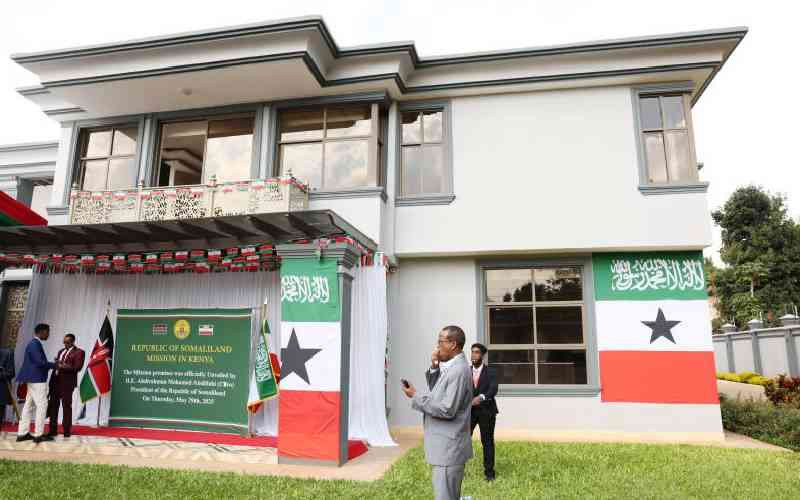
Some political questions refuse to go away, not because they are complicated, but because answering them would require a degree of honesty that we often overlook. Somaliland is one such case. For more than three decades, it has governed itself, held elections, maintained security, and managed its affairs with little outside assistance. And yet, officially, it remains unseen.
Israel’s December 26, 2025, decision to recognise Somaliland as a sovereign and independent state, the first country in more than three decades to extend such recognition, has brought that contradiction back into view.
Israel’s move has been termed unprecedented. But it is not. When Somaliland briefly gained independence in 1960 after British decolonisation, Israel was among the first 35 countries to recognise it. That period was, however, short-lived.
Somaliland soon entered into a voluntary union with Somalia, in the hope of a stronger, unified state. A ‘Greater Somalia’, they called it. The outcome is well known. The union failed, repression followed, and the Somali state collapsed into prolonged conflict.
Follow The Standard
channel
on WhatsApp
It is important to note that Somaliland did not break away through force. It is a former sovereign entity that entered the union voluntarily in 1960 and withdrew from it in 1991 when that union ceased to function to protect its people.
Let it also be known that Israel’s recognition today does not invent a new relationship; it revisits one interrupted by political failure.
Since reclaiming its independence in 1991, Somaliland has governed itself continuously without international recognition, peacekeeping forces, or inherited state institutions. The systems that exist today were built from the ground up. Elections were organised repeatedly, power changed hands peacefully, and internal stability was preserved in a region where instability became the norm.
These are not abstract claims. Over the years, Somaliland has drawn professionals from across the African continent, individuals who would not relocate or commit their expertise in the absence of functioning systems. This goes to show that our institutions work and that contracts are honoured. Aren’t these markers of a functioning state?
Additionally, Somaliland has shown itself to be a credible partner in regional security, counterterrorism cooperation, and maritime stability along vital global trade routes. It offers opportunities in renewable energy, fisheries, logistics, and digital infrastructure, all which have been sustained without external trusteeship.
Yet Somaliland remains unrecognised, particularly by African states. The explanation mostly given is adherence to the principle of territorial integrity. This principle is not arbitrary; it emerged from Africa’s post-independence experience as a safeguard against fragmentation and instability. For a time, it served an essential purpose.
But principles are not ends in themselves. In the case of Somaliland, this rigidity produces an uneasy contradiction: A polity that has built peace, institutions, and democratic practice is disregarded, while a state that has long struggled to exercise authority retains unquestioned legal standing.
Africa should not wait for external actors to validate what the evidence already demonstrates. The African Union, IGAD, and individual states, from Kenya and Ethiopia to Rwanda and Ghana, possess both the mandate and institutional maturity to engage Somaliland based on facts rather than inherited assumptions, and after 34 years of self-governance, that acknowledgment is overdue.
Dr Mohamed is ambassador of the Republic of Somaliland in Kenya.
Follow The Standard
channel
on WhatsApp
By Mohamed A Omar