

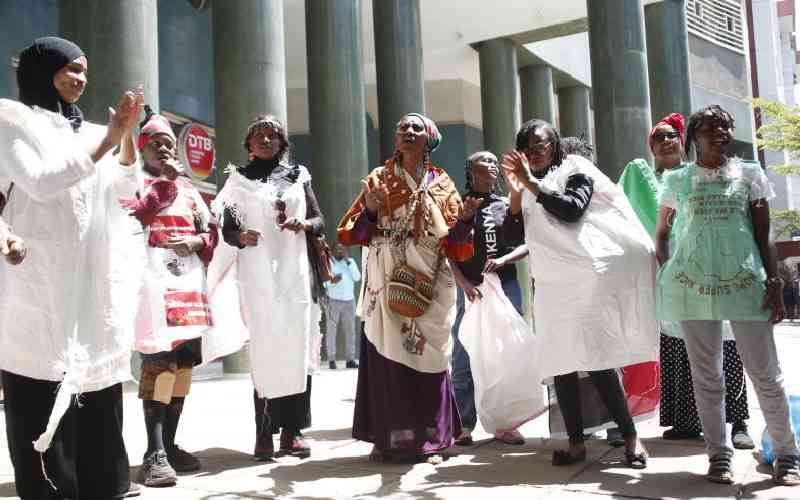
Women pray for the release of the abducted youth along Kimathi Street, Nairobi, on January 6, 2025. [File, Standard]
Kenya’s politics is often narrated as a triumph of human design: ethnic arithmetic, elite bargains, choreographed chaos, and carefully timed betrayals. Power belongs to those who plan longest, spend most, shout loudest, or intimidate best. Even God is reduced from Lord to an asset in the power plot.
But again and again, acts of God —events beyond prediction, manipulation, or containment — have intruded into political designs. They have disrupted timelines, exposed moral rot, and rendered seasoned schemers restless, reactive, and radarless. These moments state an uncomfortable fact: human power is never as sovereign as it imagines itself to be.
An act of God escapes human authorship and resists elite control. Such acts are never decorative. They interrupt trajectories. The plagues of Egypt dismantled Pharaoh’s illusion of permanence. Jonah’s storm forced a rerouting of mission. The earthquake at the resurrection announced that death’s architecture had collapsed. Acts of God do not argue with power; they overrule it.
Follow The Standard
channel
on WhatsApp
Kenya has not lacked acts of God. Politically significant events have erupted that no office, institution, or intelligence network can credibly claim authorship of. They arrive without permission, interrupt carefully laid plans, and cut through designs once thought airtight.
But power is allergic to interruption. These moments are quickly smothered by hollow narratives, manufactured explanations meant to sedate the public and restore the illusion of control. Language is mobilised to manage perception in an effort to domesticate history. And so the act-of-God dimension is pushed into the shadows, reduced to murmurs and whispers. To name it aloud would be to confess a dangerous truth: that there is a power at work beyond calculation, and beyond the reach of those who imagine themselves sovereign.
Yet fractures remain. Timelines do not quite add up. Explanations strain. Outcomes resist neat containment.
Kenyan politics thrives on the myth of total control. Coalitions are engineered months—sometimes years—before elections. The objective is to manufacture the illusion that outcomes are settled long before citizens queue to vote. Hence the boast, “Tutawashinda asubuhi mapema”—we will defeat them early in the morning. This culture breeds political schemers who believe that history can be bent at will by money, muscle, and messaging.
Acts of God puncture political arrogance. Sudden deaths force recalibration. Alliances fracture. Carefully laid plans fail. Persons written off as irrelevant resurface; old power centers regain influence. Resistance dismissed as minor erupts beyond control. Natural events derail popular schemes. Secrets spill. Power vacuums appear that no strategist accounted for. Panic grips.
The lesson is clear: you may plan but you do not own tomorrow — power, however choreographed, is never absolute.
Illusions of control are fragile. Crises in creative forms expose the limits of human power. Orders falter. Movements stall. Borders and boundaries cannot contain what is alive and unpredictable. Corruption, inequality, and injustice are laid bare. Such disruptions strip away pretense and remind a nation that sovereignty is never concentrated in a single office or individual. Creation is alive; without seeking permission, it erupts and declares its discontent. In a storm no authority can ignore, moral and political failures are exposed, forcing the public to witness the deception that had been hidden.
Schemers panic
Crises reveal who governs for service and who governs for greed. When control slips, schemers panic. Signals contradict. Kenya is one of the most prayed-for nations. Prayer meetings are full. Vigils are frequent. Fasting calendars are crowded. Yet the prayer culture is cautious. We pray for peace even when peace has become a code for silence. We pray for unity even when unity shields wrongdoing. We pray “for our leaders” without articulating the moral architecture leadership must possess. Though sincere, such cautious prayers are politically harmless.
Acts of God reveal the Creator stepping into His world without protocol, without warning, without permission. Scripture shows that such interventions are often summoned not by polite devotion, but by bold, regime‑confronting prayer.
The uncomfortable question for the Kenyan Church is this: when we pray, do we ask God merely to stabilise power—or to interrupt it? Do we ask for calm, or for truth? Scripture suggests that political reordering has often followed prayers bold enough to summon acts of God that rulers could not veto.
What if Kenya’s future hinges on the content of the Church’s prayers? This question is unsettling because it relocates responsibility to the sanctuary. It suggests that heaven may already be listening. The matter, then, is not how long the Church prays. It is first and foremost what the Church asks for.
Much of Kenyan prayer seeks to reduce tension rather than confront injustice. It anesthetises rather than awakens. But biblical prayer is not a sedative! It is holy protest— refusal to normalise what dehumanises.
If prayer is to shape Kenya’s future, prayer spaces must become places of revolution. Not violent revolt, but prophetic resistance. The altar must recover its role as a site of truth-telling. Intercession must become the deepest form of civic engagement.
Prayer must mature from vague goodwill into articulated ethical demand. It must name leaders who value human life more than ballots, whose private lives can survive public light, who tremble at injustice and resist applause. Such prayers do not campaign for individuals. They define standards. They insist that unjust alliances scatter, that immoral designs collapse, that arrogance be unsettled, and that truth interrupt convenience.
And when God interrupts political designs—scattering schemers, unsettling arrogance, exposing injustice—the Church would not scramble to interpret events. It would recognise its own fingerprints on history. Because it refused to merely recite prayers, choosing instead to protest in prayer until acts of God broke in shattering the old order and injecting irreversible change into the nation’s story.
Follow The Standard
channel
on WhatsApp
Women pray for the release of the abducted youth along Kimathi Street, Nairobi, on January 6, 2025.
[File, Standard]
Kenya’s politics is often narrated as a triumph of human design: ethnic arithmetic, elite bargains, choreographed chaos, and carefully timed betrayals. Power belongs to those who plan longest, spend most, shout loudest, or intimidate best. Even God is reduced from Lord to an asset in the power plot.
But again and again, acts of God —events beyond prediction, manipulation, or containment — have intruded into political designs. They have disrupted timelines, exposed moral rot, and rendered seasoned schemers restless, reactive, and radarless. These moments state an uncomfortable fact: human power is never as sovereign as it imagines itself to be.
An act of God escapes human authorship and resists elite control. Such acts are never decorative. They interrupt trajectories. The plagues of Egypt dismantled Pharaoh’s illusion of permanence. Jonah’s storm forced a rerouting of mission. The earthquake at the resurrection announced that death’s architecture had collapsed. Acts of God do not argue with power; they overrule it.
Follow The Standard
channel
on WhatsApp
Kenya has not lacked acts of God. Politically significant events have erupted that no office, institution, or intelligence network can credibly claim authorship of. They arrive without permission, interrupt carefully laid plans, and cut through designs once thought airtight.
But power is allergic to interruption. These moments are quickly smothered by hollow narratives, manufactured explanations meant to sedate the public and restore the illusion of control. Language is mobilised to manage perception in an effort to domesticate history. And so the act-of-God dimension is pushed into the shadows, reduced to murmurs and whispers. To name it aloud would be to confess a dangerous truth: that there is a power at work beyond calculation, and beyond the reach of those who imagine themselves sovereign.
Yet fractures remain. Timelines do not quite add up. Explanations strain. Outcomes resist neat containment.
Kenyan politics thrives on the myth of total control. Coalitions are engineered months—sometimes years—before elections. The objective is to manufacture the illusion that outcomes are settled long before citizens queue to vote. Hence the boast, “Tutawashinda asubuhi mapema”—we will defeat them early in the morning. This culture breeds political schemers who believe that history can be bent at will by money, muscle, and messaging.
Acts of God puncture political arrogance. Sudden deaths force recalibration. Alliances fracture. Carefully laid plans fail. Persons written off as irrelevant resurface; old power centers regain influence. Resistance dismissed as minor erupts beyond control. Natural events derail popular schemes. Secrets spill. Power vacuums appear that no strategist accounted for. Panic grips.
The lesson is clear: you may plan but you do not own tomorrow — power, however choreographed, is never absolute.
Illusions of control are fragile. Crises in creative forms expose the limits of human power. Orders falter. Movements stall. Borders and boundaries cannot contain what is alive and unpredictable. Corruption, inequality, and injustice are laid bare. Such disruptions strip away pretense and remind a nation that sovereignty is never concentrated in a single office or individual. Creation is alive; without seeking permission, it erupts and declares its discontent. In a storm no authority can ignore, moral and political failures are exposed, forcing the public to witness the deception that had been hidden.
Schemers panic
Crises reveal who governs for service and who governs for greed. When control slips, schemers panic. Signals contradict. Kenya is one of the most prayed-for nations. Prayer meetings are full. Vigils are frequent. Fasting calendars are crowded. Yet the prayer culture is cautious. We pray for peace even when peace has become a code for silence. We pray for unity even when unity shields wrongdoing. We pray “for our leaders” without articulating the moral architecture leadership must possess. Though sincere, such cautious prayers are politically harmless.
Acts of God reveal the Creator stepping into His world without protocol, without warning, without permission. Scripture shows that such interventions are often summoned not by polite devotion, but by bold, regime‑confronting prayer.
The uncomfortable question for the Kenyan Church is this: when we pray, do we ask God merely to stabilise power—or to interrupt it? Do we ask for calm, or for truth? Scripture suggests that political reordering has often followed prayers bold enough to summon acts of God that rulers could not veto.
Stay informed. Subscribe to our newsletter
What if Kenya’s future hinges on the content of the Church’s prayers? This question is unsettling because it relocates responsibility to the sanctuary. It suggests that heaven may already be listening. The matter, then, is not how long the Church prays. It is first and foremost what the Church asks for.
Much of Kenyan prayer seeks to reduce tension rather than confront injustice. It anesthetises rather than awakens. But biblical prayer is not a sedative! It is holy protest— refusal to normalise what dehumanises.
If prayer is to shape Kenya’s future, prayer spaces must become places of revolution. Not violent revolt, but prophetic resistance. The altar must recover its role as a site of truth-telling. Intercession must become the deepest form of civic engagement.
Prayer must mature from vague goodwill into articulated ethical demand. It must name leaders who value human life more than ballots, whose private lives can survive public light, who tremble at injustice and resist applause. Such prayers do not campaign for individuals. They define standards. They insist that unjust alliances scatter, that immoral designs collapse, that arrogance be unsettled, and that truth interrupt convenience.
And when God interrupts political designs—scattering schemers, unsettling arrogance, exposing injustice—the Church would not scramble to interpret events. It would recognise its own fingerprints on history. Because it refused to merely recite prayers, choosing instead to protest in prayer until acts of God broke in shattering the old order and injecting irreversible change into the nation’s story.
Follow The Standard
channel
on WhatsApp
By Edward Buri