

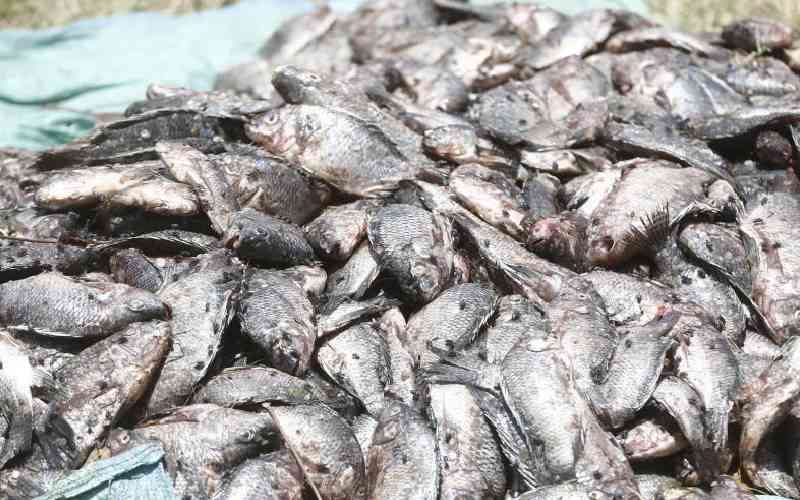
Police display 260 kilograms of fish that were seized from four individuals during a crackdown on illegal fishing in Lake Nakuru, on March 5, 2024. [File, Standard]
Zanzibar is set to host a major regional summit later this month that will bring together delegations from Kenya, Mauritius, Tanzania and Zanzibar to step up the fight against illegal fishing in the South West Indian Ocean.
The Blue Voices Regional Summit 2026, scheduled for January 26–28, will focus on strengthening coordination among coastal states to curb the growing threat of Illegal, Unreported and Unregulated (IUU) fishing — a problem that continues to drain billions from Africa’s blue economy and undermine the livelihoods of coastal communities.
According to organisers, the meeting will be co-hosted by the Ministry of Blue Economy and Fisheries of Zanzibar and The Jahazi Project, in partnership with Ascending Africa. The discussions will centre on improving cross-border cooperation through better information sharing, modernised surveillance, and harmonised regulatory frameworks to close gaps exploited by illegal fishing networks.
Follow The Standard
channel
on WhatsApp
The summit will run under the theme “One Ocean, One Voice,” signalling a collective call for countries in the region to act in unison in protecting shared marine resources and promoting sustainable use of ocean spaces.
Across the South West Indian Ocean, IUU fishing remains one of the biggest threats to marine biodiversity, food security, and national economies. Kenya, for instance, loses an estimated KSh10 billion annually to unlicensed and unreported fishing activities in its Exclusive Economic Zone (EEZ). Tanzania and Mauritius face similar challenges, with foreign vessels often operating undetected or misreporting catches.
Experts say that while individual governments have strengthened monitoring and licensing systems, illegal operators take advantage of weak coordination between neighbouring states.
“This Summit gives us a platform to build real momentum in the fight against illegal fishing. Strong regional cooperation is the most effective tool we have,” said Captain Hamad Bakar Hamad, the Principal Secretary in Zanzibar’s Ministry of Blue Economy and Fisheries. “Together we can safeguard our marine resources and support the communities that depend on them,” he added.
The PS said Zanzibar is committed to working closely with its neighbours to protect the shared ocean space, noting that the Summit aligns with the island’s Blue Economy Policy, which positions the ocean as a key pillar of livelihoods, food security and regional stability.
For decades, countries along the Indian Ocean coast have operated largely independently in monitoring their maritime zones. But with rising cases of illegal foreign trawlers, the need for a joint approach has become urgent.
The upcoming Zanzibar summit aims to shift the focus from isolated enforcement to regional solidarity. Delegates are expected to deliberate on joint action plans, shared intelligence, and standardised enforcement measures that will allow real-time communication among fisheries agencies.
Organisers say one of the outcomes could be a shared database of licensed vessels and reported catches — a move that would help plug loopholes used by rogue operators who hop across borders to evade penalties.
“Illegal fishing thrives when systems are disconnected, but cooperation changes the equation,” said Michael Mallya, spokesperson for The Jahazi Project. “By aligning our efforts and strengthening our enforcement, we take ownership of our waters and our future.”
The scale of IUU fishing in the South West Indian Ocean is staggering. Reports by regional fisheries bodies estimate that between 20–30 per cent of fish harvested in the region are caught illegally. These losses not only affect government revenues but also undermine artisanal fishers who depend on coastal fisheries for survival.
In Kenya, hundreds of small-scale fishers in areas like Kilifi, Kwale and Lamu have long complained about being pushed out by large-scale foreign trawlers operating just beyond the 12-nautical-mile limit.
“Sometimes we go out and come back empty-handed because the trawlers have already swept the area,” said 47-year-old fisherman Ali Kombo from Kilifi. “What we want is for the government to tighten patrols and make sure our waters are not invaded.”
Kenya’s State Department for Blue Economy and Fisheries has been expanding maritime patrols and modernising vessel monitoring systems (VMS), but officials admit that cross-border cooperation remains a weak link.
A senior fisheries officer in Mombasa told The Standard that even when illegal vessels are detected, enforcement is complicated because operators often register in one country but operate in another, taking advantage of jurisdiction gaps.
“That is why a platform like this Summit is so important. Once countries share data and intelligence, these vessels will find it harder to operate under the radar,” he said.
The Zanzibar summit is expected to build on existing regional instruments such as the South West Indian Ocean Fisheries Commission (SWIOFC), the Indian Ocean Tuna Commission (IOTC), and the Fisheries Transparency Initiative.
The difference this time, organisers say, is the emphasis on African-led coordination and political commitment.
“The Blue Voices Summit is not just another meeting; it’s about African countries taking ownership of the ocean governance agenda,” said Mr. Mallya. “We want to move from rhetoric to implementation — where policies translate into real action on the ground.”
The Jahazi Project, led by Ascending Africa, has been at the forefront of regional blue economy initiatives, blending traditional maritime heritage with modern sustainability approaches. Its name “Jahazi” — Swahili for dhow — symbolises East Africa’s shared coastal identity and the spirit of collaboration.
Zanzibar’s growing prominence in blue economy leadership has made it a fitting host for the Summit. Over the past few years, the island government has launched several initiatives aimed at strengthening marine conservation, including the Zanzibar Blue Economy Policy (2021).
The policy identifies marine tourism, fisheries, aquaculture, and maritime transport as key pillars for economic growth while ensuring sustainability and community inclusion.
Zanzibar officials say that by hosting the Summit, the island hopes to demonstrate how the blue economy can be a unifying development agenda for the region rather than a source of competition.
“Just like climate change, illegal fishing is a transboundary issue. You cannot deal with it alone,” said PS Hamad. “When we come together, we amplify our impact and send a clear message to those exploiting our waters illegally.”
During the three-day meeting, government delegations are expected to discuss key areas such as information sharing and data systems, developing an intergovernmental mechanism for real-time vessel tracking and intelligence exchange, strengthening monitoring, control and surveillance through satellite and drone technologies, aligning regulatory frameworks and penalties across borders, establishing coordinated enforcement operations, and integrating local fishing communities in decision-making.
Officials say the summit could also produce a Zanzibar Declaration on Ocean Governance, setting the tone for stronger cooperation in the region over the next decade.
Across East Africa, the blue economy is increasingly viewed as the next frontier for economic growth. From marine tourism and fisheries to shipping and offshore energy, countries are looking to the ocean for jobs and development.
In Kenya, the Blue Economy Implementation Committee has been spearheading programmes on sustainable fisheries, maritime safety, and aquaculture expansion. The government estimates that the blue economy has the potential to contribute up to 10 per cent of GDP if well harnessed.
However, experts caution that without tackling IUU fishing and strengthening regional governance, these ambitions will remain elusive.
Follow The Standard
channel
on WhatsApp
Police display 260 kilograms of fish that were seized from four individuals during a crackdown on illegal fishing in Lake Nakuru, on March 5, 2024.
[File, Standard]
Zanzibar is set to host a major regional summit later this month that will bring together delegations from Kenya, Mauritius, Tanzania and Zanzibar to step up the fight against illegal fishing in the South West Indian Ocean.
The Blue Voices Regional Summit 2026, scheduled for January 26–28, will focus on strengthening coordination among coastal states to curb the growing threat of Illegal, Unreported and Unregulated (IUU) fishing — a problem that continues to drain billions from Africa’s blue economy and undermine the livelihoods of coastal communities.
According to organisers, the meeting will be co-hosted by the Ministry of Blue Economy and Fisheries of Zanzibar and The Jahazi Project, in partnership with Ascending Africa. The discussions will centre on improving cross-border cooperation through better information sharing, modernised surveillance, and harmonised regulatory frameworks to close gaps exploited by illegal fishing networks.
Follow The Standard
channel
on WhatsApp
The summit will run under the theme “One Ocean, One Voice,” signalling a collective call for countries in the region to act in unison in protecting shared marine resources and promoting sustainable use of ocean spaces.
Across the South West Indian Ocean, IUU fishing remains one of the biggest threats to marine biodiversity, food security, and national economies. Kenya, for instance, loses an estimated KSh10 billion annually to unlicensed and unreported fishing activities in its Exclusive Economic Zone (EEZ). Tanzania and Mauritius face similar challenges, with foreign vessels often operating undetected or misreporting catches.
Experts say that while individual governments have strengthened
monitoring and licensing systems
, illegal operators take advantage of weak coordination between neighbouring states.
“This Summit gives us a platform to build real momentum in the fight against illegal fishing. Strong regional cooperation is the most effective tool we have,” said Captain Hamad Bakar Hamad, the Principal Secretary in Zanzibar’s Ministry of Blue Economy and Fisheries. “Together we can safeguard our marine resources and support the communities that depend on them,” he added.
The PS said Zanzibar is committed to working closely with its neighbours to protect the shared ocean space, noting that the Summit aligns with the island’s Blue Economy Policy, which positions the ocean as a key pillar of livelihoods, food security and regional stability.
For decades, countries along the Indian Ocean coast have operated largely independently in monitoring their maritime zones. But with rising cases of illegal foreign trawlers, the need for a joint approach has become urgent.
The upcoming Zanzibar summit aims to shift the focus from isolated enforcement to regional solidarity. Delegates are expected to deliberate on joint action plans, shared intelligence, and standardised enforcement measures that will allow real-time communication among fisheries agencies.
Organisers say one of the outcomes could be a shared database of licensed vessels and reported catches — a move that would help plug loopholes used by rogue operators who hop across borders to evade penalties.
“Illegal fishing thrives when systems are disconnected, but cooperation changes the equation,” said Michael Mallya, spokesperson for The Jahazi Project. “By aligning our efforts and strengthening our enforcement, we take ownership of our waters and our future.”
The scale of IUU fishing in the South West Indian Ocean is staggering. Reports by regional fisheries bodies estimate that between 20–30 per cent of fish harvested in the region are caught illegally. These losses not only affect government revenues but also undermine artisanal fishers who depend on coastal fisheries for survival.
Stay informed. Subscribe to our newsletter
In Kenya, hundreds of small-scale fishers in areas like Kilifi, Kwale and Lamu have long complained about being pushed out by large-scale foreign trawlers operating just beyond the 12-nautical-mile limit.
“Sometimes we go out and come back empty-handed because the trawlers have already swept the area,” said 47-year-old fisherman Ali Kombo from Kilifi. “What we want is for the government to tighten patrols and make sure our waters are not invaded.”
Kenya’s State Department for Blue Economy and Fisheries has been expanding maritime patrols and modernising vessel monitoring systems (VMS), but officials admit that cross-border cooperation remains a weak link.
A senior fisheries officer in Mombasa told The Standard that even when illegal vessels are detected, enforcement is complicated because operators often register in one country but operate in another, taking advantage of jurisdiction gaps.
“That is why a platform like this Summit is so important. Once countries share data and intelligence, these
vessels will find it harder to operate
under the radar,” he said.
The Zanzibar summit is expected to build on existing regional instruments such as the South West Indian Ocean Fisheries Commission (SWIOFC), the Indian Ocean Tuna Commission (IOTC), and the Fisheries Transparency Initiative.
The difference this time, organisers say, is the emphasis on African-led coordination and political commitment.
“The Blue Voices Summit is not just another meeting; it’s about African countries taking ownership of the ocean governance agenda,” said Mr. Mallya. “We want to move from rhetoric to implementation — where policies translate into real action on the ground.”
The Jahazi Project, led by Ascending Africa, has been at the forefront of regional blue economy initiatives, blending traditional maritime heritage with modern sustainability approaches. Its name “Jahazi” — Swahili for dhow — symbolises East Africa’s shared coastal identity and the spirit of collaboration.
Zanzibar’s growing prominence in blue economy leadership has made it a fitting host for the Summit. Over the past few years, the island government has launched several initiatives aimed at strengthening marine conservation, including the Zanzibar Blue Economy Policy (2021).
The policy identifies marine tourism, fisheries, aquaculture, and maritime transport as key pillars for economic growth while ensuring sustainability and community inclusion.
Zanzibar officials say that by hosting the Summit, the island hopes to demonstrate how the blue economy can be a unifying development agenda for the region rather than a source of competition.
“Just like climate change, illegal fishing is a transboundary issue. You cannot deal with it alone,” said PS Hamad. “When we come together, we amplify our impact and send a clear message to those exploiting our waters illegally.”
During the three-day meeting, government delegations are expected to discuss key areas such as information sharing and data systems, developing an intergovernmental mechanism for real-time vessel tracking and intelligence exchange, strengthening monitoring, control and surveillance through satellite and drone technologies, aligning regulatory frameworks and penalties across borders, establishing coordinated enforcement operations, and integrating local fishing communities in decision-making.
Officials say the summit could also produce a Zanzibar Declaration on Ocean Governance, setting the tone for stronger cooperation in the region over the next decade.
Across East Africa, the blue economy is increasingly viewed as the next frontier for economic growth. From marine tourism and fisheries to shipping and offshore energy, countries are looking to the ocean for jobs and development.
In Kenya, the Blue Economy Implementation Committee has been spearheading programmes on sustainable fisheries, maritime safety, and aquaculture expansion. The government estimates that the blue economy has the potential to contribute up to 10 per cent of GDP if well harnessed.
However, experts caution that without tackling IUU fishing and strengthening regional governance, these ambitions will remain elusive.
Follow The Standard
channel
on WhatsApp
By Paul Mbugua