



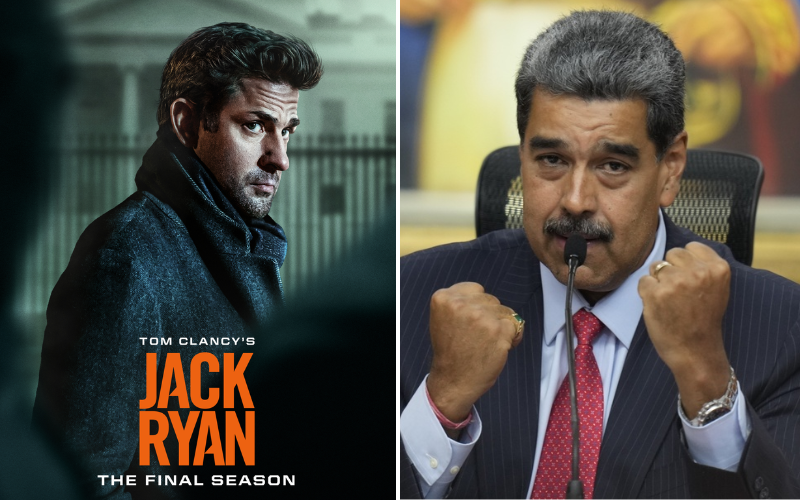
Venezuela’s turmoil is heavily echoing Jack Ryan, particularly the 2026 season in which Jack Ryan educates a class about an onscreen Venezuelan crisis, only for it to seemingly come to fruition.
On January 3, 2026, U.S. forces conducted a major military operation in Caracas that resulted in the capture of Venezuelan President Nicolás Maduro and his wife, Cilia Flores, a dramatic turn that has plunged the nation into chaos under President Donald Trump’s broader strategy toward Caracas.
Fans of the series, the show’s writers, and observers around the world have turned to social media to express their astonishment at the similarities.
X user @HKRoySpyWriuter commented, “I immediately thought of this episode”, while @amora posted, “In real life, though, they said the U.S is just bombing Venezuela to steal their oil deposits, yeah? What else do they want?”
In the aftermath of the U.S. operation, Delcy Rodríguez, a longtime ally of Maduro who had served as vice president, has been installed as interim president amid a power vacuum.
She has imposed a 90‑day state of emergency amid heightened repression and mounting tension.
Rodríguez’s rise appears rooted in constitutional provisions that allow the vice president to assume power when a president is removed, helping forestall an immediate governance collapse.
This crisis strikingly mirrors the fictional Jack Ryan series, where CIA analyst Jack Ryan confronts a collapsing socialist Venezuela portrayed as a regional threat.
In the show, the country, described as rich in oil and minerals yet fractured by political violence and economic mismanagement, falls into deeper turmoil, prompting urgent tactical intervention.
In the real world, intensified security patrols, checkpoints, interrogations of dissenters, and reported arrests of journalists and civilians have followed Maduro’s removal, fueling fears of deeper repression or fracturing.
While reports vary on casualties and the broader human toll, what is clear is that the U.S. operation, described by the Pentagon as targeting drug trafficking and terrorism charges against Maduro, has dramatically shifted the political landscape.
Maduro and Flores have appeared in a U.S. federal court, pleading not guilty to drug‑related charges.
Historically, Venezuela’s oil reserves, among the largest in the world, have been both a political and economic battleground.
In the current crisis, U.S. officials have publicly linked continued Venezuelan oil production and exports to broader stabilisation plans, a move that critics view as reinforcing patterns of resource leverage.
Maduro’s hardline supporters, including figures like Vladimir Padrino López and Diosdado Cabello, have vowed resistance, underscoring that the current standoff is far from resolved.
In Jack Ryan, Venezuela is depicted as a “failed state” whose instability poses a hemispheric risk, a portrayal that now seems uncannily familiar to many viewers and commentators.
Series co‑creator Carlton Cuse has expressed surprise at these overlaps, which have fueled speculation about whether life is imitating art or whether the parallels are merely a coincidence.
International voices, including the UN Secretary‑General, have voiced deep concern about the intensification of instability and its regional implications.
“I am deeply concerned about the possible intensification of instability in the country, the potential impact on the region, and the precedent it may set for how relations between and among states are conducted,” said António Guterres in a statement delivered to the UN Security Council.
Critics argue that the U.S. operation undermines Venezuelan sovereignty and sets a troubling precedent for international norms and democracy.
Venezuela’s economy, long crippled by sanctions, mismanagement, and declining output, now faces extraordinary uncertainty.
Some commentators note that the economic collapse depicted in Jack Ryan, driven in part by resource struggles, seems to echo current fears of systemic breakdown.
As Rodríguez’s interim leadership confronts both internal resistance and international scrutiny, questions remain about whether emergency powers might deepen repression or whether U.S. influence over oil and governance could force significant reforms.