

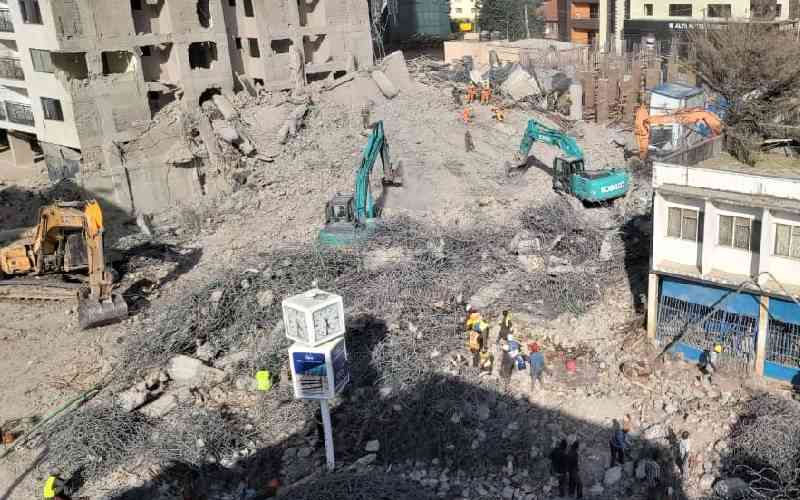
As investigations into the collapse of a building in South C continues, professional associations in the built environment have painted a grim picture of construction safety in Nairobi, warning that only 15 per cent of buildings in the city are structurally safe.
Speaking during a press briefing, professionals drawn from engineering, architecture, physical planning, surveying, interior design, valuation and construction management said the city is on a ticking time bomb caused by corruption, weak governance and the systematic sidelining of qualified experts.
According to the Institution of Engineers of Kenya (IEK), president Shammah Kiteme, inspections conducted by the National Building Inspectorate on about 15,000 buildings revealed that only 15 per cent were safe, while roughly eight per cent were rated as fair and capable of improvement.
Follow The Standard
channel
on WhatsApp
“Some of the reasons causing these collapses include involvement of quacks who lack licences and experience, as well as failure to use the right construction materials,” Eng Kiteme said.
He cited the demolition of an 11-storey building in Mombasa last year, noting that the investigation exposed widespread credential renting and cartel-like networks that compromise approval processes. “We saw a snippet of the report showing 61 per cent of approvals were done by just three engineers, while 75 per cent were handled by five architects. There is clear collusion along the approval chain,” he said.
Architectural Association of Kenya president George Ndege described the state of buildings in Kenya as “dire”.
“We are living by the grace of God. If a tremor, even at a low scale, were to occur, many buildings would come down,” Ndege said.
The professionals said the recurring tragedies would persist unless systemic failures are addressed, listing poor governance, political interference, bypassed procedures, corruption, credential renting, lack of geotechnical investigations, poor construction sequencing, substandard materials and weak quality control as key drivers of collapse.
“Structural failure is what usually attracts attention, but there are many buildings that are simply not fit for human habitation,” Ndege added.
Kiteme lamented that despite decades of deadly collapses, accountability remains elusive. “More than 200 buildings have collapsed since 1996, killing over 200 people. Investigations are always conducted, but there is no evidence that lessons are implemented or that harsh penalties are imposed,” he said.
The professionals further noted that sidelining experts remains rampant, with developers often avoiding professional input to cut costs. They estimated that fewer than 20 per cent of developments fully involve qualified professionals, a practice that compromises structural integrity.
Kiteme warned against altering approved designs, saying it is impractical and dangerous to add floors or additional loads to a building whose foundation was not designed to support them.
He also accused authorities of deliberately sabotaging online approval systems to create opportunities for bribery through manual processes.
Architect Sylvia Kasanga, president of The Architectural Alliance, said counterfeit construction materials have significantly worsened the crisis. She estimated the value of illicit and counterfeit building, construction, and electrical materials at about $2.31 billion (Sh230 billion).
Kasanga placed the greatest responsibility on contractors and developers. “The contractor has a duty of care to present certificates proving that materials used meet standards. In the South C case, investigators must make these certificates public because this is a serious sector-wide problem,” she said.
Town and County Planners Association of Kenya chairman Mairura Omwenga said corruption within county governments has been a major contributor to building failures.
“Corruption is not just about money. Compromising standards, using substandard materials, and taking shortcuts are all forms of corruption,” Omwenga said, adding that projects should be inspected at least monthly in the presence of consultants.
While developers and their consultants are obligated to ensure construction meets approved standards, Omwenga said government agencies also bear responsibility for continuously monitoring sites to ensure what is built matches what was approved.
Follow The Standard
channel
on WhatsApp
As investigations into the collapse of a building in South C continues, professional associations in the built environment have painted a grim picture of construction safety in Nairobi, warning that only 15 per cent of buildings in the city are structurally safe.
Speaking during a press briefing, professionals drawn from engineering, architecture, physical planning, surveying, interior design, valuation and construction management said the city is on a ticking time bomb caused by corruption, weak governance and the systematic sidelining of qualified experts.
According to the Institution of Engineers of Kenya (IEK), president Shammah Kiteme, inspections conducted by the National Building Inspectorate on about 15,000 buildings revealed that only 15 per cent were safe, while roughly eight per cent were rated as fair and capable of improvement.
Follow The Standard
channel
on WhatsApp
“Some of the reasons causing these collapses include involvement of quacks who lack licences and experience, as well as failure to use the right construction materials,” Eng Kiteme said.
He cited the demolition of an 11-storey building in Mombasa last year, noting that the investigation exposed widespread credential renting and cartel-like networks that compromise approval processes. “We saw a snippet of the report showing 61 per cent of
approvals were done by just three engineers
, while 75 per cent were handled by five architects. There is clear collusion along the approval chain,” he said.
Architectural Association of Kenya president George Ndege described the state of buildings in Kenya as “dire”.
“We are living by the grace of God. If a tremor, even at a low scale, were to occur, many buildings would come down,” Ndege said.
The professionals said the recurring tragedies would persist unless systemic failures are addressed, listing poor governance, political interference, bypassed procedures, corruption, credential renting, lack of geotechnical investigations, poor construction sequencing, substandard materials and weak quality control as key drivers of collapse.
“Structural failure is what usually attracts attention, but there are many buildings that are simply not fit for human habitation,” Ndege added.
Kiteme lamented that despite decades of deadly collapses, accountability remains elusive. “More than 200 buildings have collapsed since 1996, killing over 200 people. Investigations are always conducted, but there is no evidence that lessons are implemented or that harsh penalties are imposed,” he said.
The professionals further noted that sidelining experts remains rampant, with developers often avoiding professional input to cut costs. They estimated that fewer than 20 per cent of developments fully involve qualified professionals, a practice that compromises structural integrity.
Kiteme warned against altering approved designs, saying it is impractical and dangerous to add floors or additional loads to a building whose foundation was not designed to support them.
He also accused authorities of deliberately sabotaging online approval systems to create opportunities for bribery through manual processes.
Architect Sylvia Kasanga, president of The Architectural Alliance, said counterfeit construction materials have significantly worsened the crisis. She estimated the value of illicit and counterfeit building, construction, and electrical materials at about $2.31 billion (Sh230 billion).
Stay informed. Subscribe to our newsletter
Kasanga placed the greatest responsibility on contractors and developers. “The contractor has a duty of care to present certificates proving that materials used meet standards. In the South C case, investigators must make these certificates public because this is a serious sector-wide problem,” she said.
Town and County Planners Association of Kenya chairman Mairura Omwenga said
corruption within county governments
has been a major contributor to building failures.
“Corruption is not just about money. Compromising standards, using substandard materials, and taking shortcuts are all forms of corruption,” Omwenga said, adding that projects should be inspected at least monthly in the presence of consultants.
While developers and their consultants are obligated to ensure construction meets approved standards, Omwenga said government agencies also bear responsibility for continuously monitoring sites to ensure what is built matches what was approved.
Follow The Standard
channel
on WhatsApp
By Jacinta Mutura