

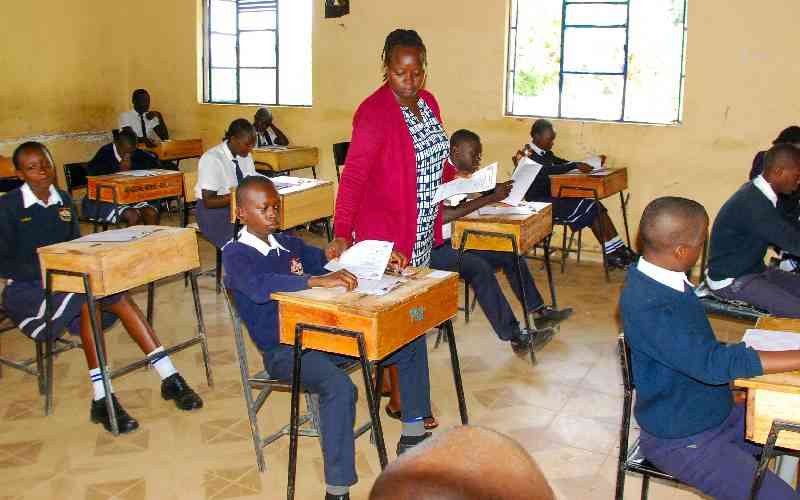
Candidates sit for KJSEA at Bondo Township School, on October 27, 2025. [Michael Mute, Standard]
The Ministry of Education recently rejected more than 66,000 requests by students who sought changes to their Grade 10 placements. Basic Education Principal Secretary Julius Bitok said that a significant number of these requests could not be accommodated due to capacity constraints in the preferred schools.
This development raises serious policy questions about how student admissions are managed. That schools lack capacity suggests that infrastructure alone is being treated as the dominant determinant of admission. Yet capacity, narrowly defined as the availability of classrooms, hostels, laboratories, sanitation facilities and related infrastructure, should not by itself determine where students are placed.
There are other equally important considerations that ought to inform enrolment decisions. One such is ideal school size, which refers to the number of students enrolled in a school. Evidence shows that school size has a profound impact on student engagement, academic performance and overall well-being. Unfortunately, this factor has received little attention in policy discourses.
Follow The Standard
channel
on WhatsApp
In the United States, for example, the National Association of Secondary School Principals recommended in 1996 that public high schools limit enrolment to no more than 600 students in a report titled, ‘Breaking ranks: Changing an American institution’. The report further proposed that teachers should be responsible for no more than 90 students during a given term. When learners feel unseen and unheard, motivation declines, discipline problems increase and academic outcomes suffer.
Former Harvard University President James Bryant Conant, in his report: ‘The American high school today’, suggested that a viable school should have at least 100 students per graduating class, which would translate to a maximum enrolment of about 750 students.
These recommendations must also be understood in the context of unusually large schools in some US states. In places such as New York, some high schools enrol more than 3,000 students. Such institutions are often impersonal and intimidating. Only exceptionally strong and academically gifted students tend to thrive in these environments. Students of average ability, or those still developing socially and emotionally, often struggle under the weight of anonymity and limited individual attention.
Kenya’s experience tells a different story. In the 1980s and early 1990s, most secondary schools enrolled between 300 and 700 students. Enrolment levels were largely proportional to the number of schools available at the time. Today, however, the situation has changed significantly.
There has been a remarkable increase in the transition rate from primary to secondary school, largely due to the 100 per cent transition policy. At the same time, there has been a rapid increase in the number of secondary schools across the country. Kenya now has approximately 10,000 public secondary or senior schools. With an estimated secondary school population of about five million learners, the average enrolment works out to roughly 500 students per school.
With few exceptions, a significant number of these schools are adequately endowed with essential infrastructure and teaching personnel. Many have laboratories, workshops for technical subjects, libraries and playgrounds to support co-curricular activities. In such a context, the phenomenon of students gravitating toward only a few so-called “elite” schools should not arise under ideal circumstances. Schools within each cluster ought to function as genuine centres of excellence. If this were the case, learners would enjoy equitable educational opportunities regardless of which school they attend, and the pressure on a handful of popular institutions would ease.
What, then, are the policy implications? First, there is an urgent need to rethink appropriate school size, school organisation and instructional approaches in secondary education. Overcrowded schools and oversized classes reduce meaningful contact between teachers and students, which makes it difficult to identify struggling learners, offer mentorship or nurture individual talent.
Second, the government must prioritise the expansion, modernisation or rehabilitation of infrastructure in schools with limited or dilapidated facilities. Classrooms, laboratories, libraries, workshops and sanitation facilities should meet minimum standards across all secondary schools.
Third, school funding mechanisms require serious reconsideration. While pegging funding to student enrolment is, in principle, reasonable, relying on this model alone creates what sociologists call the Matthew Effect—where those who already have more continue to receive more. Schools with large student populations attract more funding, while those with smaller enrolment are further disadvantaged. This has widened inequality in infrastructure and learning resources.
Fourth, the government should closely examine secondary schools that possess the characteristics associated with high student achievement but continue to record low enrolment. Parents tend to avoid schools with poor academic performance. Understanding what ails these institutions is essential. These schools should reflect their elevated status through improved outcomes, infrastructure and leadership. What is needed is an academic revival, akin to a religious revival, in their fortunes.
Fifth, there must be an aggressive and sustained in-service training programme for teachers and school leaders. Teachers need deeper mastery of subject content and pedagogy, while principals must be equipped with strong leadership and management skills. The goal should be threefold: Improved curriculum mastery, better instructional practice and effective school leadership. There are countless measures, both large and small, that can ease pressure on overcrowded schools while spreading excellence across the system.
Follow The Standard
channel
on WhatsApp
Candidates sit for KJSEA at Bondo Township School, on October 27, 2025.
[Michael Mute, Standard]
The Ministry of Education recently rejected more than 66,000 requests by students who sought changes to their Grade 10 placements. Basic Education Principal Secretary Julius Bitok said that a significant number of these requests could not be accommodated due to capacity constraints in the preferred schools.
This development raises serious policy questions about how student admissions are managed. That schools lack capacity suggests that infrastructure alone is being treated as the dominant determinant of admission. Yet capacity, narrowly defined as the availability of classrooms, hostels, laboratories, sanitation facilities and related infrastructure, should not by itself determine where students are placed.
There are other equally important considerations that ought to inform enrolment decisions. One such is ideal school size, which refers to the number of students enrolled in a school. Evidence shows that school size has a profound impact on student engagement, academic performance and overall well-being. Unfortunately, this factor has received little attention in policy discourses.
Follow The Standard
channel
on WhatsApp
In the United States, for example, the National Association of Secondary School Principals recommended in 1996 that public high schools limit enrolment to no more than 600 students in a report titled, ‘Breaking ranks: Changing an American institution’. The report further proposed that teachers should be responsible for no more than 90 students during a given term. When learners feel unseen and unheard, motivation declines, discipline problems increase and academic outcomes suffer.
Former Harvard University President James Bryant Conant, in his report: ‘The American high school today’, suggested that a viable school should have at least 100 students per graduating class, which would translate to a maximum enrolment of about 750 students.
These recommendations must also be understood in the context of unusually large schools in some US states. In places such as New York, some high schools enrol more than 3,000 students. Such institutions are often impersonal and intimidating. Only exceptionally strong and academically gifted students tend to thrive in these environments. Students of average ability, or those still developing socially and emotionally, often struggle under the weight of anonymity and limited individual attention.
Kenya’s experience tells a different story. In the 1980s and early 1990s, most secondary schools enrolled between 300 and 700 students. Enrolment levels were largely proportional to the number of schools available at the time. Today, however, the situation has changed significantly.
There has been a remarkable increase in the transition rate from primary to secondary school, largely due to the 100 per cent transition policy. At the same time, there has been a rapid increase in the number of secondary schools across the country. Kenya now has approximately 10,000 public secondary or senior schools. With an estimated secondary school population of about five million learners, the average enrolment works out to roughly 500 students per school.
With few exceptions, a significant number of these schools are adequately endowed with essential infrastructure and teaching personnel. Many have laboratories, workshops for technical subjects, libraries and playgrounds to support co-curricular activities. In such a context, the phenomenon of students gravitating toward only a few so-called “elite” schools should not arise under ideal circumstances. Schools within each cluster ought to function as genuine centres of excellence. If this were the case, learners would enjoy equitable educational opportunities regardless of which school they attend, and the pressure on a handful of popular institutions would ease.
What, then, are the policy implications? First, there is an urgent need to rethink appropriate school size, school organisation and instructional approaches in secondary education. Overcrowded schools and oversized classes reduce meaningful contact between teachers and students, which makes it difficult to identify struggling learners, offer mentorship or nurture individual talent.
Second, the government must prioritise the expansion, modernisation or rehabilitation of infrastructure in schools with limited or dilapidated facilities. Classrooms, laboratories, libraries, workshops and sanitation facilities should meet minimum standards across all secondary schools.
Third, school funding mechanisms require serious reconsideration. While pegging funding to student enrolment is, in principle, reasonable, relying on this model alone creates what sociologists call the Matthew Effect—where those who already have more continue to receive more. Schools with large student populations attract more funding, while those with smaller enrolment are further disadvantaged. This has widened inequality in infrastructure and learning resources.
Fourth, the government should closely examine secondary schools that possess the characteristics associated with high student achievement but continue to record low enrolment. Parents tend to avoid schools with poor academic performance. Understanding what ails these institutions is essential. These schools should reflect their elevated status through improved outcomes, infrastructure and leadership. What is needed is an academic revival, akin to a religious revival, in their fortunes.
Fifth, there must be an aggressive and sustained in-service training programme for teachers and school leaders. Teachers need deeper mastery of subject content and pedagogy, while principals must be equipped with strong leadership and management skills. The goal should be threefold: Improved curriculum mastery, better instructional practice and effective school leadership. There are countless measures, both large and small, that can ease pressure on overcrowded schools while spreading excellence across the system.
Stay informed. Subscribe to our newsletter
Follow The Standard
channel
on WhatsApp
By Kennedy Buhere