

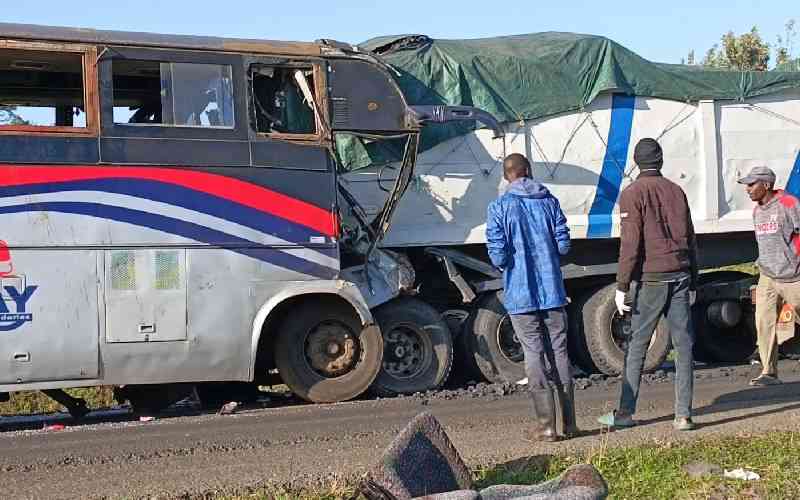
A bus that collided with a trailer at Tunnel area near Fort Ternan trading centre on Muhoroni Junction–Londiani Junction road, on January 6, 2026. [Nikko Tanui, Standard]
A 10-year-old girl is starting the year orphaned, grieving, and most likely, traumatised for life. A road accident wiped out her entire family: Her parents and her two little brothers. In one instant, everything she knew as normal changed. As happens after nearly every incident, survivors in the fatal accident spoke about the driver’s misconduct, how he appeared drowsy, how he drove dangerously. And this, for me, is where the real tragedy lies.
In almost every accident on our roads involving public service vehicles with survivors, one or two eventually find their voice and memory to recount the over-speeding, blatant traffic violations, the reckless overtaking, and the visible fatigue. There is always something the driver was doing wrong. Tragically, these accounts surface only after lives have been lost, bodies maimed and futures destroyed. One can’t help but wonder where those voices were before tragedy struck.
According to data from the National Transport and Safety Authority (NTSA), close to 4,500 lives were lost on our roads last year. In most of these accidents, investigations overwhelmingly pointed to driver error and negligence. These are dangers passengers often see and at times, quietly discuss during the journey, yet remain silent in the face of obvious danger. It is at this point that passengers cease to be victims and become enablers.
Follow The Standard
channel
on WhatsApp
A friend recounted a trip he took upcountry in a matatu during the festive season. From the outset, he noticed the driver wasn’t alert. Seated in the co-driver’s seat, he witnessed several near misses, each unsettling enough to prompt him to raise concern. No one else in the vehicle backed him. In fact, one of the passengers reprimanded him for ‘inviting kisirani’ with his incessant complaints.
When they made a stop-over in Nakuru, he insisted on having his bag offloaded, determined not to continue with the journey. Only then did the other passengers take him seriously enough to add their voices. A replacement was found, albeit after some delay, but the journey continued without incident. I shudder to imagine what might have happened had he chosen silence instead.
At the centre of Kenya’s road carnage crisis sits silence and collective inaction of passengers. At some point, witnesses to recklessness stop being victims and become participants in the tragedy that follows. While reckless drivers, rogue conductors, corruption and weak enforcement are to blame, we cannot continue to excuse the silent passengers who find their voice only after the tragedy. Nor can we absolve the passenger who laughs at near misses, urges the driver to speed up because they are running late or normalises clear traffic violations as mere inconveniences.
The Michuki reforms of the early 2000s did a great job reforming the public transport sector. Thanks to the rules, PSV drivers and conductors were uniformed and licensed while PSVs had working speed governors. But he also did something else – extended accountability for road safety to passengers of PSVs. Excess passengers in PSVs were arrested, and so were those who failed to wear seat belts or alighted at undesignated stops. These measures crucially introduced passenger responsibility on matters of road safety. And the impact was huge. Road discipline improved. Passengers began policing crews and refused to board vehicles that exposed them to risk or arrest. The ‘Michuki Laws’ somehow forced the public to treat road safety as a shared duty.
The NTSA may want to consider changing their approach to road safety campaigns. Passengers must be made to understand that speaking against reckless driving is not just a right but their responsibility. Beyond the sporadic police crackdowns targeted at PSV drivers after every major crash, there is a need to create awareness among passengers that there is safety in their voices. No number of arrests will yield better results on our roads than a culture of passengers standing up to reckless drivers.
Every life lost on our roads reflects a failure by individuals, institutions, and often engineering. Passengers need to be added to that list. We have been that passenger who keeps quiet, minds their business and hopes to reach their destination in one piece. We all are responsible for the grim statistics on our roads.
Ms Wekesa is a development communication consultant
Follow The Standard
channel
on WhatsApp
A bus that collided with a trailer at Tunnel area near Fort Ternan trading centre on Muhoroni Junction–Londiani Junction road, on January 6, 2026.
[Nikko Tanui, Standard]
A 10-year-old girl is starting the year orphaned, grieving, and most likely, traumatised for life. A road accident wiped out her entire family: Her parents and her two little brothers. In one instant, everything she knew as normal changed. As happens after nearly every incident, survivors in the fatal accident spoke about the driver’s misconduct, how he appeared drowsy, how he drove dangerously. And this, for me, is where the real tragedy lies.
In almost every accident on our roads involving public service vehicles with survivors, one or two eventually find their voice and memory to recount the over-speeding, blatant traffic violations, the reckless overtaking, and the visible fatigue. There is always something the driver was doing wrong. Tragically, these accounts surface only after lives have been lost, bodies maimed and futures destroyed. One can’t help but wonder where those voices were before tragedy struck.
According to data from the National Transport and Safety Authority (NTSA), close to 4,500 lives were lost on our roads last year. In most of these accidents, investigations overwhelmingly pointed to driver error and negligence. These are dangers passengers often see and at times, quietly discuss during the journey, yet remain silent in the face of obvious danger. It is at this point that passengers cease to be victims and become enablers.
Follow The Standard
channel
on WhatsApp
A friend recounted a trip he took upcountry in a matatu during the festive season. From the outset, he noticed the driver wasn’t alert. Seated in the co-driver’s seat, he witnessed several near misses, each unsettling enough to prompt him to raise concern. No one else in the vehicle backed him. In fact, one of the passengers reprimanded him for ‘inviting kisirani’ with his incessant complaints.
When they made a stop-over in Nakuru, he insisted on having his bag offloaded, determined not to continue with the journey. Only then did the other passengers take him seriously enough to add their voices. A replacement was found, albeit after some delay, but the journey continued without incident. I shudder to imagine what might have happened had he chosen silence instead.
At the centre of Kenya’s road carnage crisis sits silence and collective inaction of passengers. At some point, witnesses to recklessness stop being victims and become participants in the tragedy that follows. While reckless drivers, rogue conductors, corruption and weak enforcement are to blame, we cannot continue to excuse the silent passengers who find their voice only after the tragedy. Nor can we absolve the passenger who laughs at near misses, urges the driver to speed up because they are running late or normalises clear traffic violations as mere inconveniences.
The Michuki reforms of the early 2000s did a great job reforming the public transport sector. Thanks to the rules, PSV drivers and conductors were uniformed and licensed while PSVs had working speed governors. But he also did something else – extended accountability for road safety to passengers of PSVs. Excess passengers in PSVs were arrested, and so were those who failed to wear seat belts or alighted at undesignated stops. These measures crucially introduced passenger responsibility on matters of road safety. And the impact was huge. Road discipline improved. Passengers began policing crews and refused to board vehicles that exposed them to risk or arrest. The ‘Michuki Laws’ somehow forced the public to treat road safety as a shared duty.
The NTSA may want to consider changing their approach to road safety campaigns. Passengers must be made to understand that speaking against reckless driving is not just a right but their responsibility. Beyond the sporadic police crackdowns targeted at PSV drivers after every major crash, there is a need to create awareness among passengers that there is safety in their voices. No number of arrests will yield better results on our roads than a culture of passengers standing up to reckless drivers.
Every life lost on our roads reflects a failure by individuals, institutions, and often engineering. Passengers need to be added to that list. We have been that passenger who keeps quiet, minds their business and hopes to reach their destination in one piece. We all are responsible for the grim statistics on our roads.
Ms Wekesa is a development communication consultant
Follow The Standard
channel
on WhatsApp
By Faith Wekesa