

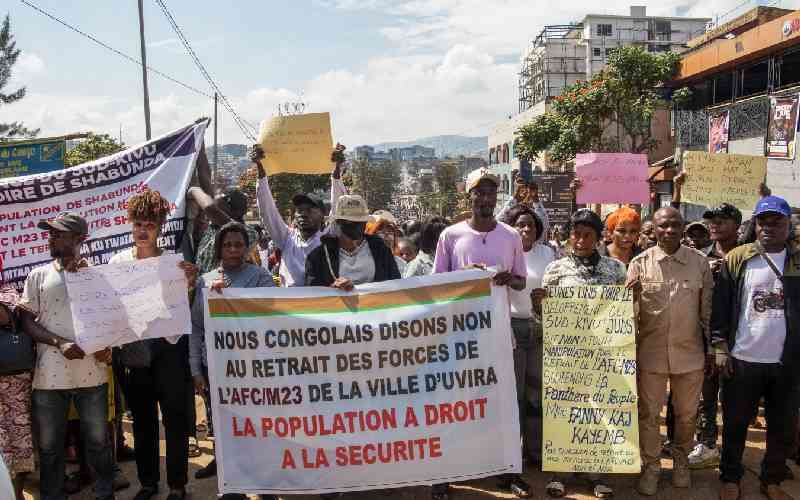
Protesters take part in a march organised by civil society groups in South Kivu to demand peace and dialogue in Bukavu on December 23, 2025. [AFP]
Ethnic profiling is a grave threat to peace and stability in Africa, particularly in East and Southern Africa, where history has repeatedly shown how quickly identity-based politics can spiral into violence.
When states define citizenship, security or political loyalty through ethnic lenses, they risk entrenching exclusion, legitimizing discrimination, and turning diversity into a fault line for conflict. The tragic experiences of Rwanda’s genocide against the Tutsi and the recurring cycles of ethnic violence in eastern DR Congo illustrate how ethnic labeling reinforced by political elites can cross borders, fuel armed groups, and undermine trust between states.
In a region marked by porous borders and shared communities, ethnic profiling does not remain a domestic issue. It becomes a regional security threat that breeds retaliatory nationalism. African governments must therefore resist policies and rhetoric that reduce citizens to ethnic identities which stokes animosity towards a particular ethnic group.
Follow The Standard
channel
on WhatsApp
This is why recent statements against ethnic Tutsis by General Sylvain Ekenge, the Congolese army spokesperson at the end of last year on the Congolese national RTNC TV, must be condemned. The general, reading from a prepared speech, claimed that ‘when you marry a Tutsi woman today, you must be careful.” He went ahead to characterise them as spies and instruments of infiltration.
The statement sent shockwaves across the world, bringing back the horrendous memories of how such hate speech fueled the genocide against the Tutsi in 1994. General Ekenge, who recent reports suggest was suspended over the statements (many believe this aimed at palliating backlash from the international community), proved what would be called a doctrinal echo.
In contexts shaped by ethnic violence, hate speech is rarely an accident. It is more often a symptom, a public articulation of ideas already normalised within institutions, sharpened by political incentives, and made operational through patterns of persecution on the ground.
The big question is not simply why the DRC army spokesperson made the statements but what conditions allowed it and made it strategically useful? A national army spokesperson is not a barroom ideologue. He is a node in the state’s communications system. His words are not private prejudices. They function as political signals. They delineate who belongs, who is suspect, and which entities are imagined as legitimate targets of suspicion, coercion or elimination. In an already inflamed environment, such signals convert prejudice into permission.
General Ekenge’s remark is recognisable. It draws on the conspiratorial anthropology that animated the “Ten Hutu Commandments” and other genocidal texts. For the record, genocide ideology does not begin with machetes. It begins with stories that make violence feel like self-defense. It begins with language that turns neighbors into invaders and marriage into espionage.
The remarks should be read as an escalation within a longer political history: more than three decades in which génocidaires and their ideological heirs were not treated as an international pariah to be isolated, but as a usable constituency, one that’s welcomed, settled, and periodically instrumentalised by successive Congolese power arrangements.
This is the deeper architecture that makes today’s rhetoric intelligible. When actors associated with genocide and genocide ideology are absorbed into local political economies and security networks, they do not arrive as neutral refugees. They arrive with narratives, grievances, and an identity-politics toolkit honed for mobilisation. If the state then tolerates, bargains with, or embeds these actors, it creates a moral and strategic inversion: those who should have been disarmed and delegitimized become partners.
Over time, the line between opportunistic alliance and ideological convergence can blur. Even where the original motive is expediency, the result is normalisation. And once normalised, genocide ideology stops being an imported toxin and becomes a domestic political resource available for electioneering, for militia recruitment, for deflecting governance failure, for forging unity through an invented internal enemy.
The insistence that Ekenge ‘does not represent policy’ is precisely the kind of statement that often accompanies policy in action. The burning of village of Nturo, mass shooting of cattle- the livelihood of Congolese Tutsi families, aerial bombardment of predominantly Tutsi villages in Masisi, Rutshuru, and Minembwe, and broader patterns of displacement and intimidation are evidence of moves from rhetoric to implementation.
When inflammatory narratives coincide with repeated acts that remove populations from land, destroy civilian homes, and render return impossible, the pattern resembles not random insecurity but a political logic: engineering demographic and psychological outcomes through violence and fear.
In other words, hate speech in DRC is not simply expressive. It is instrumental. It prepares a constituency to tolerate what is being done. It pre-emptively discredits the victims by presenting them as conspirators. And it supplies the moral alibi through which state and allied actors can claim that atrocities are security operations, community defense or responses rather than offensives.
There is also a communications realism to Ekenge´s villainous statement. A military spokesperson on national television, reading from prepared notes, is rarely freelancing in any meaningful sense. Prepared remarks imply preparation. Preparation implies clearance. Clearance implies institutional consent, or at minimum the absence of institutional veto.
Even if no written approval chain is produced, the political function remains, the state permitted the broadcast, aired it on a national platform, and if it now wishes to distance itself must do more than issue ambiguous statements. To treat the episode as isolated is therefore not caution but evasion.
-The writer is a member of the Congolese civil society based in London
Follow The Standard
channel
on WhatsApp
Protesters take part in a march organised by civil society groups in South Kivu to demand peace and dialogue in Bukavu on December 23, 2025.
[AFP]
Ethnic profiling is a grave threat to peace and stability in Africa, particularly in East and Southern Africa, where history has repeatedly shown how quickly identity-based politics can spiral into violence.
When states define citizenship, security or political loyalty through ethnic lenses, they risk entrenching exclusion, legitimizing discrimination, and turning diversity into a fault line for conflict. The tragic experiences of Rwanda’s genocide against the Tutsi and the recurring cycles of ethnic violence in eastern DR Congo illustrate how ethnic labeling reinforced by political elites can cross borders, fuel armed groups, and undermine trust between states.
In a region marked by porous borders and shared communities, ethnic profiling does not remain a domestic issue. It becomes a regional security threat that breeds retaliatory nationalism. African governments must therefore resist policies and rhetoric that reduce citizens to ethnic identities which stokes animosity towards a particular ethnic group.
Follow The Standard
channel
on WhatsApp
This is why recent statements against ethnic Tutsis by General Sylvain Ekenge, the Congolese army spokesperson at the end of last year on the Congolese national RTNC TV, must be condemned. The general, reading from a prepared speech, claimed that ‘when you marry a Tutsi woman today, you must be careful.” He went ahead to characterise them as spies and instruments of infiltration.
The statement sent shockwaves across the world, bringing back the horrendous memories of how such hate speech fueled the genocide against the Tutsi in 1994. General Ekenge, who recent reports suggest was suspended over the statements (many believe this aimed at palliating backlash from the international community), proved what would be called a doctrinal echo.
In contexts shaped by ethnic violence, hate speech is rarely an accident. It is more often a symptom, a public articulation of ideas already normalised within institutions, sharpened by political incentives, and made operational through patterns of persecution on the ground.
The big question is not simply why the DRC army spokesperson made the statements but what conditions allowed it and made it strategically useful? A national army spokesperson is not a barroom ideologue. He is a node in the state’s communications system. His words are not private prejudices. They function as political signals. They delineate who belongs, who is suspect, and which entities are imagined as legitimate targets of suspicion, coercion or elimination. In an already inflamed environment, such signals convert prejudice into permission.
General Ekenge’s remark is recognisable. It draws on the conspiratorial anthropology that animated the “Ten Hutu Commandments” and other genocidal texts. For the record, genocide ideology does not begin with machetes. It begins with stories that make violence feel like self-defense. It begins with language that turns neighbors into invaders and marriage into espionage.
The remarks should be read as an escalation within a longer political history: more than three decades in which génocidaires and their ideological heirs were not treated as an international pariah to be isolated, but as a usable constituency, one that’s welcomed, settled, and periodically instrumentalised by successive Congolese power arrangements.
This is the deeper architecture that makes today’s rhetoric intelligible. When actors associated with genocide and genocide ideology are absorbed into local political economies and security networks, they do not arrive as neutral refugees. They arrive with narratives, grievances, and an identity-politics toolkit honed for mobilisation. If the state then tolerates, bargains with, or embeds these actors, it creates a moral and strategic inversion: those who should have been disarmed and delegitimized become partners.
Over time, the line between opportunistic alliance and ideological convergence can blur. Even where the original motive is expediency, the result is normalisation. And once normalised, genocide ideology stops being an imported toxin and becomes a domestic political resource available for electioneering, for militia recruitment, for deflecting governance failure, for forging unity through an invented internal enemy.
The insistence that Ekenge ‘does not represent policy’ is precisely the kind of statement that often accompanies policy in action. The burning of village of Nturo, mass shooting of cattle- the livelihood of Congolese Tutsi families, aerial bombardment of predominantly Tutsi villages in Masisi, Rutshuru, and Minembwe, and broader patterns of displacement and intimidation are evidence of moves from rhetoric to implementation.
When inflammatory narratives coincide with repeated acts that remove populations from land, destroy civilian homes, and render return impossible, the pattern resembles not random insecurity but a political logic: engineering demographic and psychological outcomes through violence and fear.
In other words, hate speech in DRC is not simply expressive. It is instrumental. It prepares a constituency to tolerate what is being done. It pre-emptively discredits the victims by presenting them as conspirators. And it supplies the moral alibi through which state and allied actors can claim that atrocities are security operations, community defense or responses rather than offensives.
Stay informed. Subscribe to our newsletter
There is also a communications realism to Ekenge´s villainous statement. A military spokesperson on national television, reading from prepared notes, is rarely freelancing in any meaningful sense. Prepared remarks imply preparation. Preparation implies clearance. Clearance implies institutional consent, or at minimum the absence of institutional veto.
Even if no written approval chain is produced, the political function remains, the state permitted the broadcast, aired it on a national platform, and if it now wishes to distance itself must do more than issue ambiguous statements. To treat the episode as isolated is therefore not caution but evasion.
-The writer is a member of the Congolese civil society based in London
Follow The Standard
channel
on WhatsApp
By Innocent Nteziryayo