



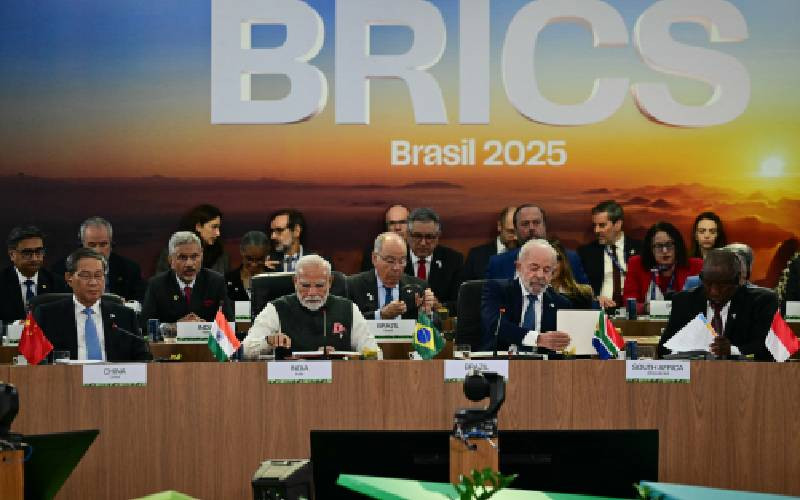
Recently the French Minister for Europe and Foreign Affairs Jean Noel Barrot, while meeting the Indian External Affairs Minister Dr S Jaishankar, made an interesting observation that France was heading the G7 (in which India has been a permanent invitee for over a decade) and India was the chair of BRICS in 2026 and both strategic partners had great possibility of cooperation for enhancing multilateralism.
Both countries believe and subscribe to it. President Macron further underscored that India is going to be the President of BRICS. I want to work with India to build bridges. BRICS countries must not become anti-G7 and G7 must not become anti-BRICS.
This is a recognition of the growing heft of the BRICS and emerging multipolarity and the need for collaborative rather than conflictual approaches. There is indeed a real convergence possibility in an idealistic scenario as the G7 dominates in global finance, technology and high-value-added services and controls major global institutions and currencies, while BRICS could be the new pivot for economic growth with commodities, consumption and huge markets with manufacturing and manpower and are key partners in global value supply chains. India and the EU strategic partnership will be further strengthened with the signing of the Trade Agreement and the visit of the EU leadership as the Chief Guest on this Republic Day 2026, a distinct honour and affirmation of the special partnership.
This statement is significant since unilateralism has become the major currency in international discourse, with the most recent example being the regime change in Venezuela and President Trump walking out of 66 international agreements or organisations. The transatlantic alliance is also going through unprecedented stress. Hence, the desire for cross-regional connections between and among the mini and plurilaterals is not surprising. In any case, India, being the founding member of the BRICS and QUAD, supposedly on two opposing ends of the spectrum, believes that BRICS is not anti-West but a non-Western alternative representing cross-continent aspirations of major economies and countries from the Global South, with China and Russia as the P-5 members. India can easily become a credible bridge and bridge builder between the divergent groupings across the East-West and North-South divide, given its inclusive and universalistic approaches enshrined in the foreign policy ambit of ‘Vasudhaiv Kutumbakam’ -the World is one family.
Follow The Standard
channel
on WhatsApp
Since the US Investment Banker Jim O’ Neil expounded about the promising and emerging economies as the BRIC Group with Brazil, Russia, India and China, it has grown to ten members with several middle powers including South Africa, Ethiopia, Egypt, Iran, Indonesia and the UAE. Saudi Arabia remains interested and continues to participate in the meetings, while Argentina, under its new pro-US political dispensation, decided to opt out of it. At the Kazan Summit, it was also decided to have associate members as partner countries since over two dozen nations have expressed a deep desire to join the BRICS, which has acquired a new heft in a disrupted world order.
BRICS represents nearly half of the world population, with India as the most populous country with exceptional human resources; also, nearly 40 per cent of the global GDP compares rather well with G7 – China and India leading the economic pack, with India being the fastest growing major economy in the world, recently surpassing Japan to become the 4th largest. It comprises a group with the biggest producers and consumers of energy, as well as enviable heft in critical minerals and technologies. The group believes in mutual respect and mutual interests. Even with politically and economically divergent systems and approaches, it enjoys a high diplomatic weight and sheer scale.
India, as the Chair in 2026, will be hosting the BRICS Summit and a large number of sectoral meetings ranging from commerce, connectivity, currency and counter-terrorism and culture to technology and fintech, education, R&D, traditional medicine and youth and sports exchanges. A key quest for BRICS and India is the urgency and imperative for global institutional reforms, especially that of the UN and UNSC, which is threatening to become irrelevant, having been consigned to the post World War II mindset of victor and the vanquished of the P-5 veto powers. Moreover, for President Trump, driven by his MAGA constituency, the weaponisation of financial instruments should be a one-way street and their prerogative and de-dollarisation the big redline. Already, the five original BRICS countries are in the cross hairs of the USA, including Russia, China, India, Brazil and South Africa, compressing them in his high and unreasonable game of tariffs.
BRICS is trying to provide a viable alternative bereft of dominance and dictation, especially in the context of South-South cooperation, despite members ranging from the largest democracy to totalitarian states. But its internal diversity reinforces multipolarity and options. It challenges Western dominance by providing a more beneficial cooperative and consensual landscape, along with certain institutions like the New Development Bank. There is an effort to create a new BRICS currency, on which countries like India are still not convinced, even though this trend has been initiated due to unilateral and abrasive sanctions and the weaponisation of financial instruments, forcing the rest of the world to secure itself through transactions in national currencies. This trend could become a major force multiplier for multipolarity in times to come.
Instead of a single global security architecture, multipolarity promotes regionalised security systems: The original five of BRICS have varying roles in the regional security dynamic – Russia shapes Eurasian security dynamics; China dominates East Asian strategic calculations; India asserts influence in the Indian Ocean, South Asia and the Global South in general; Brazil and South Africa act as regional stabilisers. This decentralisation reduces global uniformity but increases regional power competition, sometimes heightening local instability. This also has an internal challenge as competing powers within an organisation, including BRICS, may slow down the integration process and block hegemonistic projects.
Interestingly, India is also slated to host the QUAD Summit in 2026 with the US, Japan, and Australia despite some uncertainty. This provides a unique opportunity to India to iron out certain misperceptions while bridging the gaps seeped in zero-sum games through a better understanding and cooperation between the perceived rival groups and camps. Global challenges require global solidarity.
BRICS is not aiming to replace the existing world order but is hoping to reshape the multipolar collaborative matrix. This is a process in motion, but a potent force which will continue to strengthen as long as the powerful countries resort to hypocrisy and undermine the very institutions they themselves had created through unilateral and unfocal approaches. India is a voice of reason and believes in bridging the divides through dialogue and diplomacy, and reforms of the existing institutions and not necessarily their replacement.
2026 will witness the continuation of this policy even during India’s BRICS presidency, while working for multipolarity and multilateralism, which are under serious threat.PM Narendra Modi has so aptly redefined the BRICS to mean Building Resilience and Innovation for Cooperation and Sustainability. He further added that ‘condemning terrorism should be our principle, not just a convenience ‘.
The writer is a former Indian Ambassador to Jordan, Libya, and Malta
Follow The Standard
channel
on WhatsApp
Recently the French Minister for Europe and Foreign Affairs Jean Noel Barrot, while meeting the Indian External Affairs Minister Dr S Jaishankar, made an interesting observation that France was heading the G7 (in which India has been a permanent invitee for over a decade) and India was the chair of BRICS in 2026 and both strategic partners had great possibility of cooperation for enhancing multilateralism.
Both countries believe and subscribe to it. President Macron further underscored that India is going to be the President of BRICS. I want to work with India to build bridges. BRICS countries must not become anti-G7 and G7 must not become anti-BRICS.
This is a recognition of the growing heft of the BRICS and emerging multipolarity and the need for collaborative rather than conflictual approaches. There is indeed a real convergence possibility in an idealistic scenario as the G7 dominates in global finance, technology and high-value-added services and controls major global institutions and currencies, while BRICS could be the new pivot for economic growth with commodities, consumption and huge markets with manufacturing and manpower and are key partners in global value supply chains. India and the EU strategic partnership will be further strengthened with the signing of the Trade Agreement and the visit of the EU leadership as the Chief Guest on this Republic Day 2026, a distinct honour and affirmation of the special partnership.
This statement is significant since unilateralism has become the major currency in international discourse, with the most recent example being the regime change in Venezuela and President Trump walking out of 66 international agreements or organisations. The transatlantic alliance is also going through unprecedented stress. Hence, the desire for cross-regional connections between and among the mini and plurilaterals is not surprising. In any case, India, being the founding member of the BRICS and QUAD, supposedly on two opposing ends of the spectrum, believes that BRICS is not anti-West but a non-Western alternative representing cross-continent aspirations of major economies and countries from the Global South, with China and Russia as the P-5 members. India can easily become a credible bridge and bridge builder between the divergent groupings across the East-West and North-South divide, given its inclusive and universalistic approaches enshrined in the foreign policy ambit of ‘Vasudhaiv Kutumbakam’ -the World is one family.
Follow The Standard
channel
on WhatsApp
Since the US Investment Banker Jim O’ Neil expounded about the promising and emerging economies as the BRIC Group with Brazil, Russia, India and China, it has grown to ten members with several middle powers including South Africa, Ethiopia, Egypt, Iran, Indonesia and the UAE. Saudi Arabia remains interested and continues to participate in the meetings, while Argentina, under its new pro-US political dispensation, decided to opt out of it. At the Kazan Summit, it was also decided to have associate members as partner countries since over two dozen nations have expressed a deep desire to join the BRICS, which has acquired a new heft in a disrupted world order.
BRICS represents nearly half of the world population, with India as the most populous country with exceptional human resources; also, nearly 40 per cent of the global GDP compares rather well with G7 – China and India leading the economic pack, with India being the fastest growing major economy in the world, recently surpassing Japan to become the 4th largest. It comprises a group with the biggest producers and consumers of energy, as well as enviable heft in critical minerals and technologies. The group believes in mutual respect and mutual interests. Even with politically and economically divergent systems and approaches, it enjoys a high diplomatic weight and sheer scale.
India, as the Chair in 2026, will be hosting the BRICS Summit and a large number of sectoral meetings ranging from commerce, connectivity, currency and counter-terrorism and culture to technology and fintech, education, R&D, traditional medicine and youth and sports exchanges. A key quest for BRICS and India is the urgency and imperative for global institutional reforms, especially that of the UN and UNSC, which is threatening to become irrelevant, having been consigned to the post World War II mindset of victor and the vanquished of the P-5 veto powers. Moreover, for President Trump, driven by his MAGA constituency, the weaponisation of financial instruments should be a one-way street and their prerogative and de-dollarisation the big redline. Already, the five original BRICS countries are in the cross hairs of the USA, including Russia, China, India, Brazil and South Africa, compressing them in his high and unreasonable game of tariffs.
BRICS is trying to provide a viable alternative bereft of dominance and dictation, especially in the context of South-South cooperation, despite members ranging from the largest democracy to totalitarian states. But its internal diversity reinforces multipolarity and options. It challenges Western dominance by providing a more beneficial cooperative and consensual landscape, along with certain institutions like the New Development Bank. There is an effort to create a new BRICS currency, on which countries like India are still not convinced, even though this trend has been initiated due to unilateral and abrasive sanctions and the weaponisation of financial instruments, forcing the rest of the world to secure itself through transactions in national currencies. This trend could become a major force multiplier for multipolarity in times to come.
Instead of a single global security architecture, multipolarity promotes regionalised security systems: The original five of BRICS have varying roles in the regional security dynamic – Russia shapes Eurasian security dynamics; China dominates East Asian strategic calculations; India asserts influence in the Indian Ocean, South Asia and the Global South in general; Brazil and South Africa act as regional stabilisers. This decentralisation reduces global uniformity but increases regional power competition, sometimes heightening local instability. This also has an internal challenge as competing powers within an organisation, including BRICS, may slow down the integration process and block hegemonistic projects.
Interestingly, India is also slated to host the QUAD Summit in 2026 with the US, Japan, and Australia despite some uncertainty. This provides a unique opportunity to India to iron out certain misperceptions while bridging the gaps seeped in zero-sum games through a better understanding and cooperation between the perceived rival groups and camps. Global challenges require global solidarity.
BRICS is not aiming to replace the existing world order but is hoping to reshape the multipolar collaborative matrix. This is a process in motion, but a potent force which will continue to strengthen as long as the powerful countries resort to hypocrisy and undermine the very institutions they themselves had created through unilateral and unfocal approaches. India is a voice of reason and believes in bridging the divides through dialogue and diplomacy, and reforms of the existing institutions and not necessarily their replacement.
2026 will witness the continuation of this policy even during India’s BRICS presidency, while working for multipolarity and multilateralism, which are under serious threat.PM Narendra Modi has so aptly redefined the BRICS to mean Building Resilience and Innovation for Cooperation and Sustainability. He further added that ‘condemning terrorism should be our principle, not just a convenience ‘.
The writer is a former Indian Ambassador to Jordan, Libya, and Malta
Follow The Standard
channel
on WhatsApp
By Anil Trigunayat