

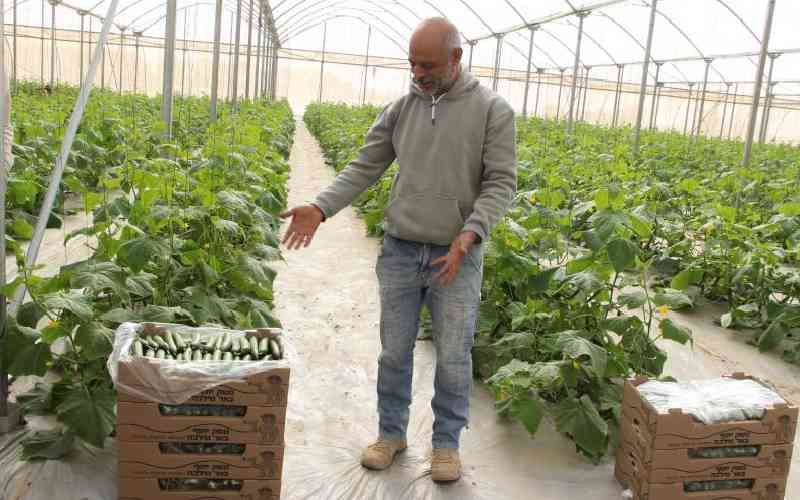
Roey Yosef in one of his greenhouses, which grow variety of organic crops in Be’er Milka, southern Negev desert in Israel. [Nanjinia Wamuswa, Standard]
After a drive of over three hours from Tel Aviv City, we arrived at Roey Yosef’s farm, which has several greenhouses.
The 10-hectare organic farm is located deep in the Be’er Milka area of the southern Negev desert, close to the Egyptian border and roughly 35 kilometres (km) south of the Gaza Strip.
A walk through various greenhouses shows Yosef has built a flourishing farm, amidst extreme temperatures, arid conditions, limited vegetation, a relentlessly intense sun, a harsh climate and sandy, nutrient-poor soil.
Follow The Standard
channel
on WhatsApp
Yosef reveals that the secret to his success is investment in modern agricultural innovations and technologies.
“Investing in cutting-edge techniques has made my desert farming not just possible, but a successful and profitable venture,” he tells Smart Harvest, which visited his farm, and part of a delegation attending the PLANTech Conference 2025 in Israel.
Yosef says that his path into agriculture was inspired by his grandparents, who were farmers. As a child, he loved working alongside them.
“I initially planned to become a veterinarian, but after studying agriculture at university, I realised that farming was my true calling,” he recalls.
He moved to the area to begin farming in 2012, after serving three years in the Israeli army.
He also lived while working there as a volunteer hiking guide for school groups. After settling at Milka, Yosef admits, choosing which crops to grow became a challenge. Many local farmers cultivated cherry tomatoes and exported them to Europe and Russia. Workers package produce at Roey Yosef’s organic farm in Be’er Milka, southern Negev desert in Israel. [Nanjinia Wamuswa, Standard]
Unfortunately, the markets collapsed beginning in 2012, forcing farmers to shift their focus to local markets. “When we arrived, we felt cherry tomatoes were too risky, so we started with fig orchards and gradually expanded into other crops,” he explains.
Today, the thriving organic farm, which has become a model of resilience, grows mainly cherry tomatoes and cucumbers. Other crops include figs, grapes, lemons, oranges, dates, garden eggs, pomelos, pomegranates, onions, pumpkins and about 200 olive trees. It employs seven farmhands
This diversification protects him against market fluctuations and seasonal challenges. Since Israel’s organic market accounts for only about one per cent of total fruit and vegetable consumption, Yosef reduces risk by growing between 10 and 20 different crops each season.
He benefits from a 10-30 per cent premium price for organic produce over conventional goods. Yosef says choosing the right season for each crop has worked well for him. Timing has been critical and one of his success ingredients.
“We plant tomatoes in June and July and harvest them until the winter; some plants continue producing until March or April. Cucumbers are grown only in winter in greenhouses. Fruit seasons are short: table grapes and figs are harvested from August to October, pomegranates in July, while lemons and oranges are harvested in winter,” he explains.
Being a desert, Yosef says water management is extremely important. He reveals, “Israel has a strong national water network. In the past, our water came from the Sea of Galilee, but today, very fresh water is supplied by four desalination plants on the Mediterranean coast.”
Desalination is an artificial process where saline water is converted into fresh water. However, this water is extremely pure, similar to rainwater, so Yosef has to add all the necessary nutrients manually to ensure proper crop growth.
“Most liquid fertilisers are applied through the irrigation system. Liquid fertilisers often come from sugar industries, made using nutrient-rich by-products,” he says.
Sprinkler systems
Yosef uses high-pressure systems and drip irrigation, an efficient method that delivers water directly to plant roots in precisely measured amounts.
He says it reduces water usage by 30 to 50 per cent, compared to traditional sprinkler systems.
“Our high-pressure water systems are controlled digitally. I control and manage it even from my phone,” Yosef says, adding that his farm uses solar panels that provide energy to produce food in an environmentally friendly way while also reducing the carbon footprint.
In the desert, he explains, growing crops in a greenhouse is essential, as it helps regulate extreme temperatures and also serves as a windbreak to protect the plants.
Although weeds are a major challenge in organic farming, Yosef has learned to manage them using mechanical weeding, soil covers and planting alfalfa between vineyard rows to both suppress weeds and fix nitrogen.
He uses natural pest control methods to protect his crops, introducing beneficial insects, such as wasps, which reduces the need for chemical pesticides. This approach is not only better for the environment but also helps produce healthier, organic food.
“The desert’s unique conditions actually give us an advantage; the intense sunlight and dry air allow us to control pests and diseases naturally, without relying on chemicals,” he shares. Yosef reveals that farmers do receive occasional government support, usually for specific initiatives.
For example, he’s received 25 per cent of the cost of the metal structure for one greenhouse when the government encouraged tomato production for a particular season.
As the climate crisis threatens global food security, desert farming offers a sustainable solution for producing food in areas where traditional farming is no longer viable.
This is how Israeli farmers, through creativity, scientific research and a relentless drive to overcome environmental challenges, have transformed barren land into one of the world’s most productive agricultural ecosystems. Kenya, where more than 80 per cent of the land is classified as arid or semi-arid and vegetation struggles to survive across vast stretches, could learn from these innovations.
By adopting similar modern agricultural practices and investing in successful farming enterprises, the country can boost productivity and sustainability.
Follow The Standard
channel
on WhatsApp
Roey Yosef in one of his greenhouses, which grow variety of organic crops in Be’er Milka, southern Negev desert in Israel.
[Nanjinia Wamuswa, Standard]
After a drive of over three hours from Tel Aviv City, we arrived at Roey Yosef’s farm, which has several greenhouses.
The 10-hectare organic farm is located deep in the Be’er Milka area of the southern Negev desert, close to the Egyptian border and roughly 35 kilometres (km) south of the Gaza Strip.
A walk through various greenhouses shows Yosef has built a flourishing farm, amidst extreme temperatures, arid conditions, limited vegetation, a relentlessly intense sun, a harsh climate and sandy, nutrient-poor soil.
Follow The Standard
channel
on WhatsApp
Yosef reveals that the secret to his success is investment in modern agricultural innovations and technologies.
“Investing in cutting-edge techniques has made my desert farming not just possible, but a
successful and profitable venture
,” he tells Smart Harvest, which visited his farm, and part of a delegation attending the PLANTech Conference 2025 in Israel.
Yosef says that his path into agriculture was inspired by his grandparents, who were farmers. As a child, he loved working alongside them.
“I initially planned to become a veterinarian, but after studying agriculture at university, I realised that farming was my true calling,” he recalls.
He moved to the area to begin farming in 2012, after serving three years in the Israeli army. Workers package produce at Roey Yosef’s organic farm in Be’er Milka, southern Negev desert in Israel. [Nanjinia Wamuswa, Standard]
He also lived while working there as a volunteer hiking guide for school groups. After settling at Milka, Yosef admits, choosing which crops to grow became a challenge. Many local farmers cultivated cherry tomatoes and exported them to Europe and Russia.
[Nanjinia Wamuswa, Standard]
Unfortunately, the markets collapsed beginning in 2012, forcing farmers to shift their focus to local markets. “When we arrived, we felt cherry tomatoes were too risky, so we started with fig orchards and gradually expanded into other crops,” he explains.
Today, the thriving organic farm, which has become a model of resilience, grows mainly cherry tomatoes and cucumbers. Other crops include figs, grapes, lemons, oranges, dates, garden eggs, pomelos, pomegranates, onions, pumpkins and about 200 olive trees. It employs seven farmhands
This diversification protects him against market fluctuations and seasonal challenges. Since Israel’s organic market accounts for only about one per cent of total fruit and vegetable consumption, Yosef reduces risk by growing between 10 and 20 different crops each season.
Stay informed. Subscribe to our newsletter
He benefits from a 10-30 per cent
premium price for organic produce
over conventional goods. Yosef says choosing the right season for each crop has worked well for him. Timing has been critical and one of his success ingredients.
“We plant tomatoes in June and July and harvest them until the winter; some plants continue producing until March or April. Cucumbers are grown only in winter in greenhouses. Fruit seasons are short: table grapes and figs are harvested from August to October, pomegranates in July, while lemons and oranges are harvested in winter,” he explains.
Being a desert, Yosef says water management is extremely important. He reveals, “Israel has a strong national water network. In the past, our water came from the Sea of Galilee, but today, very fresh water is supplied by four desalination plants on the Mediterranean coast.”
Desalination is an artificial process where saline water is converted into fresh water. However, this water is extremely pure, similar to rainwater, so Yosef has to add all the necessary nutrients manually to ensure proper crop growth.
“Most liquid fertilisers are applied through the irrigation system. Liquid fertilisers often come from sugar industries, made using nutrient-rich by-products,” he says.
Sprinkler systems
Yosef uses high-pressure systems and drip irrigation, an efficient method that delivers water directly to plant roots in precisely measured amounts.
He says it reduces water usage by 30 to 50 per cent, compared to traditional sprinkler systems.
“Our high-pressure water systems are controlled digitally. I control and manage it even from my phone,” Yosef says, adding that his farm uses solar panels that provide energy to produce food in an environmentally friendly way while also reducing the carbon footprint.
In the desert, he explains, growing crops in a greenhouse is essential, as it helps regulate extreme temperatures and also serves as a windbreak to protect the plants.
Although weeds are a major challenge in organic farming, Yosef has learned to manage them using mechanical weeding, soil covers and planting alfalfa between vineyard rows to both suppress weeds and fix nitrogen.
He uses natural pest control methods to protect his crops, introducing beneficial insects, such as wasps, which reduces the need for chemical pesticides. This approach is not only better for the environment but also helps produce healthier, organic food.
“The desert’s unique conditions actually give us an advantage; the intense sunlight and dry air allow us to control pests and diseases naturally, without relying on chemicals,” he shares. Yosef reveals that farmers do receive occasional government support, usually for specific initiatives.
For example, he’s received 25 per cent of the cost of the metal structure for one greenhouse when the government encouraged tomato production for a particular season.
As the climate crisis threatens global food security,
desert farming offers a sustainable solution
for producing food in areas where traditional farming is no longer viable.
This is how Israeli farmers, through creativity, scientific research and a relentless drive to overcome environmental challenges, have transformed barren land into one of the world’s most productive agricultural ecosystems. Kenya, where more than 80 per cent of the land is classified as arid or semi-arid and vegetation struggles to survive across vast stretches, could learn from these innovations.
By adopting similar modern agricultural practices and investing in successful farming enterprises, the country can boost productivity and sustainability.
Follow The Standard
channel
on WhatsApp
By Nanjinia Wamuswa