



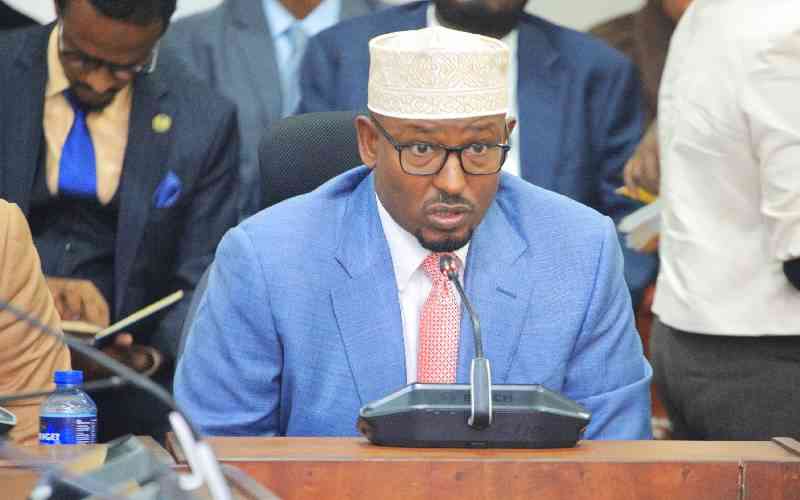
Wajir Governor Ahmed Abdullahi before the Senate CPIC Committee at Bunge Towers, Nairobi, on January 26, 2026. [Elvis Ogina, Standard]
Wajir Governor Ahmed Abdullahi told the Senate that his administration has made significant progress in settling inherited pending bills, insisting that only verifiable claims are being honoured to avoid plunging the county into further fiscal distress.
Governor Abdullahi who appeared before the Senate County Public Investment and Special Fund Committee, chaired by sessional Chairperson Nominated Senator Peris Tobiko, said his administration had already paid over Sh700 million in inherited pending bills.
The Governor was responding to queries arising from the Auditor General’s report on the Wajir Water and Sewerage Company (Wajir WASCO) for the financial year ended June 2023 with a particular focus on historical pending bills and weak financial records.
Follow The Standard
channel
on WhatsApp

“Since coming to office, we have paid over Sh700 millions of pending bills because the situation we inherited was really unprecedented, you find liabilities recorded that have no physical works on the ground and at the same time, works that exist physically but are not recorded anywhere,” said Abdullahi.
The Council of Governors Chairman maintained that the county had adopted a deliberate approach of settling only bills that can be verified physically, while balancing service delivery and current operational needs.
However, the explanation triggered sharp exchanges with Wajir Senator Abbas Sheikh, who accused the county leadership of failing to honour commitments made to clear long-standing bills dating as far back as 2013.
“We have taken a conscious decision to start with what is verifiable, from water supplied to classrooms and dispensaries that can be seen, we are currently finishing off with the old balances without adding new pending bills, in efforts to ensure that we clear them all,” said Governor Abdullahi.
The Governor argued that the Wajir Water and Sewerage Company generates limited own-source revenue, forcing the county to progressively absorb its liabilities through the executive’s budget framework rather than leaving the utility to collapse under historical debt.
Senator Abbas told the committee that unpaid contractors and suppliers had suffered severe economic and social consequences, including bankruptcy, school dropouts and even deaths linked to depression over the years due to delays in honouring debts owed to them.
The Wajir Senator rejected the governor’s assertion that many claims were fictitious, insisting that numerous unpaid projects including classrooms, water points, troughs and dispensaries, exist on the ground.
“There are people who lost their lives because of depression, others had their children drop out of school because they could not pay loans taken to supply the county, the government has a duty of continuity regardless of leadership transitions,” said Senator Abbas.
Governor Abdullahi stated that when he handed over office in 2017 after being defeated in the general election there were sufficient funds to clear liabilities at the time, but that he later inherited claims amounting to Sh9 billion without any corresponding cash balances when he took over in 2O22.
He told Senators that when he took over he did not find a shilling in the account, yet there were claims of Sh9 billion with all the audits done having never conclusively proved these figures adding that the last Auditor-General’s report before the 2022 elections recognised Sh1.3 billion in pending bills, most of which he claims to have settled.
Nominated Senator Hamida Ali Kibwana lamented that pending bills remain a systemic problem across counties which must be addressed within existing legal frameworks stating that people are dying across counties because they delivered services and have not been paid for years.
“Pending bills must be treated as a priority, not as a discretionary matter this is clearly stipulated under provisions of the Public Finance Management regulations,” said Kibwana.
Elgeyo Marakwet Senator William Kipsang also weighed in, warning against misuse of financial systems that allow counties to divert approved payments to other expenditures.
“There was a proposal to safeguard the Integrated Financial Management Information System so that once payments are approved, governors cannot substitute them, that precaution must be enforced,” said Kisang.
The Office of the Controller of Budget, appearing before the committee, confirmed that counties are required to submit annual pending bills payment plans and that approvals are only granted where funds exist in the County Revenue Fund, though compliance varies across counties
Chairperson Tobiko ultimately ruled that the committee would restrict itself to matters arising directly from the Wajir Water and Sewerage Company audit, directing the Controller of Budget to submit further clarification on pending bills linked specifically to the water utility.
“We cannot make a blanket ruling on all pending bills in Wajir without sufficient information. Our focus remains on the special funds and the water company before us which is clearly our mandate,” Senator Tobiko ruled.
The committee resolved to rely on additional written submissions from the Auditor-General and relevant offices before finalizing its report on the Wajir WASCO audit, bringing to a close a tense session marked by sharp political and fiscal fault lines.
Follow The Standard
channel
on WhatsApp
Wajir Governor Ahmed Abdullahi before the Senate CPIC Committee at Bunge Towers, Nairobi, on January 26, 2026.
[Elvis Ogina, Standard]
Wajir Governor Ahmed Abdullahi told the Senate that his administration has made significant progress in settling inherited pending bills, insisting that only verifiable claims are being honoured to avoid plunging the county into further fiscal distress.
Governor Abdullahi who appeared before the Senate County Public Investment and Special Fund Committee, chaired by sessional Chairperson Nominated Senator Peris Tobiko, said his administration had already paid over Sh700 million in inherited pending bills.
The Governor was responding to queries arising from the Auditor General’s report on the Wajir Water and Sewerage Company (Wajir WASCO) for the financial year ended June 2023 with a particular focus on historical pending bills and weak financial records.
Follow The Standard
channel
on WhatsApp
“Since coming to office, we have paid over Sh700 millions of pending bills because the situation we inherited was really unprecedented, you find liabilities recorded that have no physical works on the ground and at the same time, works that exist physically but are not recorded anywhere,” said Abdullahi.
The Council of Governors Chairman maintained that the county had adopted a deliberate approach of settling only bills that can be verified physically, while balancing service delivery and current operational needs.
However, the explanation triggered sharp exchanges with Wajir Senator Abbas Sheikh, who accused the county leadership of failing to honour commitments made to clear long-standing bills dating as far back as 2013.
“We have taken a conscious decision to start with what is verifiable, from water supplied to classrooms and dispensaries that can be seen, we are currently finishing off with the old balances without adding new pending bills, in efforts to ensure that we clear them all,” said Governor Abdullahi.
The Governor argued that the Wajir Water and Sewerage Company generates limited own-source revenue, forcing the county to progressively
absorb its liabilities
through the executive’s budget framework rather than leaving the utility to collapse under historical debt.
Senator Abbas told the committee that unpaid contractors and suppliers had suffered severe economic and social consequences, including bankruptcy, school dropouts and even deaths linked to depression over the years due to delays in honouring debts owed to them.
The Wajir Senator rejected the governor’s assertion that many claims were fictitious, insisting that numerous unpaid projects including classrooms, water points, troughs and dispensaries, exist on the ground.
“There are people who lost their lives because of depression, others had their children drop out of school because they could not pay loans taken to supply the county, the government has a duty of continuity regardless of leadership transitions,” said Senator Abbas.
Governor Abdullahi stated that when he handed over office in 2017 after being defeated in the general election there were sufficient funds to clear liabilities at the time, but that he later inherited claims amounting to Sh9 billion without any corresponding cash balances when he took over in 2O22.
He told Senators that when he took over he did not find a shilling in the account, yet there were claims of Sh9 billion with all the audits done having never conclusively proved these figures adding that the last Auditor-General’s report before the 2022 elections recognised Sh1.3 billion in pending bills, most of which he claims to have settled.
Stay informed. Subscribe to our newsletter
Nominated Senator Hamida Ali Kibwana lamented that pending bills remain a systemic problem across counties which must be addressed within existing legal frameworks stating that people are dying across counties because they delivered services and have not been paid for years.
“Pending bills must be treated as a priority, not as a discretionary matter this is clearly stipulated under provisions of the Public Finance Management regulations,” said Kibwana.
Elgeyo Marakwet Senator William Kipsang also weighed in, warning against misuse of financial systems that allow counties to divert approved payments to other expenditures.
“There was a proposal to safeguard the Integrated Financial Management Information System so that once payments are approved, governors cannot substitute them, that precaution must be enforced,” said Kisang.
The Office of the Controller of Budget, appearing before the committee, confirmed that counties are required to submit annual
pending bills payment plans
and that approvals are only granted where funds exist in the County Revenue Fund, though compliance varies across counties
Chairperson Tobiko ultimately ruled that the committee would restrict itself to matters arising directly from the Wajir Water and Sewerage Company audit, directing the Controller of Budget to submit further clarification on pending bills linked specifically to the water utility.
“We cannot make a blanket ruling on all pending bills in Wajir without sufficient information. Our focus remains on the special funds and the water company before us which is clearly our mandate,” Senator Tobiko ruled.
The committee resolved to rely on additional written submissions from the Auditor-General and relevant offices before finalizing its report on the Wajir WASCO audit, bringing to a close a tense session marked by sharp political and fiscal fault lines.
Follow The Standard
channel
on WhatsApp
By Edwin Nyarangi