



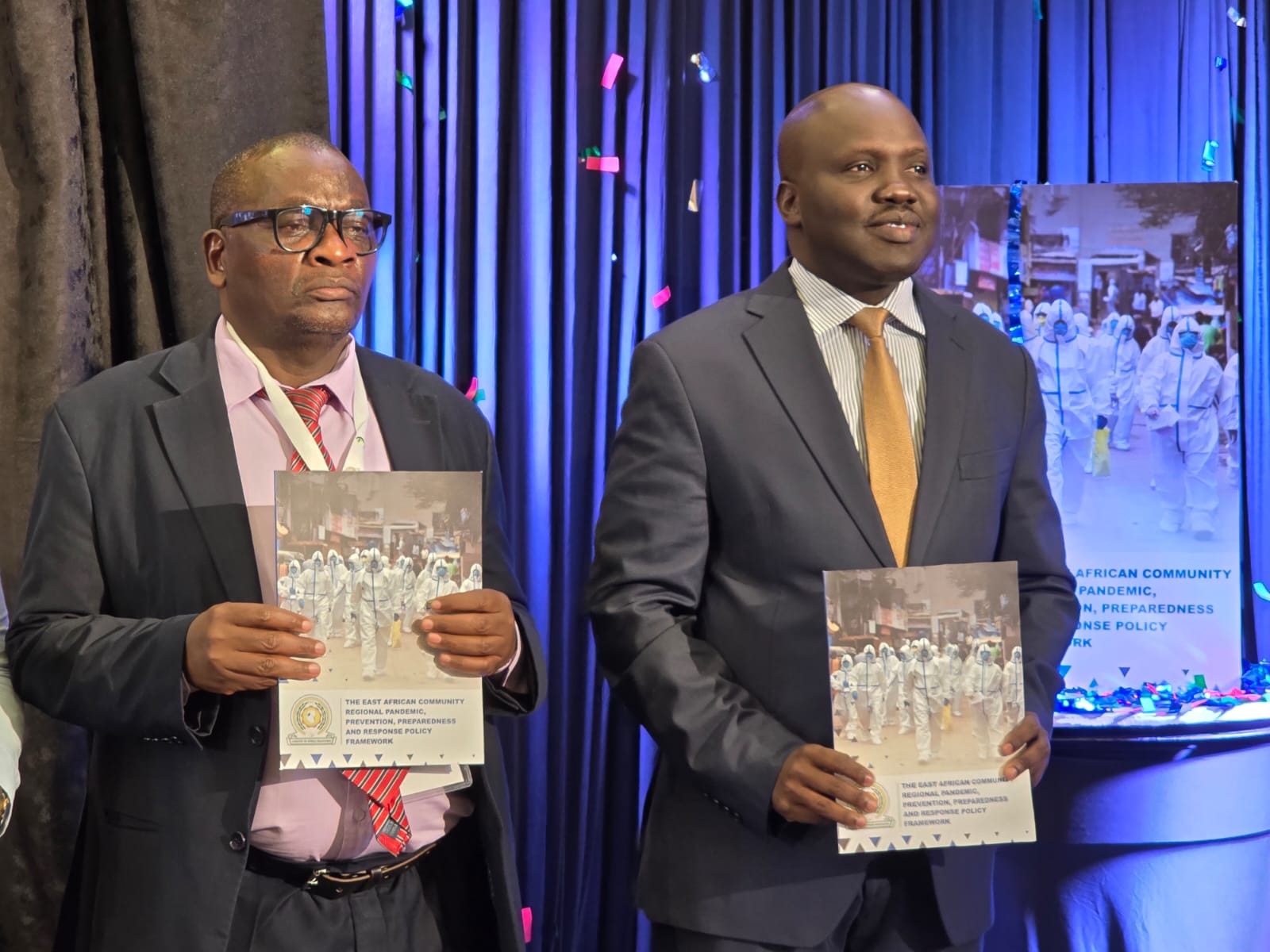
The East African Community has rolled out a regional policy framework aimed at strengthening pandemic preparedness and response across partner states, citing lessons drawn from COVID-19, Ebola, cholera and other recurring health emergencies.
The ‘East African Community Regional Pandemic Prevention, Preparedness and Response Policy Framework’ was launched on Wednesday by the EAC Secretariat in collaboration with the African Population and HealthResearch Center (APHRC).
The framework seeks to build a regional disease surveillance network based on one health aspects, expand vaccination programmes and ensure coordinated response to health challenges across the region.
This is based on the fact that East Africa has faced significant health and economic challenges from pandemics, with Covid-19 being the most recent and impactful.
The framework was approved by the Council of Ministers of Health and is intended to guide how the region prepares for, responds to and recovers from future pandemics.
The policy also seeks to enhance regional research, innovation and local manufacturing, build resilient and equitable health systems, improve community engagement and risk communication, as well as improve coordination, financing and governance of health systems across the bloc.
Speaking during the rollout in Nairobi on Wednesday, EAC Deputy Secretary General in charge of infrastructure, productive, social and political sectors Andrea Ariik said the policy was developed after the region experienced repeated health shocks that exposed weaknesses in preparedness.
“We as a community stand together in solidarity on issues of health, education, even matters of security, because bcause we are one family and anything which affects any of our partner states becomes a concern of the whole community,” Ariik said.
The framework was developed through consultations with partner states and later validated before being presented to the Health Sector Council for approval.
According to Ariik, the immediate goal of the rollout is to create public awareness and ownership of the policy.
“What we have today, one, is to create visibility of this policy so that our people are able to embrace and take the ownership because the policy belongs to them,” he said. “It is to improve their livelihood.”
He acknowledged that health challenges in one partner state can quickly become a regional concern due to porous borders and frequent movement of people.
“We as a community stand together in so many things, stand together in solidarity on issues of health, issues of education, even matters of security, because we are one family. Diseases do not have boundaries,” Ariik said.
He explained that an outbreak in one country can easily spread across the region.
“If it happens today in Congo, there’s nothing that will stop it from going all the way up to Tanzania. If it happens in Tanzania, it can cross all the way to South Sudan, and the same case in Somalia, to Rwanda, Burundi, and so on,” he said.
The policy focuses on strengthening governance systems and health systems while pushing for increased financing for the health sector, which Rigg said remains underfunded across the region.
“We have realised that we have a serious financial gap in the health sector as a community, and this policy will advocate for more financing in the health sector.”
The framework also calls for seamless coordination among partner states and the pooling of experts to enable faster and more effective response when emergencies arise.
“So that once we have a problem, then we respond as a community, because we already have a team of experts prepared to fight for any pandemic disease,” he said.
The policy also supports regional efforts to manufacture vaccines and other medical products.
Ariik said a regional centre in Kigali is being used to advance vaccine manufacturing and broader pharmaceutical collaboration.
“We have a centre in Kigali, and we work together as a community to advance on how to manufacture vaccines,” he said, adding that the community is also exploring ways to promote and improve local medicines.
“Our people before modernity used to treat diseases, and we have all those local medicines that only need to be improved, add value, and we use them,” he said.
Ariik said negotiating as a bloc gives the region leverage when dealing with global manufacturers.
“If you go outside there and meet the companies that manufacture vaccines, it is either you work with the community of 350 million, or you lose that market,” he said.
He outlined several challenges that have previously hindered effective response to pandemics, including shortages of health personnel, equipment and infrastructure.
He said lack of equipment, poor infrastructure in border areas and insecurity have also slowed emergency responses.
“You get to a border where you cannot penetrate. You don’t have the mobility to get there simply because there are no good roads.”
On financing, Ariik said partner states do not have dedicated pandemic preparedness funds.
Ariik said the new policy is expected to address these gaps and ensure the region is better prepared for future health emergencies through collective action and solidarity.
In his remarks, APHRC’s Deputy Executive Director, Dr Joseph Gichuru, commended the
partnership between APHRC and the EAC that led to the development and adoption of the
Framework.
“The adoption of the Pandemic Prevention, Preparedness, and Response (PPPR)
Policy Framework in May 2025 stands as a powerful endorsement of what we can achieve when
we choose unity over isolation.”
Productive, Social, and Political sectors, Hon. Andrea Aguer Ariik Malueth, addressing delegates during launch on January 21, 2026/HANDOUT
Delivering a keynote address, Acting Director General of the National Public
Health Institute of Kenya Dr Kamene Kimenye highlighted the region’s vulnerability to both endemic and emerging
diseases, noting that health threats in one Partner State quickly become regional concerns in a
shared economic and social space of more than 300 million people.
“The COVID-19 pandemic exposed critical gaps in surveillance, diagnostics, supply chains, and
vaccine access,” she said.
“This Policy Framework offers a comprehensive blueprint to strengthen
resilience through cross-border coordination, digital innovation, sustainable financing, and
meaningful community engagement.”
The launch marks a significant milestone in the East African Community’s efforts to build a
coordinated, interoperable, and resilient health system capable of preventing, detecting, and
responding to future pandemics.
As the region moves toward implementation, the EAC called on
governments, development partners, research institutions, civil society, the private sector, and
the media to join in translating the Framework into concrete action that safeguards lives,
livelihoods, and regional development.