

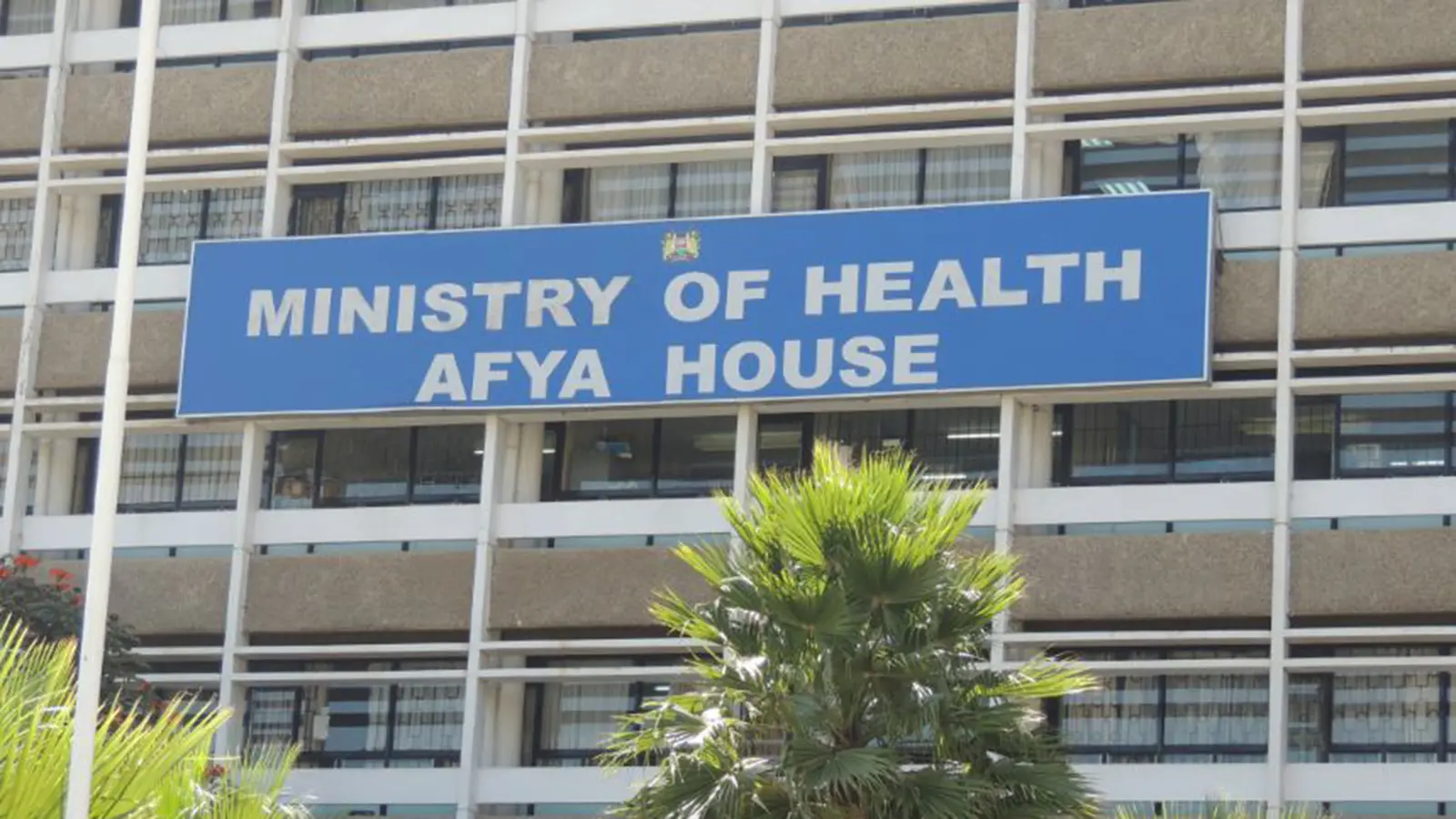
Ministry of Health headquarters at Afya House/FILE
The Ministry of Health has directed the Kenya National
Public Health Institute (KNPHI) to strip its Deputy Director for Laboratory
Services, Leonard Kingwara, of his roles.
In a letter dated January 19, 2026, MoH explained that Kingwara
is not registered with the Kenya Medical Laboratory Technicians and
Technologists Board (KMLTTB).
The letter instructed acting KNPHI Director to
immediately bar Kingwara from undertaking any functions related to laboratory
services.
The letter was also copied to Health Cabinet Secretary Aden
Duale.
According to the ministry, Kingwara is not authorised to practice
within KNPHI’s laboratory services unit because he lacks the mandatory
registration and licensing required under the law.
“Mr Leonard Kingwara is not registered or licensed with the
Kenya Medical Laboratory Technicians and Technologists Board within the meaning
of sections 2, 19, and 20 of Cap 253A,” the letter stated.
The ministry warned that the engagement of unlicensed individuals
in activities that constitute medical laboratory practice exposes institutions
and the public to serious regulatory, clinical, and medico-legal risks.
“Leonard Kingwara shall not engage, directly or indirectly,
in any activity constituting medical laboratory practice, including laboratory
supervision, coordination, validation, forensic analysis, diagnostic testing or
professional representation,” the letter reads..
The directive has raised questions within the health sector,
with concerns emerging over why some officials have been allowed to serve in
similar positions for extended periods without being registered with the statutory
professional body.
Critics argue that inconsistent enforcement of licensing
requirements could undermine confidence in public health institutions.
Kingwara is a long-serving public officer with 16 years of
cumulative experience in public service, including a decade at the Ministry of
Health.
He holds a Master’s degree and a PhD in Molecular Science,
credentials that supporters say reflect strong academic and technical training,
even as regulators insist that professional licensing remains a legal requirement.
Contacted, Kingwara confirmed he has received instructions
to stay away from the role.
“I received all communication via social media,” he told the
Star.
The controversy comes at a delicate moment for KNPHI, a
newly established institution expected to play a central role in safeguarding
the country against public health threats.
The institute is also set to receive substantial funding
from the Ministry of Health’s development partners to support various health
programmes across the country.
Some of the ministry’s key partners include the Global Fund,
the World Bank, the United States State Department, and the African Medical and
Research Foundation (AMREF), all of whom support critical health initiatives
ranging from disease surveillance to health system strengthening.
KNPHI was officially launched on May 8, 2025, during a
colourful ceremony held at the Kenyatta International Conference Centre (KICC)
that brought together local and regional stakeholders in the health sector.
Speaking during the launch, Health Cabinet Secretary Aden
Duale said the establishment of KNPHI marked a major milestone in Kenya’s
pursuit of Universal Health Coverage (UHC) and the strengthening of national
and regional health security.
KNPHI is designed to serve as the country’s central platform
for disease surveillance, public health research, policy coordination, and
rapid emergency response.