



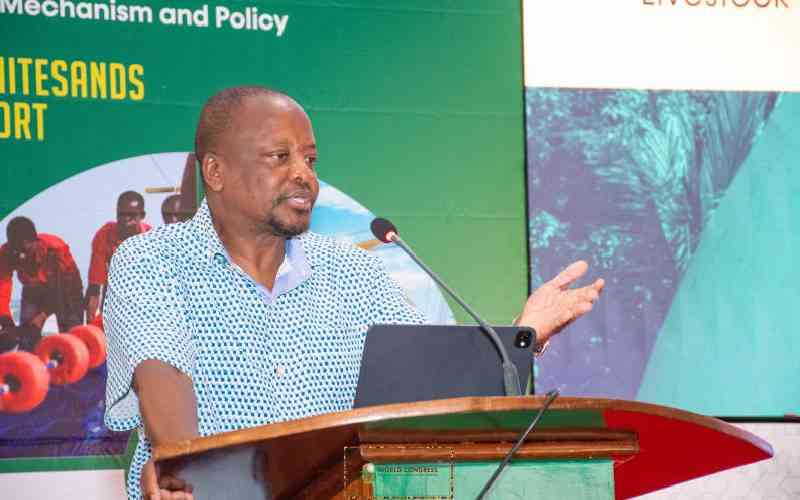
Agriculture Cabinet Secretary Mutahi Kagwe has warned development partners against imposing generic agricultural projects on Kenya.
A tough-talking Kagwe declared that the country will reject initiatives that are not locally designed and aligned with its specific needs.
The CS emphasised that Kenya’s agricultural priorities must be structured internally and funded based on local realities, not external templates.

Follow The Standard
channel
on WhatsApp
He spoke on Tuesday during a national and county governments’ consultative meeting with the World Bank in Mombasa.
“Do not tell us you are funding us because you are funding 20 other countries. We are not the same. Our needs are different. We want to be initiators. We want to be co-designers. We will reject projects that we have not tailored,” Kagwe said.
The meeting was attended by Agriculture Principal Secretary Kipronoh Ronoh, Agriculture Committee Chairman at the Council of Governors (CoG) and Bungoma Governor Ken Lusaka, CoG Arid and Semi-Arid Lands (Asal) Chairman and Garissa Governor Nathif Jamah, more than 40 County Executive Committee members, the CoG chief executive officer, and representatives from the National Treasury and the World Bank country team.
Kagwe urged governors to properly structure county agricultural programmes and link them directly to the Kenya Agricultural Digital Information Centre and the Kenya Integrated Agriculture Management Information System (KIAMIS).
“Leverage convergence. Avoid duplication. Plug into national systems,” he said.
The CS emphasised that counties must align their agricultural investments with national digital platforms to improve coordination, transparency, and measurable impact.
Currently, 7.2 million farmers have been registered under KIAMIS, with 5.5 million receiving digital advisory services, including agronomy, weather, and market updates via mobile phones.
The consultative meeting reviewed the progress of two major World Bank-funded programmes—the National Agricultural Value Chain Development Project and the Food Systems Resilience Project—which together amount to Sh49.5 billion.
Kagwe reminded stakeholders that the funds are loans that must be repaid, calling for strict fiduciary discipline and value for money.
“These are not ordinary projects. Their success or failure has consequences for food security and national stability,” he warned.
The CS also raised concern over Kenya’s annual Sh500 billion food import bill, terming it unsustainable and a threat to food sovereignty.
Through public-private partnership lease models and the Land Commercialisation Initiative, the government is targeting large-scale production of palm oil, maize, rice, wheat, sorghum, and other high-value crops to reduce imports and strengthen self-sufficiency.
Kagwe noted that more than 700,000 animals have been vaccinated under the ongoing nationwide campaign, which is being integrated with traceability systems to unlock export markets.
The CS also said the government was prioritising feedlots, rangeland management, livestock markets, and breeding improvements, particularly in Asal counties.
The consultative meeting marked a shift in tone from traditional donor-recipient dynamics toward co-creation and strategic ownership.
Governors were urged to move from being implementers of externally structured programmes to architects of their own agricultural transformation strategies to ensure success.
Participants renewed their commitment to strengthening intergovernmental collaboration under the CoG and the Joint Agricultural Sector Consultation and Coordination Mechanism framework, while enhancing structured engagement with development partners.
Follow The Standard
channel
on WhatsApp
Agriculture Cabinet Secretary Mutahi Kagwe has warned development partners against imposing generic agricultural projects on Kenya.
A tough-talking Kagwe declared that the country will reject initiatives that are not locally designed and aligned with its specific needs.
The CS emphasised that Kenya’s agricultural priorities must be structured internally and funded based on local realities, not external templates.
Follow The Standard
channel
on WhatsApp
He spoke on Tuesday during a national and county governments’ consultative meeting with the World Bank in Mombasa.
“Do not tell us you are funding us because you are funding 20 other countries. We are not the same. Our needs are different. We want to be initiators. We want to be co-designers. We will reject projects that we have not tailored,” Kagwe said.
The meeting was attended by Agriculture Principal Secretary Kipronoh Ronoh, Agriculture Committee Chairman at the Council of Governors (CoG) and Bungoma Governor Ken Lusaka, CoG Arid and Semi-Arid Lands (Asal) Chairman and Garissa Governor Nathif Jamah, more than 40 County Executive Committee members, the CoG chief executive officer, and representatives from the National Treasury and the World Bank country team.
Kagwe urged governors to properly structure
county agricultural programmes
and link them directly to the Kenya Agricultural Digital Information Centre and the Kenya Integrated Agriculture Management Information System (KIAMIS).
“Leverage convergence. Avoid duplication. Plug into national systems,” he said.
The CS emphasised that counties must align their agricultural investments with national digital platforms to improve coordination, transparency, and measurable impact.
Currently, 7.2 million farmers have been registered under KIAMIS, with 5.5 million receiving digital advisory services, including agronomy, weather, and market updates via mobile phones.
The consultative meeting reviewed the progress of two major World Bank-funded programmes—the National Agricultural Value Chain Development Project and the Food Systems Resilience Project—which together amount to Sh49.5 billion.
Kagwe reminded stakeholders that the funds are loans that must be repaid, calling for strict fiduciary discipline and value for money.
“These are not ordinary projects. Their success or failure has consequences for food security and national stability,” he warned.
The CS also raised concern over Kenya’s annual Sh500 billion food import bill, terming it unsustainable and a threat to food sovereignty.
Stay informed. Subscribe to our newsletter
Through public-private partnership lease models and the Land Commercialisation Initiative, the government is targeting
large-scale production of palm oil,
maize, rice, wheat, sorghum, and other high-value crops to reduce imports and strengthen self-sufficiency.
Kagwe noted that more than 700,000 animals have been vaccinated under the ongoing nationwide campaign, which is being integrated with traceability systems to unlock export markets.
The CS also said the government was prioritising feedlots, rangeland management, livestock markets, and breeding improvements, particularly in Asal counties.
The consultative meeting marked a shift in tone from traditional donor-recipient dynamics toward co-creation and strategic ownership.
Governors were urged to move from being implementers of externally structured programmes to architects of their own agricultural transformation strategies to ensure success.
Participants renewed their commitment to strengthening intergovernmental collaboration under the CoG and the Joint Agricultural Sector Consultation and Coordination Mechanism framework, while enhancing structured engagement with development partners.
Follow The Standard
channel
on WhatsApp
By Patrick Beja