

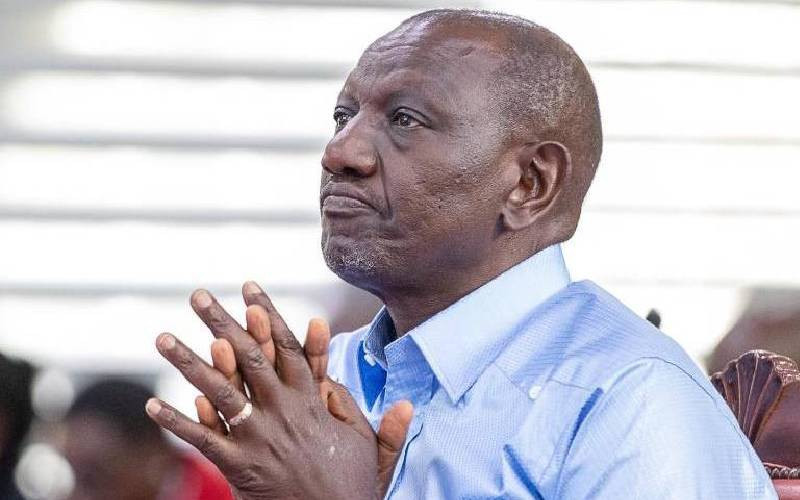
I sat quietly under the mango tree, watching him do some stretches. We had taken a break from our intense book interview after hours of documenting his life in his forthcoming autobiography, Beyond Belief.
He smiled, his eyes shifting to his old compound. He stared at the Elgon Teak tree planted by President Uhuru Kenyatta in 2013, when he visited his home to celebrate his election as Governor.
With a smile, he said, “My brother Caleb, I’m not boasting, but I believe I’m the only leader in Kenya to have hosted four Heads of State in my house. I hosted Daniel Arap Moi while serving as District Officer in the Rift Valley. I hosted Mwai Kibaki when I was District Commissioner in Murang’a, and then I hosted Uhuru soon after being elected the first Governor of Bungoma. On August 28, 2022, as the President-elect, William Ruto graced my home. Raila Odinga and I used to watch football in my Nairobi home,” said Kenneth Makelo Lusaka.
I slowly peeled back the life of Lusaka, a man in whom President Ruto saw the skill and prowess to be his 2027 Presidential Campaign Coordinator in Western Kenya.
Follow The Standard
channel
on WhatsApp
But why has Ruto had a persistent and intense interest in the Mulembe Nation? Since his election in 2022, Ruto has made countless visits to Western Kenya.
Ruto’s determination reminded me of conversations I once had with the eloquent Peoples Watchman, Martin Shikuku, and Mama Phoebe Asiyo. The two politicians shared an interesting conspiracy theory revolving around the tyranny of numbers that the Luhya possessed.
After the 2009 population census, Shikuku and I sat in my house for a book interview. Our talk strayed into the presidency and Luhya unity. “Do you know the Luhya overtook the Kikuyu in population a long time ago? But since Luhya have never tasted the presidency, we lack the requisite hunger. The day we shall unite, the political game will change dramatically,” he told me.
Mama Asiyo would later share similar sentiments. After the 2007 post-election violence, she hosted Kikuyu and Luo elders at her home in Karachuoyo. She said that the 2007 presidential election was stolen based on the illusion of tyranny of numbers. “The ruling class and the powerful manipulate the census. Why do you think Raila invests energy in the Luhya? He knows they are the majority. If they can put their act together, register as voters, and turn out to vote, they will change Kenya’s political equation.” It took time for her words to sink in.
Mama Asiyo unleashed another shocker: “The visits of elders from Central to Western Kenya and Luo Nyanza are carefully crafted. I have Intel from NIS that many girls from central are seeking marriages in Western to help grow their population“
Is Ruto reading from the Shikuku and Asiyo scripts? He appointed a seasoned administrator as his campaign coordinator and a younger but aggressive politician, Ayub Savula, to woo the Western vote. However, Ruto’s big challenge is to ensure youth in western Kenya register in large numbers, agree to vote for him, and actually turn out to vote.
“Why” some ask, “would Ruto pick Lusaka and sidestep two senior politicians, Musalia Mudavadi and Moses Wetangu’la?” Musalia was quick to congratulate Lusaka on the appointment. Musalia is tied down by travel and boardroom assignments. He is unable to indulge in the rough and tumble of field politics.
Wetangu’la, on the other hand, is a man under siege. The Speaker of the National Assembly is yet to recover from the humiliation he suffered when a Ford K MCA candidate in his ward lost to an Independent candidate. Then his younger brother, Tim Wanyonyi, who is eyeing the Bungoma Governor’s seat, vowed he would never run on a Ford Kenya ticket.
Lusaka has unique characteristics that make the coordination his cup of tea. He speaks and communicates fluently in numerous Luhya dialects. He avoids aggression and confrontations. He thoroughly understands government operations and how to communicate with wananchi on the ground, and he has great mobilisation skills.
But who is this man, Lusaka? After studying political science at the University of Nairobi, Lusaka joined the provincial administration as District Officer (DO). Serving under Moi was a tense tour of duty with critical political lessons at every turn.
He served as DO in various parts of Kenya before becoming District Commissioner in Marigat and Kajiado districts. When Mwai Kibaki took over as President, Lusaka was appointed DC Muranga at the height of the Mungiki menace. Then he was promoted to Permanent Secretary, Livestock, before becoming Governor of Bungoma in 2013.
Apart from his loyalty and friendship with Ruto, the President must have considered his deep understanding of politics and government operations essential in winning the hearts and minds of the Mulembe people.
Wetangu’la, who in 1978 taught Lusaka English at Kibabii High School, and Musalia, the former Vice President and Finance minister, might be more politically experienced, but they are comparatively dim in matters of administration and government.
“Wherever I worked, I made it my duty to unite leaders and ensure peace reigned. I had witnessed enough destructive politics and knew the importance of peace,” he told me as we sipped tea.
While in Kajiado, Lusaka had to deal with deep animosities between two powerful Maasai leaders: former Vice President Professor George Saitoti and army General Joseph Ole Nkaissery. Lusaka had to help bring peace among warring parties. “Saitoti and Nkaissery had become formidable political enemies, but I knew that their people would only know economic growth if their leaders worked together,” he says in his book.
Saitoti and the retired army general needed a working formula. Nkaissery was in Kanu, a party that had become opposition after losing its nearly 40-year grip on power in 2002. Lusaka organized a meeting of the two leaders at Saitoti’s Jogoo House office.
“We waited for hours. At one point, the professor asked me,” Are you sure this man is coming “Yes, I’m sure’ I kept telling him as I made frantic calls to Nkaissery”
Each time I called the general to ask him how far he was, he would retort:” Mimi ni Maasai nakuja pole pole kwa miguu.” I was becoming desperate and was almost giving up when he eventually arrived. A great sigh of relief settled upon the tense atmosphere that had engulfed Saitoti’s office,” recalls Lusaka
Lusaka tried his best at diplomacy. Nkaissery’s biggest complaint was that Saitoti did not respect other Maasai leaders and supported his rival. Saitoti promised to respect all Maasai leaders but told Nkaissery that he could not abandon his friend. The two shook hands amid shouts of joy, song and ululation. “I was delighted that I had brokered peace between them,” says Lusaka
As a provincial administrator, Lusaka made many great friends; among them President Ruto, Saitoti and former Interior Cabinet minister John Michuki. He stood by them and they stood by him. The friendship ran deep.
He recalls one Saturday afternoon, on April 19, 2008, when he sat in Michuki’s office to discuss administrative matters. Michuki told him that President Kibaki would be presiding over an important function in Muranga the following day. Lusaka had to ensure the event ran smoothly and successfully.
”As God in his humour would have it, during the tour, the president was pressed and needed to answer the call of nature at the District Commissioners’ house. I found myself with Kibaki, his wife Mama Lucy and Michuki in my living room. During this brief moment, Michuki turned to Kibaki and said, “Your Excellency, if we had more DCs like Mr. Lusaka here, even if they were only five in the whole country, we would be very far as a nation.”
On Monday, April 21 2008, a day after the President had eased his way through Lusaka’s home, Lusaka was appointed Secretary, Provincial Administration. “I was in pleasant shock. With a stroke of a pen, recommendations from Michuki had elevated me to a major slot in government. It was a brief bathroom encounter loaded with lessons on the workings of political power,” says the Bungoma Governor.
He had suddenly become boss to those in Harambee House who used to treat him contemptuously and even ignore his calls.
Later that day, Michuki gave him a broad smile, shook his hand and said: “Kijana, now you are the boss.” In 2009, Lusaka became Permanent Secretary (PS) in the Ministry of Livestock Development.
When he joined politics in 2013, he ran on the New Ford Kenya ticket.
“We campaigned around trust, consistency and integrity. When I became Governor, I made a strategic move of appointing ‘rivals’ into my cabinet. I was determined during my term, 2013 to 2017, to bring unity in Bungoma. Immediately I won, I called Wetangu’la, Eseli Simiyu and Wafula Wamunyinyi to a meeting in Eldoret. I asked Wetangu’la to give me five names out of the cabinet of ten to join my government.”
Wetangu’la, who had been elected Senator, was accused of election malpractice and his election was nullified by the High Court in Bungoma on September 30, 2013. However, in a by-election held on December 19, 2013, he beat his closest rival, Musikari Kombo, to recapture the Senatorial seat.
“During the vote tallying in Webuye, it emerged that Wetangu’la was leading. There was pressure to reject the results. I told the leaders, “Let us give Wetangu’la his victory. Denying him victory will cause bloodshed. I don’t want blood on my hands,” says Lusaka.
Lusaka received numerous calls demanding Kombo’s victory. “Let Kombo get it and bloodshed be damed,” he was told.
Lusaka told his campaign team: “If we allow rigging to happen, we shall be left with blood on our hands?” Wetangu’la was declared Bungoma Senator.
In 2017, Lusaka joined the Jubilee coalition led by President Uhuru Kenyatta and his deputy William Ruto. He became the first leader to dissolve his political party. He told the New Ford Kenya top organ meeting in Nairobi: “We have already removed our clothes and taken the dive, so we must land on water. How we land is irrelevant. We cannot undo what we have already done.”
William Ruto, then Deputy President, sat him down and told him: “You are in this small village party of yours, where are you headed?” Lusaka took his resolve to his supporters, telling them: “Let’s close this kiosk and build a supermarket. A fly must die. But a wise fly dies in milk while a foolish one dies in the toilet. I would rather we died in milk. Uhuru and Ruto have the milk.”
For sleeping with Jubilee in a Ford Kenya stronghold, he paid a heavy price. He lost the gubernatorial race in 2017 and was suddenly abandoned.
Lusaka argues that in 2017, he suffered the curse of incumbency:” There was a clear disconnect between my team and the public. The chaos in my camp was so rampant that at some point we had people threatening each other with guns and legal battles. I was a strong candidate with a weak, chaotic and disjointed team.”
After the loss, Ruto asked him to travel to Nairobi. Lusaka travelled to the Bomas of Kenya, where there was live coverage. Linus Kaikai, then of NTV, invited him to join the television panelists
“Later, Uhuru walked to where I was. He hugged me and said: “Wewe umesimama na sisi. Sitakuacha. Ulifanya kazi nzuri na nitakufa na wewe.” Ruto had intimated to me that he wanted to propose me as the Speaker for the National Assembly.” Just like that, Lusaka became Speaker of the Senate.
As Speaker, Lusaka found himself torn between two friends. Supremacy battles over the passage of bills and committees threw him into murky waters. “I found myself standing between President Uhuru Kenyatta and his Deputy William Ruto, both my good friends. The Speaker, however, is supposed to make impartial decisions.” Then, in 2022, Lusaka came under intense pressure to join Uhuru Kenyatta’s Azimio la Umoja Coalition that fronted Raila Odinga to run against Ruto for the Presidency. On Thursday, March 10 2022, while on the Kisumu-Kakamega highway, he instructed his driver to pull over to enable him talk to the President
“Bwana Lusaka, at last you have been found. I have been looking for you for days. Now, I still want you to run on the Azimio ticket. You will become Speaker of the National Assembly, “said Uhuru
“I listened keenly as Uhuru Kenyatta spoke about our friendship and the battles we had fought together. Then there was a long, thick silence as he waited for my response, “says Lusaka
“With a shaky voice, I told him why I had to walk away from him. “Your Excellency, I am sorry I have to let you down. The tide in Bungoma is extremely powerful. If I attempt to swim against it, I will drown. You have done a lot for me, and I will forever be grateful. But please, Sir, allow me to walk away this time. You have done your two terms, and you are now retiring. Please don’t go home with me,” he told the President. On Friday, March 11 2022, he officially joined Ford Kenya.
Wetangu’la had moved ahead to tell the people that Lusaka would seek the Governor’s seat on a Ford Kenya ticket. “He lit the campaign fires for me. Wetangula would tell rallies: “Lusaka is our candidate; therefore, we stand by him.” With the support of his former teacher, the ground reverberated with goodwill towards him.
Lusaka became the presidential campaign coordinator for the Kenya Kwanza Coalition in Bungoma: “Our campaign strategy took the form of organizing rallies not in public places but in homes of popular and influential people. Rallies would start as early as 6 a.m. at someone’s home.”
The friendship between Ruto and Lusaka runs deep. The fact that Lusaka delivered Bungoma to Kenya Kwanza in 2022 further cements their relationship.
Follow The Standard
channel
on WhatsApp
I sat quietly under the mango tree, watching him do some stretches. We had taken a break from our intense book interview after hours of documenting his life in his forthcoming autobiography, Beyond Belief.
He smiled, his eyes shifting to his old compound. He stared at the Elgon Teak tree planted by President Uhuru Kenyatta in 2013, when he visited his home to celebrate his election as Governor.
With a smile, he said, “My brother Caleb, I’m not boasting, but I believe I’m the only leader in Kenya to have hosted four Heads of State in my house. I hosted Daniel Arap Moi while serving as District Officer in the Rift Valley. I hosted Mwai Kibaki when I was District Commissioner in Murang’a, and then I hosted Uhuru soon after being elected the first Governor of Bungoma. On August 28, 2022, as the President-elect, William Ruto graced my home. Raila Odinga and I used to watch football in my Nairobi home,” said Kenneth Makelo Lusaka.
I slowly peeled back the life of Lusaka, a man in whom President Ruto saw the skill and prowess to be his 2027 Presidential Campaign Coordinator in Western Kenya.
Follow The Standard
channel
on WhatsApp
But why has Ruto had a persistent and intense interest in the Mulembe Nation? Since his election in 2022, Ruto has made countless visits to Western Kenya.
Ruto’s determination reminded me of conversations I once had with the eloquent Peoples Watchman, Martin Shikuku, and Mama Phoebe Asiyo. The two politicians shared an interesting conspiracy theory revolving around the tyranny of numbers that the Luhya possessed.
After the 2009 population census, Shikuku and I sat in my house for a book interview. Our talk strayed into the presidency and Luhya unity. “Do you know the Luhya overtook the Kikuyu in population a long time ago? But since Luhya have never tasted the presidency, we lack the requisite hunger. The day we shall unite, the political game will change dramatically,” he told me.
Mama Asiyo would later share similar sentiments. After the 2007 post-election violence, she hosted Kikuyu and Luo elders at her home in Karachuoyo. She said that the 2007 presidential election was stolen based on the illusion of tyranny of numbers. “The ruling class and the powerful manipulate the census. Why do you think Raila invests energy in the Luhya? He knows they are the majority. If they can put their act together, register as voters, and turn out to vote, they will change Kenya’s political equation.” It took time for her words to sink in.
Mama Asiyo unleashed another shocker: “The visits of elders from Central to Western Kenya and Luo Nyanza are carefully crafted. I have Intel from NIS that many girls from central are seeking marriages in Western to help grow their population“
Is Ruto reading from the Shikuku and Asiyo scripts? He appointed a seasoned administrator as his campaign coordinator and a younger but aggressive politician, Ayub Savula, to woo the Western vote. However, Ruto’s big challenge is to ensure youth in western Kenya register in large numbers, agree to vote for him, and actually turn out to vote.
“Why” some ask, “would Ruto pick Lusaka and sidestep two senior politicians, Musalia Mudavadi and Moses Wetangu’la?” Musalia was quick to congratulate Lusaka on the appointment. Musalia is tied down by travel and boardroom assignments. He is unable to indulge in the rough and tumble of field politics.
Wetangu’la, on the other hand, is a man under siege. The Speaker of the National Assembly is yet to recover from the humiliation he suffered when a Ford K MCA candidate in his ward lost to an Independent candidate. Then his younger brother, Tim Wanyonyi, who is eyeing the Bungoma Governor’s seat, vowed he would never run on a Ford Kenya ticket.
Lusaka has unique characteristics that make the coordination his cup of tea. He speaks and communicates fluently in numerous Luhya dialects. He avoids aggression and confrontations. He thoroughly understands government operations and how to communicate with wananchi on the ground, and he has great mobilisation skills.
But who is this man, Lusaka? After studying political science at the University of Nairobi, Lusaka joined the provincial administration as District Officer (DO). Serving under Moi was a tense tour of duty with critical political lessons at every turn.
He served as DO in various parts of Kenya before becoming District Commissioner in Marigat and Kajiado districts. When Mwai Kibaki took over as President, Lusaka was appointed DC Muranga at the height of the Mungiki menace. Then he was promoted to Permanent Secretary, Livestock, before becoming Governor of Bungoma in 2013.
Stay informed. Subscribe to our newsletter
Apart from his loyalty and friendship with Ruto, the President must have considered his deep understanding of politics and government operations essential in winning the hearts and minds of the Mulembe people.
Wetangu’la, who in 1978 taught Lusaka English at Kibabii High School, and Musalia, the former Vice President and Finance minister, might be more politically experienced, but they are comparatively dim in matters of administration and government.
“Wherever I worked, I made it my duty to unite leaders and ensure peace reigned. I had witnessed enough destructive politics and knew the importance of peace,” he told me as we sipped tea.
While in Kajiado, Lusaka had to deal with deep animosities between two powerful Maasai leaders: former Vice President Professor George Saitoti and army General Joseph Ole Nkaissery. Lusaka had to help bring peace among warring parties. “Saitoti and Nkaissery had become formidable political enemies, but I knew that their people would only know economic growth if their leaders worked together,” he says in his book.
Saitoti and the retired army general needed a working formula. Nkaissery was in Kanu, a party that had become opposition after losing its nearly 40-year grip on power in 2002. Lusaka organized a meeting of the two leaders at Saitoti’s Jogoo House office.
“We waited for hours. At one point, the professor asked me,” Are you sure this man is coming “Yes, I’m sure’ I kept telling him as I made frantic calls to Nkaissery”
Each time I called the general to ask him how far he was, he would retort:” Mimi ni Maasai nakuja pole pole kwa miguu.” I was becoming desperate and was almost giving up when he eventually arrived. A great sigh of relief settled upon the tense atmosphere that had engulfed Saitoti’s office,” recalls Lusaka
Lusaka tried his best at diplomacy. Nkaissery’s biggest complaint was that Saitoti did not respect other Maasai leaders and supported his rival. Saitoti promised to respect all Maasai leaders but told Nkaissery that he could not abandon his friend. The two shook hands amid shouts of joy, song and ululation. “I was delighted that I had brokered peace between them,” says Lusaka
As a provincial administrator, Lusaka made many great friends; among them President Ruto, Saitoti and former Interior Cabinet minister John Michuki. He stood by them and they stood by him. The friendship ran deep.
He recalls one Saturday afternoon, on April 19, 2008, when he sat in Michuki’s office to discuss administrative matters. Michuki told him that President Kibaki would be presiding over an important function in Muranga the following day. Lusaka had to ensure the event ran smoothly and successfully.
”As God in his humour would have it, during the tour, the president was pressed and needed to answer the call of nature at the District Commissioners’ house. I found myself with Kibaki, his wife Mama Lucy and Michuki in my living room. During this brief moment, Michuki turned to Kibaki and said, “Your Excellency, if we had more DCs like Mr. Lusaka here, even if they were only five in the whole country, we would be very far as a nation.”
On Monday, April 21 2008, a day after the President had eased his way through Lusaka’s home, Lusaka was appointed Secretary, Provincial Administration. “I was in pleasant shock. With a stroke of a pen, recommendations from Michuki had elevated me to a major slot in government. It was a brief bathroom encounter loaded with lessons on the workings of political power,” says the Bungoma Governor.
He had suddenly become boss to those in Harambee House who used to treat him contemptuously and even ignore his calls.
Later that day, Michuki gave him a broad smile, shook his hand and said: “Kijana, now you are the boss.” In 2009, Lusaka became Permanent Secretary (PS) in the Ministry of Livestock Development.
When he joined politics in 2013, he ran on the New Ford Kenya ticket.
“We campaigned around trust, consistency and integrity. When I became Governor, I made a strategic move of appointing ‘rivals’ into my cabinet. I was determined during my term, 2013 to 2017, to bring unity in Bungoma. Immediately I won, I called Wetangu’la, Eseli Simiyu and Wafula Wamunyinyi to a meeting in Eldoret. I asked Wetangu’la to give me five names out of the cabinet of ten to join my government.”
Wetangu’la, who had been elected Senator, was accused of election malpractice and his election was nullified by the High Court in Bungoma on September 30, 2013. However, in a by-election held on December 19, 2013, he beat his closest rival, Musikari Kombo, to recapture the Senatorial seat.
“During the vote tallying in Webuye, it emerged that Wetangu’la was leading. There was pressure to reject the results. I told the leaders, “Let us give Wetangu’la his victory. Denying him victory will cause bloodshed. I don’t want blood on my hands,” says Lusaka.
Lusaka received numerous calls demanding Kombo’s victory. “Let Kombo get it and bloodshed be damed,” he was told.
Lusaka told his campaign team: “If we allow rigging to happen, we shall be left with blood on our hands?” Wetangu’la was declared Bungoma Senator.
In 2017, Lusaka joined the Jubilee coalition led by President Uhuru Kenyatta and his deputy William Ruto. He became the first leader to dissolve his political party. He told the New Ford Kenya top organ meeting in Nairobi: “We have already removed our clothes and taken the dive, so we must land on water. How we land is irrelevant. We cannot undo what we have already done.”
William Ruto, then Deputy President, sat him down and told him: “You are in this small village party of yours, where are you headed?” Lusaka took his resolve to his supporters, telling them: “Let’s close this kiosk and build a supermarket. A fly must die. But a wise fly dies in milk while a foolish one dies in the toilet. I would rather we died in milk. Uhuru and Ruto have the milk.”
For sleeping with Jubilee in a Ford Kenya stronghold, he paid a heavy price. He lost the gubernatorial race in 2017 and was suddenly abandoned.
Lusaka argues that in 2017, he suffered the curse of incumbency:” There was a clear disconnect between my team and the public. The chaos in my camp was so rampant that at some point we had people threatening each other with guns and legal battles. I was a strong candidate with a weak, chaotic and disjointed team.”
After the loss, Ruto asked him to travel to Nairobi. Lusaka travelled to the Bomas of Kenya, where there was live coverage. Linus Kaikai, then of NTV, invited him to join the television panelists
“Later, Uhuru walked to where I was. He hugged me and said: “Wewe umesimama na sisi. Sitakuacha. Ulifanya kazi nzuri na nitakufa na wewe.” Ruto had intimated to me that he wanted to propose me as the Speaker for the National Assembly.” Just like that, Lusaka became Speaker of the Senate.
As Speaker, Lusaka found himself torn between two friends. Supremacy battles over the passage of bills and committees threw him into murky waters. “I found myself standing between President Uhuru Kenyatta and his Deputy William Ruto, both my good friends. The Speaker, however, is supposed to make impartial decisions.” Then, in 2022, Lusaka came under intense pressure to join Uhuru Kenyatta’s Azimio la Umoja Coalition that fronted Raila Odinga to run against Ruto for the Presidency. On Thursday, March 10 2022, while on the Kisumu-Kakamega highway, he instructed his driver to pull over to enable him talk to the President
“Bwana Lusaka, at last you have been found. I have been looking for you for days. Now, I still want you to run on the Azimio ticket. You will become Speaker of the National Assembly, “said Uhuru
“I listened keenly as Uhuru Kenyatta spoke about our friendship and the battles we had fought together. Then there was a long, thick silence as he waited for my response, “says Lusaka
“With a shaky voice, I told him why I had to walk away from him. “Your Excellency, I am sorry I have to let you down. The tide in Bungoma is extremely powerful. If I attempt to swim against it, I will drown. You have done a lot for me, and I will forever be grateful. But please, Sir, allow me to walk away this time. You have done your two terms, and you are now retiring. Please don’t go home with me,” he told the President. On Friday, March 11 2022, he officially joined Ford Kenya.
Wetangu’la had moved ahead to tell the people that Lusaka would seek the Governor’s seat on a Ford Kenya ticket. “He lit the campaign fires for me. Wetangula would tell rallies: “Lusaka is our candidate; therefore, we stand by him.” With the support of his former teacher, the ground reverberated with goodwill towards him.
Lusaka became the presidential campaign coordinator for the Kenya Kwanza Coalition in Bungoma: “Our campaign strategy took the form of organizing rallies not in public places but in homes of popular and influential people. Rallies would start as early as 6 a.m. at someone’s home.”
The friendship between Ruto and Lusaka runs deep. The fact that Lusaka delivered Bungoma to Kenya Kwanza in 2022 further cements their relationship.
Follow The Standard
channel
on WhatsApp
By Caleb Atemi