



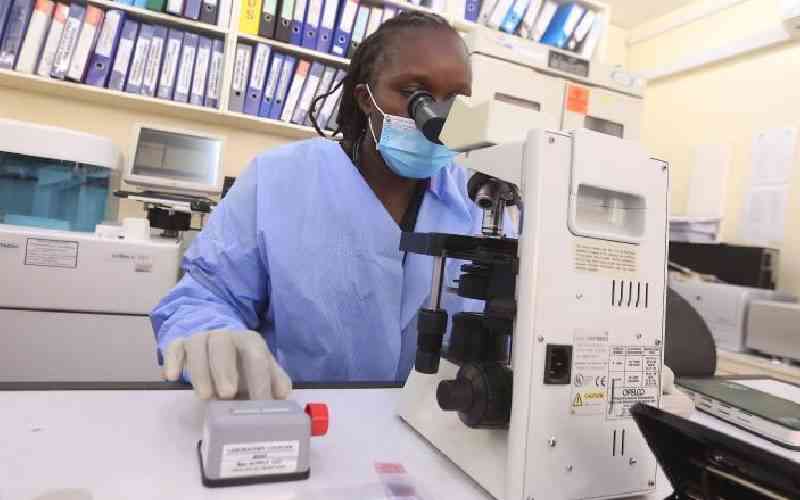
Lab technologists during routine clinical research at Kombewa Clinical Research Centre in Seme, Kisumu county. [File, Standard]
Today, Kenyan universities have expanded student enrolment, opened new campuses, and grown postgraduate programmes. Yet the country still struggles to generate knowledge, innovations, and solutions to its most pressing problems. This is not because our academics lack talent or ambition, but because the university system itself is not designed to properly support research and innovation. Nonetheless, if Kenya is serious about becoming a true knowledge economy, we must rethink how research and innovation are organised, funded, and supported across higher education.
For more than a decade, government policy has focused on expanding access to university education, allowing more young people than ever to attend university. While this is a significant achievement, the expansion has not been matched by investment in research. Universities are mostly judged by the number of graduates they produce rather than the knowledge they create or the problems they help solve. The result is a system that excels at churning out graduates but struggles to create knowledge that drives national development.
A major part of the problem is the teaching-heavy model that dominates universities, where academic staff carry heavy teaching loads, supervise large numbers of postgraduate students, and handle extensive administrative duties such as examinations, committee work, and compliance reporting. With so much to do, research often becomes something academics try to fit in during evenings or weekends, making it difficult to produce meaningful and high-quality work.
Follow The Standard
channel
on WhatsApp
Although some universities have established research offices and innovation hubs, these initiatives show good intentions, but they often suffer from limited funding and expertise. Also, many universities struggle to connect with industry or government in ways that yield real results, and success is often measured by the number of patents, reports, or memoranda of understanding rather than innovations that improve people’s lives.
The weakness is especially evident in postgraduate training where PhD students and postdoctoral researchers are supposed to be the backbone of research, but in Kenya, training is often fragmented and underfunded. Many doctoral students work without strong research environments, regular funding, or opportunities for cross-disciplinary collaboration. Not least, postdoctoral positions are rare and poorly structured, making it hard for young researchers to build careers or sustain research teams.
It is easy to think that Kenya cannot afford to prioritise research and that the main goal of our universities is to produce more graduates. Although this makes sense in the short term, it misses the bigger picture whereby countries that have successfully grown their economies tend to invest deliberately in knowledge creation and not by treating research as an afterthought. Thus, long-term national productivity, innovation, and competitiveness all depend on a strong domestic research base.
One big mistake policymakers and university leaders could make is to leave innovation to the private sector while limiting universities to teaching. We must remember that universities play a central role in research precisely because private firms often avoid long-term, low-profit, and high-risk projects. This also means that when universities are weak in research, the private sector’s capacity to innovate also suffers and the two must, thus, work together to make groundbreaking discoveries.
The question, therefore, is not whether Kenyan universities should do research, but how the system can make it possible. Not every university needs to be a research powerhouse, but some must be deliberately supported through clear policy measures to focus on research while others focus on teaching. This would allow each institution to excel in its role without being judged by unrealistic expectations.
To strengthen research, a select number of universities should be clearly designated and funded as research-focused institutions. Academic staff in these universities should have reduced teaching loads and protected time for research. Doctoral and postdoctoral training must be well-funded, structured, and aligned with national priorities such as agriculture, health, climate resilience, digital technologies, and public service. The government should also provide innovation funding that can support projects over several years and link universities to industry and government in ways that solve real national problems rather than simply celebrating the granting of certificates.
Kimani is an Associate Professor at University of Sheffield, United Kingdom and Visiting Professor at Uganda Christian University
Follow The Standard
channel
on WhatsApp
Lab technologists during routine clinical research at Kombewa Clinical Research Centre in Seme, Kisumu county.
[File, Standard]
Today, Kenyan universities have expanded student enrolment, opened new campuses, and grown postgraduate programmes. Yet the country still struggles to generate knowledge, innovations, and solutions to its most pressing problems. This is not because our academics lack talent or ambition, but because the university system itself is not designed to properly support research and innovation. Nonetheless, if Kenya is serious about becoming a true knowledge economy, we must rethink how research and innovation are organised, funded, and supported across higher education.
For more than a decade, government policy has focused on expanding access to university education, allowing more young people than ever to attend university. While this is a significant achievement, the expansion has not been matched by investment in research. Universities are mostly judged by the number of graduates they produce rather than the knowledge they create or the problems they help solve. The result is a system that excels at churning out graduates but struggles to create knowledge that drives national development.
A major part of the problem is the teaching-heavy model that dominates universities, where academic staff carry heavy teaching loads, supervise large numbers of postgraduate students, and handle extensive administrative duties such as examinations, committee work, and compliance reporting. With so much to do, research often becomes something academics try to fit in during evenings or weekends, making it difficult to produce meaningful and high-quality work.
Follow The Standard
channel
on WhatsApp
Although some universities have established research offices and innovation hubs, these initiatives show good intentions, but they often suffer from limited funding and expertise. Also, many universities struggle to connect with industry or government in ways that yield real results, and success is often measured by the number of patents, reports, or memoranda of understanding rather than innovations that improve people’s lives.
The weakness is especially evident in postgraduate training where PhD students and postdoctoral researchers are supposed to be the backbone of research, but in Kenya, training is often fragmented and underfunded. Many doctoral students work without strong research environments, regular funding, or opportunities for cross-disciplinary collaboration. Not least, postdoctoral positions are rare and poorly structured, making it hard for young researchers to build careers or sustain research teams.
It is easy to think that Kenya cannot afford to prioritise research and that the main goal of our universities is to produce more graduates. Although this makes sense in the short term, it misses the bigger picture whereby countries that have successfully grown their economies tend to invest deliberately in knowledge creation and not by treating research as an afterthought. Thus, long-term national productivity, innovation, and competitiveness all depend on a strong domestic research base.
One big mistake policymakers and university leaders could make is to leave innovation to the private sector while limiting universities to teaching. We must remember that universities play a central role in research precisely because private firms often avoid long-term, low-profit, and high-risk projects. This also means that when universities are weak in research, the private sector’s capacity to innovate also suffers and the two must, thus, work together to make groundbreaking discoveries.
The question, therefore, is not whether Kenyan universities should do research, but how the system can make it possible. Not every university needs to be a research powerhouse, but some must be deliberately supported through clear policy measures to focus on research while others focus on teaching. This would allow each institution to excel in its role without being judged by unrealistic expectations.
To strengthen research, a select number of universities should be clearly designated and funded as research-focused institutions. Academic staff in these universities should have reduced teaching loads and protected time for research. Doctoral and postdoctoral training must be well-funded, structured, and aligned with national priorities such as agriculture, health, climate resilience, digital technologies, and public service. The government should also provide innovation funding that can support projects over several years and link universities to industry and government in ways that solve real national problems rather than simply celebrating the granting of certificates.
Kimani is an Associate Professor at University of Sheffield, United Kingdom and Visiting Professor at Uganda Christian University
Follow The Standard
channel
on WhatsApp
By Danson Kimani