



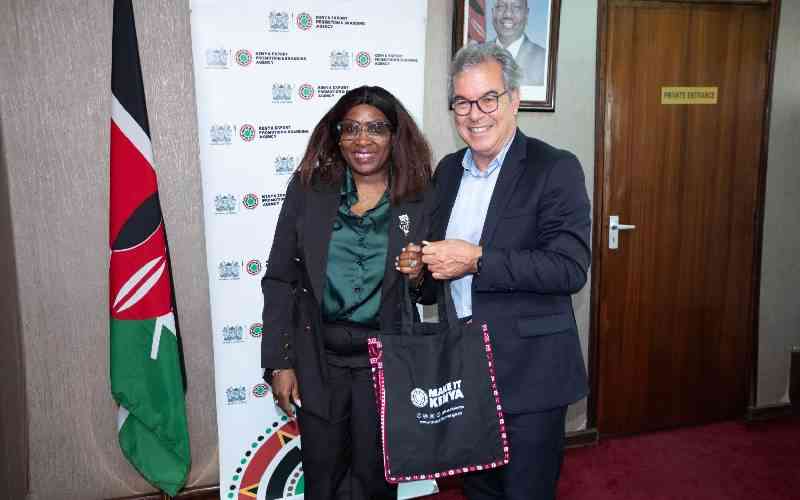
KEPROBA CEO Floice Mukabana and ApexBrasil president Jorge Viana after they held discussions on priority areas of cooperation between the two export promotion agencies. [Benard Orwongo Standard]
The economic relationship between Kenya and Brazil has long been characterised by a significant trade imbalance, with Brazil exporting far more to Kenya than Kenya exports to Brazil.
Statistics from the Kenya National Chamber of Commerce and Industry (KNCCI) indicate that total trade between the two countries stood at $169.46 million (Sh22 billion) in 2024.
Of this, Brazil exported goods worth $168.26 million (Sh21.8 billion) to Kenya, while Kenya’s exports to Brazil amounted to just $1.2 million (Sh156 million).
Follow The Standard
channel
on WhatsApp

KNCCI Economic Diplomacy Chair Cynthia Nyawira said this gap has been widening since 2023, noting that the solution lies not in trade alone, but in joint production.
Kenya’s exports to Brazil remain concentrated in low-value products, while imports from Brazil include raw sugar, industrial alcohol and agricultural machinery.
“To make this partnership real, we propose structured skills and technician exchange programmes in livestock, poultry, feed formulation, processing, and cold-chain operations so that technology transfer becomes practical and sustainable,” said Nyawira.
Both governments have expressed determination to deepen economic ties and broaden the base of commerce.
Agribusiness has emerged as the clearest entry point for such collaboration. Kenya has around 22 million head of cattle but produces only about 480,000 tonnes of beef annually, against projected national consumption of more than 626,000 tonnes.
Brazil, by contrast, has over 230 million cattle and already supplies beef to markets in the Gulf and China at scale.
Brazil could partner with Kenya by investing in joint feedlots in arid and semi-arid land counties, improving cattle genetics, developing export-grade abattoirs, and establishing joint ventures for chilled and portion-controlled beef cuts.
In broiler production, Kenya produces between 400 and 450 million chickens annually, meeting only 60–65 per cent of national demand, a deficit that continues to widen.
The partnership is to establish integrated broiler production zones in Kenya, supported by Brazilian technology, bringing together hatcheries, feed mills, modern processing plants, and contract farming systems that directly link small farmers to large buyers and regional markets.
Egg production presents another opportunity. Kenya consumes about nine billion eggs annually, but produces only around four billion, leaving a deficit of five billion eggs each year, while Brazil produces more than 57 billion eggs annually.
“Joint ventures in layer farms, hatcheries, feed technology, and farmer training could rapidly close Kenya’s supply gap and stabilise prices for consumers.”
These possibilities formed the backdrop to the Kenya–Brazil Multisector Trade Mission held in Nairobi, which brought together 26 Brazilian entrepreneurs, led by ApexBrasil, Brazil’s trade and investment promotion agency, and Kenyan counterparts from across agribusiness, manufacturing, food and beverages, construction, automotive, and aviation.
The forum was designed to directly confront the trade imbalance and reposition Kenya as a production and investment base for Africa.
Nyawira urged Kenyan entrepreneurs to present bankable projects with clear production plans and export-ready strategies, noting that Kenya offers political stability, a skilled English-speaking workforce, over 90 per cent renewable electricity, and access to Africa’s fastest-growing integrated market.
President of the Brazilian Trade and Investment Promotion Agency (ApexBrasil) Jorge Viana said Brazil’s objective goes beyond commerce to include economic cooperation, cultural exchange and shared development.
“It is inspiring to see the economic growth of East Africa, particularly Kenya. Brazil stands ready to be a strong and reliable partner in this journey,” he said, noting that over 170 business meetings were held during the mission.
Kenya Export Promotion and Branding Agency (Keproba) Chief Executive Floice Mukabana identified opportunities for Kenyan exporters in products such as vegetable colouring matter, coffee and tea extracts, sugars, apparel, and live fish.
She said the greatest untapped potential lies in higher-value industrial products, including agrochemicals, disodium carbonate, insecticides, herbicides, and titanium ores.
Mukabana highlighted Kenya’s strengths in black tea, agro-processing, pharmaceuticals, medical devices, and emerging green technologies, which align with Brazil’s industrial and consumer needs.
During the mission, Keproba and ApexBrasil signed a cooperation framework to promote two-way trade and investment, share market intelligence, and support SME integration into global value chains.
“The Keproba stand ready to work with ApexBrasil to ensure Kenyan exporters successfully penetrate the Brazilian and Latin American markets. More importantly, it signals a shift from transactional trade to strategic partnership,” said Mukabana.
Brazil’s Beyond Africa Group representative Paulo Pan said the mission followed a December meeting organised by Brazil’s Ministry of Foreign Affairs and reflects a top foreign-policy priority of deepening economic ties.
“Kenya is Brazil’s gateway to the East African market,” he said, noting plans to diversify exports beyond motor vehicles into aviation and other strategic sectors.
Paulo says they are currently working jointly with Kenya on initiatives such as strengthening Kenya’s cotton sector, supporting school feeding programs, and developing systems to improve water security.
Director of SMEs and Start-ups at the Kenya Private Sector Alliance, Mary Ngechu said as the voice of Kenya’s private sector, they remain firmly committed to improving the business environment and positioning Kenya as a strategic regional hub.
She said the East African region alone represents a market of over 300 million people, and this opportunity expands even further through continental frameworks such as the Tripartite Free Trade Area and the African Continental Free Trade Area, which aims to create a single African market.
Kenya Investment Authority CEO John Mwendwa observed that Kenya is East Africa’s largest economy, with a GDP of about Sh136 billion, over 93 per cent renewable energy, and a strong legal framework that allows 100 per cent foreign ownership and free repatriation of profits.
He said Kenya leads Africa in startup funding, attracting nearly Sh130 billion ($1 billion) annually, and offers fully serviced special economic zones and financial incentives.
Brazil’s growing footprint in Kenya has already been reinforced by regulatory approvals of Brazilian beef, meat products, and offal, effectively opening the Kenyan market to Brazilian exports in this high‑demand category.
Brazil exported over $41 million (Sh5.33 billion) in agricultural goods to Kenya in 2024, mainly agro‑products that now include the potential for certified beef exports following Kenya’s regulatory approval.
This move is expected to expand trade flows and help satisfy Kenyan demand for high‑quality animal protein, a sector that has struggled to keep pace with domestic needs.
Earlier agreements also opened Kenya’s market to Brazilian rice, after Kenya’s plant‑health body approved phytosanitary certification that enabled Brazilian rice imports.
Analysts projected this could bring an additional $2.15 million (Sh279.5 million) in trade value through expanded rice exports.
In early 2025, Kenya and Brazil signed a Memorandum of Understanding on agriculture and livestock development, covering crop development, value addition, livestock products, veterinary vaccines, animal genetics, training, and climate-smart production systems.
Kenya’s Ambassador to Brazil, Dr Andrew Karanja, described the MoU as a milestone designed to deepen trade, marketing, and capacity building.
During the second Brazil‑Africa Dialogue on Food Security, Fight Against Hunger, and Rural Development, a meeting in Brasília that brought 44 African countries together with international institutions, National Assembly, Moses Wetangula, reaffirmed Kenya’s strategic view of Brazil as a partner.
“These efforts reflect our national commitment to end hunger and build sustainable food systems. We are keen to learn from Brazil on how to scale our livestock sector beyond local markets,” Wetangula said.
He highlighted the need for knowledge exchange and noted Kenya’s interest in Brazilian expertise in livestock productivity, sugar value chains, and agricultural innovation, areas where Brazil has decades of experience and global leadership.
While current Kenya–Brazil trade volumes may appear modest, both sides agree that the real story lies in what comes next.
Follow The Standard
channel
on WhatsApp
KEPROBA CEO Floice Mukabana and ApexBrasil president Jorge Viana after they held discussions on priority areas of cooperation between the two export promotion agencies.
[Benard Orwongo Standard]
The economic relationship between Kenya and Brazil has long been characterised by a significant trade imbalance, with Brazil exporting far more to Kenya than Kenya exports to Brazil.
Statistics from the Kenya National Chamber of Commerce and Industry (KNCCI) indicate that total trade between the two countries stood at $169.46 million (Sh22 billion) in 2024.
Of this, Brazil exported goods worth $168.26 million (Sh21.8 billion) to Kenya, while Kenya’s exports to Brazil amounted to just $1.2 million (Sh156 million).
Follow The Standard
channel
on WhatsApp
KNCCI Economic Diplomacy Chair Cynthia Nyawira said this gap has been widening since 2023, noting that the solution lies not in trade alone, but in joint production.
Kenya’s exports to Brazil remain concentrated in low-value products, while imports from Brazil include raw sugar, industrial alcohol and agricultural machinery.
“To make this partnership real, we propose structured skills and technician exchange programmes in livestock, poultry, feed formulation, processing, and cold-chain operations so that technology transfer becomes practical and sustainable,” said Nyawira.
Both governments have expressed determination to deepen economic ties and
broaden the base of commerce.
Agribusiness has emerged as the clearest entry point for such collaboration. Kenya has around 22 million head of cattle but produces only about 480,000 tonnes of beef annually, against projected national consumption of more than 626,000 tonnes.
Brazil, by contrast, has over 230 million cattle and already supplies beef to markets in the Gulf and China at scale.
Brazil could partner with Kenya by investing in joint feedlots in arid and semi-arid land counties, improving cattle genetics, developing export-grade abattoirs, and establishing joint ventures for chilled and portion-controlled beef cuts.
In broiler production, Kenya produces between 400 and 450 million chickens annually, meeting only 60–65 per cent of national demand, a deficit that continues to widen.
The partnership is to establish integrated broiler production zones in Kenya, supported by Brazilian technology, bringing together hatcheries, feed mills, modern processing plants, and contract farming systems that directly link small farmers to large buyers and regional markets.
Egg production presents another opportunity. Kenya consumes about nine billion eggs annually, but produces only around four billion, leaving a deficit of five billion eggs each year, while Brazil produces more than 57 billion eggs annually.
Stay informed. Subscribe to our newsletter
“Joint ventures in layer farms, hatcheries, feed technology, and farmer training could rapidly close Kenya’s supply gap and stabilise prices for consumers.”
These possibilities formed the backdrop to the Kenya–Brazil Multisector Trade Mission held in Nairobi, which brought together 26 Brazilian entrepreneurs, led by ApexBrasil, Brazil’s trade and investment promotion agency, and Kenyan counterparts from across agribusiness, manufacturing, food and beverages, construction, automotive, and aviation.
The forum was designed to directly confront the trade imbalance and reposition Kenya as a production and investment base for Africa.
Nyawira urged Kenyan entrepreneurs to present bankable projects with
clear production plans
and export-ready strategies, noting that Kenya offers political stability, a skilled English-speaking workforce, over 90 per cent renewable electricity, and access to Africa’s fastest-growing integrated market.
President of the Brazilian Trade and Investment Promotion Agency (ApexBrasil) Jorge Viana said Brazil’s objective goes beyond commerce to include economic cooperation, cultural exchange and shared development.
“It is inspiring to see the economic growth of East Africa, particularly Kenya. Brazil stands ready to be a strong and reliable partner in this journey,” he said, noting that over 170 business meetings were held during the mission.
Kenya Export Promotion and Branding Agency (Keproba) Chief Executive Floice Mukabana identified opportunities for Kenyan exporters in products such as vegetable colouring matter, coffee and tea extracts, sugars, apparel, and live fish.
She said the greatest untapped potential lies in higher-value industrial products, including agrochemicals, disodium carbonate, insecticides, herbicides, and titanium ores.
Mukabana highlighted Kenya’s strengths in black tea, agro-processing, pharmaceuticals, medical devices, and emerging green technologies, which align with Brazil’s industrial and consumer needs.
During the mission, Keproba and ApexBrasil signed a cooperation framework to promote two-way trade and investment, share market intelligence, and support SME integration into global value chains.
“The Keproba stand ready to work with ApexBrasil to ensure Kenyan exporters successfully penetrate the Brazilian and Latin American markets. More importantly, it signals a shift from transactional trade to strategic partnership,” said Mukabana.
Brazil’s Beyond Africa Group representative Paulo Pan said the mission followed a December meeting organised by Brazil’s Ministry of Foreign Affairs and reflects a top foreign-policy priority of deepening economic ties.
“Kenya is Brazil’s gateway to the East African market,” he said, noting plans to diversify exports beyond motor vehicles into aviation and other strategic sectors.
Paulo says they are currently working jointly with Kenya on initiatives such as strengthening Kenya’s cotton sector, supporting school feeding programs, and developing systems to improve water security.
Director of SMEs and Start-ups at the Kenya Private Sector Alliance, Mary Ngechu said as the voice of Kenya’s private sector, they remain firmly committed to improving the business environment and positioning Kenya as a strategic regional hub.
She said the East African region alone represents a market of over 300 million people, and this opportunity expands even further through continental frameworks such as the Tripartite Free Trade Area and the African Continental Free Trade Area, which aims to create a single African market.
Kenya Investment Authority CEO John Mwendwa observed that Kenya is East Africa’s largest economy, with a GDP of about Sh136 billion, over 93 per cent renewable energy, and a strong legal framework that allows 100 per cent foreign ownership and free repatriation of profits.
He said Kenya leads Africa in startup funding, attracting nearly Sh130 billion ($1 billion) annually, and offers fully serviced special economic zones and financial incentives.
Brazil’s growing footprint in Kenya has already been reinforced by regulatory approvals of Brazilian beef, meat products, and offal, effectively opening the Kenyan market to Brazilian exports in this high‑demand category.
Brazil exported over $41 million (Sh5.33 billion) in agricultural goods to Kenya in 2024, mainly agro‑products that now include the potential for certified beef exports following Kenya’s regulatory approval.
This move is expected to expand trade flows and help satisfy Kenyan demand for high‑quality animal protein, a sector that has struggled to keep pace with domestic needs.
Earlier agreements also opened Kenya’s market to Brazilian rice, after Kenya’s plant‑health body approved phytosanitary certification that enabled Brazilian rice imports.
Analysts projected this could bring an additional $2.15 million (Sh279.5 million) in trade value through expanded rice exports.
In early 2025, Kenya and Brazil signed a Memorandum of Understanding on agriculture and livestock development, covering crop development, value addition, livestock products, veterinary vaccines, animal genetics, training, and climate-smart production systems.
Kenya’s Ambassador to Brazil, Dr Andrew Karanja, described the MoU as a milestone designed to deepen trade, marketing, and capacity building.
During the second Brazil‑Africa Dialogue on Food Security, Fight Against Hunger, and Rural Development, a meeting in Brasília that brought 44 African countries together with international institutions, National Assembly, Moses Wetangula, reaffirmed Kenya’s strategic view of Brazil as a partner.
“These efforts reflect our national commitment to end hunger and build sustainable food systems. We are keen to learn from Brazil on how to scale our livestock sector beyond local markets,” Wetangula said.
He highlighted the need for knowledge exchange and noted Kenya’s interest in Brazilian expertise in livestock productivity, sugar value chains, and agricultural innovation, areas where Brazil has decades of experience and global leadership.
While current Kenya–Brazil trade volumes may appear modest, both sides agree that the real story lies in what comes next.
Follow The Standard
channel
on WhatsApp
By Nanjinia Wamuswa