



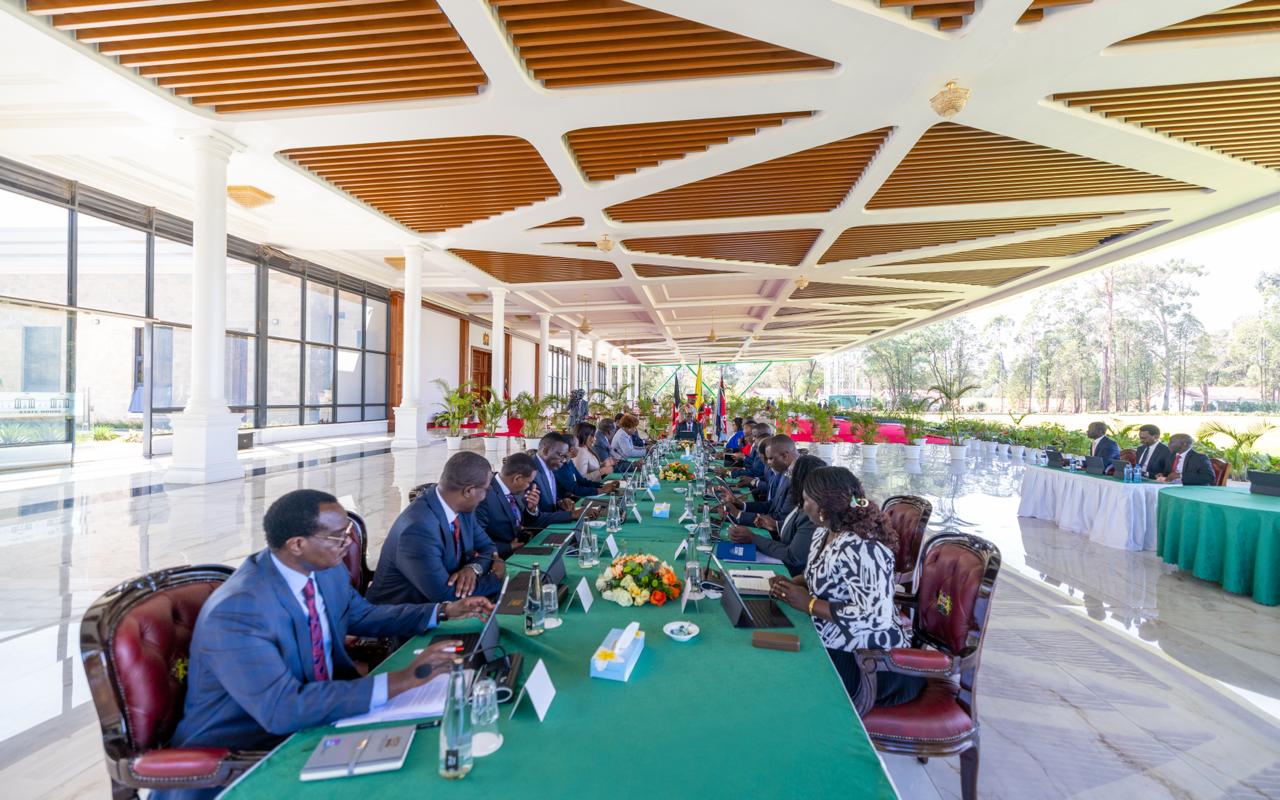
President William Ruto chairs a Cabinet meeting on February 10, 2026/PCS
A government audit has revealed that 720 staff members altered more than 4.7 million payroll records without leaving audit trails, including cases where employees edited their own records.
The findings exposed significant integrity and cybersecurity gaps in the Government Human Resource Information System-Kenya (HRIS-K).
The Cabinet has approved sweeping reforms to address these long-standing payroll weaknesses and ensure statutory deductions are applied uniformly at source.
“The audit exposed weaknesses that threaten the integrity of public funds and the reliability of government payroll,” said a Cabinet dispatch.
“We are taking decisive steps to restore trust and accountability in the system.”
The special audit, covering the 2024-2025 financial year, also flagged errors in identity records, tax compliance, and bank accounts, compounded by poor system integration and the failure of about 300 State Corporations to migrate to HRIS-K.
Financial irregularities linked to unauthorised payments and excessive salary arrears were identified, while weak disaster-recovery arrangements and expired ICT licences posed further risks.
In response, the Cabinet sanctioned a reform roadmap that includes mandatory security certification for HRIS-K users by March 11, 2026, the deployment of forensic analytics to guide disciplinary and legal action, a governance reset of the HRIS-K system, and full integration of a statutory deductions platform.
“These reforms are designed to stabilise the system immediately and prevent recurrence of past anomalies,” the Cabinet dispatch added.
“Our goal is a secure, transparent, and accountable payroll system that protects public funds.”
The Cabinet also directed that statutory deductions be effected strictly at source across all public entities. A meeting of Principal Secretaries, accounting officers, and heads of parastatals will be convened to oversee the implementation of the reforms.
Accounting officers have been instructed to submit verified payroll data, fully cooperate with ongoing audits, and take personal responsibility for any irregularities within their institutions.
The reforms further provide for the establishment of Payroll Audit Units and urgent ICT upgrades to strengthen internal controls and safeguard public resources.
The Cabinet’s decision marks one of the most significant efforts in recent years to overhaul government payroll systems, addressing both operational and structural weaknesses that have persisted across multiple administrations.