



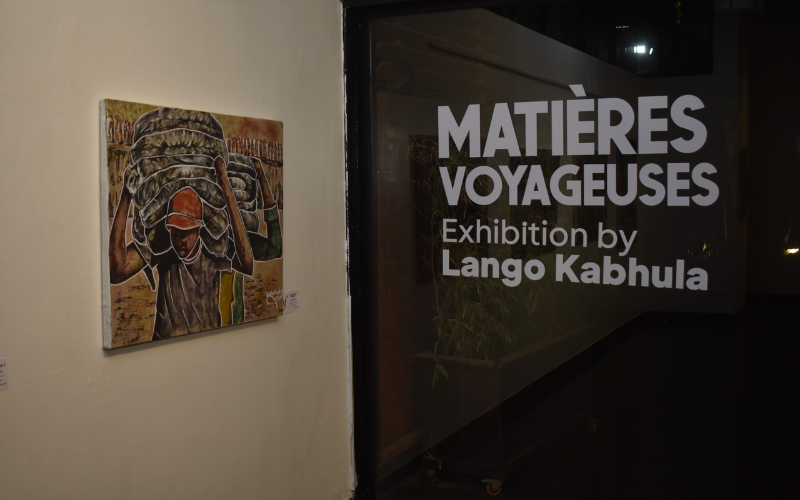
Congolese artist Lango Kabhula opened an exhibition titled Matières Voyageuses (translated as Travelling Materials) at Alliance Française Nairobi on February 9. The exhibition runs until February 28.
Curated by Sarah Luddy in collaboration with Alliance Française Nairobi, it features 16 large-scale paintings and a series of 13 smaller works, accompanied by an immersive installation.


“It refers to the entire history of materials, that is, their extraction, circulation, transformation, and use,” says Kabhula.
He explains that the notion of travel connects resource exploitation with migration, identity, and artistic creation, particularly through the use of recycled objects.
A central installation features an umbrella suspended from the ceiling and a video performance projected onto the floor in a continuous three-minute loop.

Kabhula explains that the umbrella, a symbol of protection and refuge, functions as a fragile shelter in the face of exploitation and displacement, while the video engages the body as a site of memory, resistance, and presence.
“The umbrella evokes survival, care, and resistance within unstable contexts. In this installation, it plays a central symbolic role,” he says.
The video performance centres on Mwan’engo, a reincarnated ancestor of a young man living in 2024. Kabhula drew inspiration for this figure from the histories of ancient African societies, particularly those of the Great Lakes region.

Kabhula uses earth and sand in his work to question resources. He describes sand as a carrier of memory, sustaining life and holding the traces of countless generations that have lived upon it.
Matières Voyageuses is a continuation of his last year’s solo exhibition, Bearing Witness, curated by Linda Chao Mbugua at Sena Art Gallery’s Under the Swahili Tree exhibition.
Kabhula notes that while both exhibitions stem from his ongoing research on historical exploitation and contemporary overexploitation of natural resources in the DR Congo, Matières Voyageuses takes a more installation-based and immersive approach, revolving around the figure of Mwan’engo.