



Audio By Vocalize
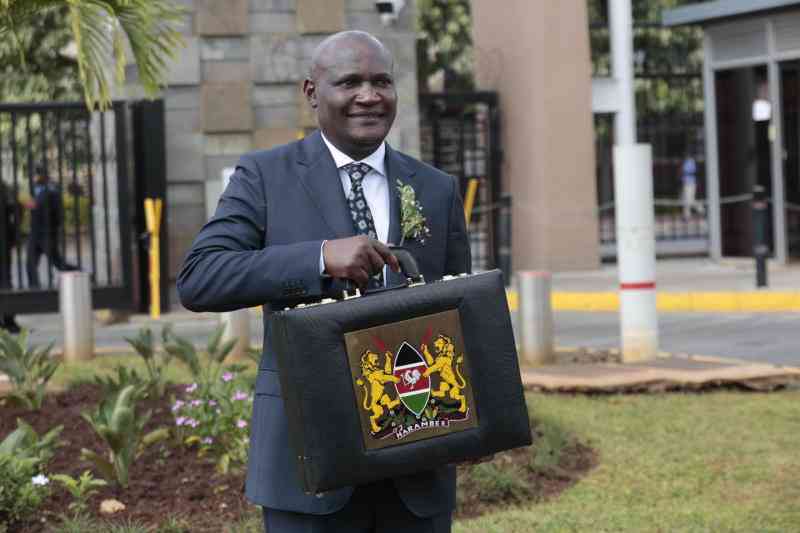
Treasury CS John Mbadi during the 2025 Budget reading at Parliament Buildings, Nairobi, on June 12, 2025. [File, Standard]
When the Budget Policy Statement (BPS) finally arrives in Parliament marked “Secret,” it is natural to wonder what’s being hidden from Kenyans.
Because, a week earlier, we were regaled with good news stories about tax cuts for formal sector earners at the lower end of the income scale.
As is often said, the devil is always in the detail. So, Page 50 of the updated, “secret” BPS – in comparison to its original draft – offers us a mini-diatribe about “fostering fairness and equity in personal income tax.” Let’s prepare for lots of privacy invasions through Mpesa and bank account snooping, and all manner of “push” income tax assessments from KRA and a subsequent logjam of tax disputes. The long-stated rationale is the self-employed don’t pay enough (or any) tax. And remember, this year’s rules also require a painful accounting of our tax-deductible spending.
Whether this pain is administered through a Tax Laws Amendment or Finance Bill doesn’t matter.
Of course, we are speculating here, but if there was a way to accelerate the informalization of our economy while thinking that this is the way to formalise it, this is exactly it. Good luck to the future of mobile money, and other unintended consequences. Maybe Safaricom is overvalued. We probably want to watch carefully how our “wash wash” Parliamentarians interrogate this.
Which is not to say that we have reached our revenue potential. I remain unconvinced by the efficacy (and logic) of KRA’s revenue modelling, but our Sh18-19 trillion economy should be delivering a pure tax take of Sh4.5-4.75 trillion at 25 per cent flat tax extraction. Non-tax revenue, including A-in-A for government services, should be hitting another Sh1.25-1.5 trillion.
That’s an annual Sh6 trillion money train to deliver us to heaven and back. By wild example, we could put a trillion each into education and healthcare, throw another trillion at infrastructure, and still have three trillion left for everything from security and justice to social protection and commercial affairs. And that’s today’s Sh18-19 trillion economy, not the Sh39 trillion Vision 2030 one.
Sh6 trillion? That’s less than one per cent of the debits and credits flowing through our national payments system so you can see the emergent logic. Put it this way. If we slapped a one per cent tax on every RTGS, EFT or mobile money transaction in Kenya, the take would exceed Sh6 trillion.
We haven’t even gotten to counties, where, extrapolating from CRA’s 2019 guesstimates, they should be collecting Sh250 billion in own source revenues, not Sh70 billion. Sh250 billion is over half of the current equitable share, which itself should be at least a trillion on its own by now.
Expectedly, none of this wild imagination exists in the BPS now before Parliament. The plan for 2026/27 is 3.534 trillion in revenues versus Sh4.704 trillion in spending, meaning, after accounting for grants, we will add Sh1.116 trillion to our national debt. That’s after the same budget imbalance leaves us piling up Sh1.141 trillion in debt in the current (2025/26) fiscal year. By June 2027, debt will have hit Sh14.067 trillion in what we hope is a Sh20.947 trillion economy.
And we just can’t help it. By June 2030, our debt mountain will have grown to Sh16.524 trillion. Or more. The general trend seems to be that revenue underperformance and poor expenditure control means actual deficits far exceed the plan. It isn’t just our debt trap, we refuse to live within our means. Think about that the next time you experience a presidential jolly in your digs.
There is a sense of disappointment in this BPS,and effectively, this administration. I have said before that it doesn’t feel like either a statement of intent or a statement of commitment. More descriptive than prescriptive; more stationary than visionary; more procedural than strategic.
Which is surprising given 2026/27 is the current administration’s final full budget year in this term. One was hoping for a signature BPS that would preface the signature Budget Statement in June.
What would a signature BPS have highlighted for this administration? I have written about content before (remembering that it is likely the output of multiple cooks making broth), but let’s narrow this to innovation in five areas; revenue, expenditure, debt, resources and economy.
Revenue innovation? See above. To be fair, though, this administration has made positive strides on the revenue front in a tough economy; you can see a desire to make revenue (tax and non-tax) collection more seamless and maybe, more painless. However – back to revenue modelling – something doesn’t add up; the effort announced doesn’t fully align with the actual numbers.
Spending innovation? Let’s just say that Kenya is yet to discover an administration that is willing to constructively tackle our expenditure problem, debt treadmill notwithstanding. And it’s a problem in two ways. We are not spending enough on the right things (like education and health), and we refuse to cut, or innovate, spending in the “less right” things (think, administration across the board). A serious government would already have taken a hacksaw to our almost 200 national government programs, especially those euphemistically titled “general administration”.
Debt innovation? The real debt innovation is not to take on more debt, which would mean delivering a truly balanced budget, or more optimistically, running a budget surplus (to cut debt). But let’s be fair again; at least this administration has mastered “liquidity management operations (LMOs)”; we even have a draft LMO policy up for public participation. What’s missing as a long-term question is the matter of odious debt; or differently, the lack of return from our borrowing.
Resource innovation? Probably through a mix of necessity and foresight, official thinking seems to have stumbled upon the idea that there is more to resource mobilisation than taxes and debt. And resources, in the strict sense, are more than money, which is why I argue that we need to work our full “balance sheet” – human, knowledge, social, financial, economic, physical and land. We patiently await the day when we will figure this out with a proper Resourcing Plan for Kenya.
Economic innovation? We are still in no-man’s land here. Yet this is what drives the other four innovations. One day we might finally figure, to build on that famous saying, that, “counties will move us fast; but national will move us far”. Settle on that idea, and then we can talk all day about how we pursue a restructuring of the economy across agriculture, industry and services.
Here’s a final thought to bring this all together as Parliament debates this BPS plus National infrastructure Fund and Sovereign Wealth Fund bills. Where’s the overall, once in a lifetime Sessional paper that (a) builds on Vision 2030 (Sessional Paper Number 1 of 2012) (b) celebrates BETA and (c) presents our “First World” vision and ambition? That would be game, set and match.
Follow The Standard
channel
on WhatsApp
Treasury CS John Mbadi during the 2025 Budget reading at Parliament Buildings, Nairobi, on June 12, 2025.
[File, Standard]
When the Budget Policy Statement (BPS) finally arrives in Parliament marked “Secret,” it is natural to wonder what’s being hidden from Kenyans.
Because, a week earlier, we were regaled with good news stories about tax cuts for formal sector earners at the lower end of the income scale.
As is often said, the devil is always in the detail. So, Page 50 of the updated, “secret” BPS – in comparison to its original draft – offers us a mini-diatribe about “fostering fairness and equity in personal income tax.” Let’s prepare for lots of privacy invasions through Mpesa and bank account snooping, and all manner of “push” income tax assessments from KRA and a subsequent logjam of tax disputes. The long-stated rationale is the self-employed don’t pay enough (or any) tax. And remember, this year’s rules also require a painful accounting of our tax-deductible spending.
Whether this pain is administered through a Tax Laws Amendment or Finance Bill doesn’t matter.
Of course, we are speculating here, but if there was a way to accelerate the informalization of our economy while thinking that this is the way to formalise it, this is exactly it. Good luck to the future of mobile money, and other unintended consequences. Maybe Safaricom is overvalued. We probably want to watch carefully how our “wash wash” Parliamentarians interrogate this.
Which is not to say that we have reached our revenue potential. I remain unconvinced by the efficacy (and logic) of KRA’s revenue modelling, but our Sh18-19 trillion economy should be delivering a pure tax take of Sh4.5-4.75 trillion at 25 per cent flat tax extraction. Non-tax revenue, including A-in-A for government services, should be hitting another Sh1.25-1.5 trillion.
That’s an annual Sh6 trillion money train to deliver us to heaven and back. By wild example, we could put a trillion each into education and healthcare, throw another trillion at infrastructure, and still have three trillion left for everything from security and justice to social protection and commercial affairs. And that’s today’s Sh18-19 trillion economy, not the Sh39 trillion Vision 2030 one.
Sh6 trillion? That’s less than one per cent of the debits and credits flowing through our national payments system so you can see the emergent logic. Put it this way. If we slapped a one per cent tax on every RTGS, EFT or mobile money transaction in Kenya, the take would exceed Sh6 trillion.
We haven’t even gotten to counties, where, extrapolating from CRA’s 2019 guesstimates, they should be collecting Sh250 billion in own source revenues, not Sh70 billion. Sh250 billion is over half of the current equitable share, which itself should be at least a trillion on its own by now.
Expectedly, none of this wild imagination exists in the BPS now before Parliament. The plan for 2026/27 is 3.534 trillion in revenues versus Sh4.704 trillion in spending, meaning, after accounting for grants, we will add Sh1.116 trillion to our national debt. That’s after the same budget imbalance leaves us piling up Sh1.141 trillion in debt in the current (2025/26) fiscal year. By June 2027, debt will have hit Sh14.067 trillion in what we hope is a Sh20.947 trillion economy.
And we just can’t help it. By June 2030, our debt mountain will have grown to Sh16.524 trillion. Or more. The general trend seems to be that revenue underperformance and poor expenditure control means actual deficits far exceed the plan. It isn’t just our debt trap, we refuse to live within our means. Think about that the next time you experience a presidential jolly in your digs.
There is a sense of disappointment in this BPS,and effectively, this administration. I have said before that it doesn’t feel like either a statement of intent or a statement of commitment. More descriptive than prescriptive; more stationary than visionary; more procedural than strategic.
Which is surprising given 2026/27 is the current administration’s final full budget year in this term. One was hoping for a signature BPS that would preface the signature Budget Statement in June.
What would a signature BPS have highlighted for this administration? I have written about content before (remembering that it is likely the output of multiple cooks making broth), but let’s narrow this to innovation in five areas; revenue, expenditure, debt, resources and economy.
Stay informed. Subscribe to our newsletter
Revenue innovation? See above. To be fair, though, this administration has made positive strides on the revenue front in a tough economy; you can see a desire to make revenue (tax and non-tax) collection more seamless and maybe, more painless. However – back to revenue modelling – something doesn’t add up; the effort announced doesn’t fully align with the actual numbers.
Spending innovation? Let’s just say that Kenya is yet to discover an administration that is willing to constructively tackle our expenditure problem, debt treadmill notwithstanding. And it’s a problem in two ways. We are not spending enough on the right things (like education and health), and we refuse to cut, or innovate, spending in the “less right” things (think, administration across the board). A serious government would already have taken a hacksaw to our almost 200 national government programs, especially those euphemistically titled “general administration”.
Debt innovation? The real debt innovation is not to take on more debt, which would mean delivering a truly balanced budget, or more optimistically, running a budget surplus (to cut debt). But let’s be fair again; at least this administration has mastered “liquidity management operations (LMOs)”; we even have a draft LMO policy up for public participation. What’s missing as a long-term question is the matter of odious debt; or differently, the lack of return from our borrowing.
Resource innovation? Probably through a mix of necessity and foresight, official thinking seems to have stumbled upon the idea that there is more to resource mobilisation than taxes and debt. And resources, in the strict sense, are more than money, which is why I argue that we need to work our full “balance sheet” – human, knowledge, social, financial, economic, physical and land. We patiently await the day when we will figure this out with a proper Resourcing Plan for Kenya.
Economic innovation? We are still in no-man’s land here. Yet this is what drives the other four innovations. One day we might finally figure, to build on that famous saying, that, “counties will move us fast; but national will move us far”. Settle on that idea, and then we can talk all day about how we pursue a restructuring of the economy across agriculture, industry and services.
Here’s a final thought to bring this all together as Parliament debates this BPS plus National infrastructure Fund and Sovereign Wealth Fund bills. Where’s the overall, once in a lifetime Sessional paper that (a) builds on Vision 2030 (Sessional Paper Number 1 of 2012) (b) celebrates BETA and (c) presents our “First World” vision and ambition? That would be game, set and match.
Follow The Standard
channel
on WhatsApp
By Dennis Kabaara