

Audio By Vocalize

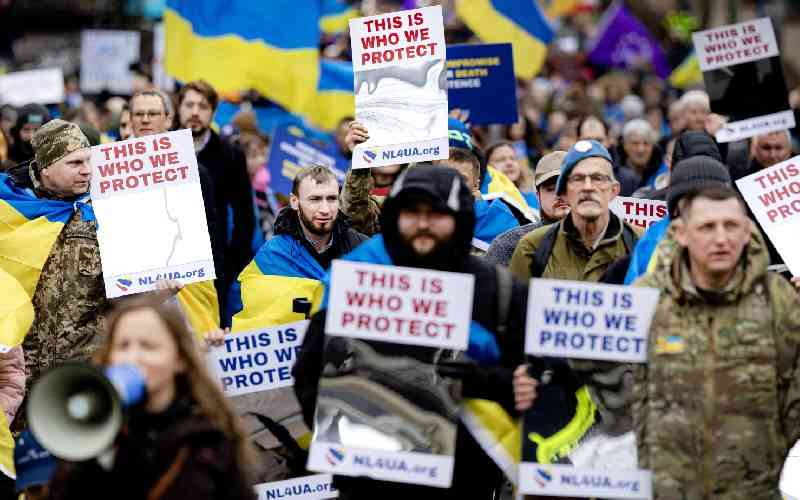
People hold Ukrainian flags and placards during a rally, two days before the four years of the war in Ukraine, at Dam Square in Amsterdam on February 22, 2026. [AFP]
Today marks four years since the full-scale invasion of Ukraine— an act of aggression that was condemned across the world. Governments spoke, resolutions were passed, and sanctions were imposed. The message was clear – borders cannot be redrawn by force, a principle deeply resonant for nations whose sovereignty was hard-won.
Yet the war of aggression did not end. Imperial ambition does not retreat easily. In fact, this war did not begin in 2022. It began in 2014 with the illegal occupation of Crimea and the launch of armed aggression in eastern Ukraine.
Four years ago, Russia escalated that war into a full-scale invasion, presenting it as a “special military operation” and justifying it with carefully packaged objectives: “demilitarisation,” “denazification,” protection of Russian speakers, and prevention of NATO expansion. The pattern was clear from the outset: Narratives were constructed first, and then evidence was fabricated later.
The same method was applied elsewhere, including in Kenya, where official denials have contrasted sharply with documented cases of recruitment into the Russian military. Four years on, the promises of 2022 stand exposed as unfulfilled slogans. Ukraine was among the principal victims of Nazism in the Second World War. Millions of Ukrainians – soldiers, civilians, national minorities – were killed on our land. Some of the fiercest battles against Hitler’s regime were fought on Ukrainian soil. Ukrainians fought in vast numbers within the Allied coalition that ultimately defeated Nazism.
To portray modern Ukraine – a democratic, multi-ethnic state – as the embodiment of the very ideology that devastated its land is the cynical exploitation of history in the service of aggression. There is nothing to debate in slogans. The evidence lies in conduct – and in consequences.
On occupied territories of Ukraine today, children are taken from their families and transported across borders. Schools are forced to abandon the Ukrainian language and history, their libraries replaced with rewritten narratives approved by occupation authorities. Classrooms introduce militarised drills, preparing young people for gradual integration into the structures of the occupying army.
Churches and places of worship are bombarded and destroyed. Clergy who refuse to align with occupation authorities are harassed, detained, or expelled. Religious communities are pressured to replace their priests with those loyal to Moscow.
Faith – which should offer comfort in war – is turned into an instrument of control. Across Ukraine, far from active front lines, critical civilian infrastructure has been systematically targeted: Power stations, transmission grids, water supply systems, heating plants, railway hubs, and residential districts.
Strikes were timed for winter months, when freezing temperatures amplify their human cost – cutting heat, electricity, transport, and water to entire cities. Hospitals rely on generators. Families endure prolonged blackouts. Elderly residents face sub-zero conditions inside their homes. These are not battlefield necessities. They are instruments of pressure directed at civilian resilience. When such patterns recur over months and years, across regions and seasons, they cannot be explained as an accident or miscalculation. They reflect deliberate policy.
An army confident in its battlefield capacity confronts opposing forces. When it turns instead to deportations, cultural erasure, and sustained attacks on civilian infrastructure, it signals that military aims are not being secured through military means. Civilian suffering becomes a substitute for battlefield success. Attacking the defenceless is not dominance. It is the admission of strategic incapacity. History does not remember such armies as great powers. It remembers them as crimes in uniform.
Despite years of fighting and immense losses, Russia has failed to break Ukraine. Ukrainian society has not collapsed. The state continues to function. International support has endured. What was presented as a swift campaign has hardened into attrition. Territorial shifts remain limited. The strategic picture has not changed. The costs, however, continue to rise – militarily, economically, and demographically.
As losses mount and mobilisation fatigue deepens at home, recruitment efforts have expanded beyond Russia’s borders. Across multiple regions – including here in Africa – recurring patterns have emerged: Promises of civilian employment, high salaries, rapid legal status, and financial security for families. Contracts are obscured. Terms are misrepresented.
Intermediaries arrange transit. Once abroad, many discover that the promised conditions do not exist. Payments are delayed, reduced, or withheld. Legal protections are absent. Documents are confiscated. Individuals are pressured into combat roles far removed from what they believed they had agreed to. Employment becomes combat. Contracts become coercion. Recruits become expendable. Money was the lure. Deception is the structure. Passports are taken. Legal protections evaporate. Casualties are quietly absorbed. Those who survive return home injured or traumatised – often without the compensation that justified the risk. Those who die are reduced to statistics, their families left facing opacity rather than accountability.
This absence of responsibility is not incidental. It reflects a system in which information is manipulated, obligations are blurred, and losses are concealed. Importing manpower delays the reckoning, but it does not alter the reality. Wars of aggression end when they become unsustainable. Bringing in foreign recruits postpones that moment. Each new fighter drawn into the conflict under false pretences prolongs it – for Ukraine and for every family whose son believed he was signing up for something else.
For nations shaped by their own struggles for sovereignty and dignity, the principle is clear: Borders matter. Independence matters. Truth matters. This war began with the violation of a neighbour’s sovereignty. It continues through the distortion of history and the exploitation of vulnerable people in Africa. Propaganda, coercion, or imported manpower do not confer legitimacy on aggression. Every abducted child. Every deliberate strike against civilian infrastructure. Every contract signed under false pretences. Every Kenyan or African citizen recruited into this war through deception. These are not isolated incidents. They form a pattern.
When conduct is repeated, targeted, and systematic, intent is no longer debated. It is demonstrated. Demonstrated intent establishes responsibility. War crimes have no statute of limitations.
Follow The Standard
channel
on WhatsApp
By Yurii Tokar