



Audio By Vocalize
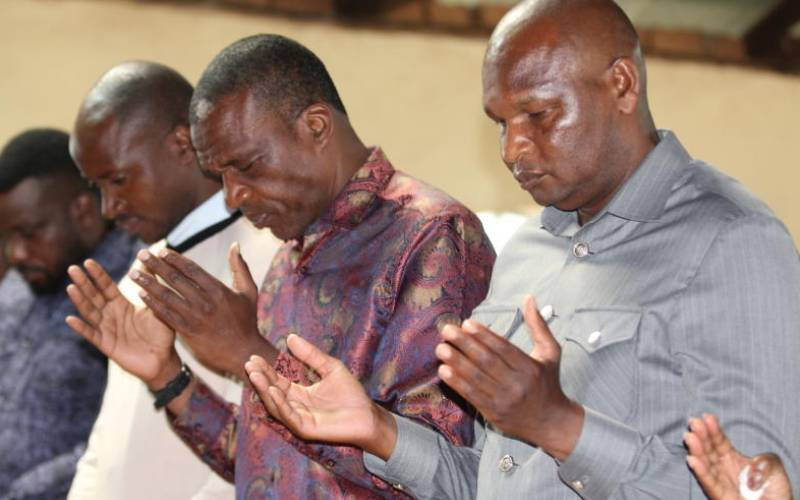
President Ruto’s aide Farouk Kibet and UDA candidate David Indakwa pray during a fund drive at Butali Salvation Army Church in Malava on October 5, 2025. [Benjamin Sakwa, Standard]
According to Martin Andati, another Political Analyst, argues that Farouk is more trusted in handling finances and delivering an assignment than Prime Cabinet Secretary Musalia Mudavadi and National Assembly Speaker Moses Wetangula.
“He understands the political dynamics of Malava by virtue of being a neighbour to Kakamega County. Most importantly, Farouk is more trusted in terms of delivering any political assignment and handling finances. Farouk has been working on the perception that he is pro-people, a hands-on person who engages ordinary people just like his boss,” said Andati.
President William Ruto’s aide, Farouk Kibet, appears to be having a new role as he shifts his attention to Western as a political spanner boy to help the president in his quest to bolster support in the slippery but rich voting bloc.
From Malava to Bungoma, Kakamega to Vihiga, Farouk has increasingly become the face of State House politics in a region long considered politically fluid and fiercely contested.
Farouk has been the driving force behind the hotly contested Malava parliamentary by-election, which the UDA party won under the newly elected MP David Ndakwa. Months later, the people of West Kabras ward are expected to cast their vote today to elect a new MCA who will succeed Ndakwa, and Farouk has led the campaigns throughout the campaign period.
For years, Farouk operated behind the scenes, a quiet but powerful mobiliser within Ruto’s inner circle.
Those who understand Kenya Kwanza politics describe him as the President’s political antenna: sensing the ground, managing local networks and neutralising dissent before it grows.
But in the Western region, the aide is no longer operating in the shadows.
During the Malava by-election campaigns, Farouk’s presence was unmistakable. He attended rallies, directly addressed crowds, and, in some instances, openly endorsed preferred candidates, occasionally stepping into arenas already occupied by local heavyweights.
His political footprint has triggered murmurs across the region.
Western is not an easy political terrain. It is home to seasoned politicians with deep grassroots networks, including National Assembly Speaker Moses Wetang’ula and Prime Cabinet Secretary Musalia Mudavadi, but Farouk is trudging on to change the tide in Ruto’s favor.
In several public events, the President’s aide has appeared to command more immediate authority than locally elected leaders.
At times, he has directly engaged MCAs, MPs, and grassroots coordinators, giving instructions, setting political tone, and even reshaping campaign messaging.
During one recent political confrontation in Kakamega, Farouk dramatically appeared at a rally organised by rival camps, turning what had been a local contest into a high-stakes political spectacle, maintaining that he is rooting for the Western region to succeed President Ruto in 2032.
“Ruto is the immediate neighbour to Western people, and this region has stuck with Ruto in thick and thin, and therefore we want a Luhya kingpin to succeed President Ruto as President in 2032, and that is why we have decided to walk together with this community in terms of development and politics,” said Farouk.
He added, “We want the Western region to enjoy the presidency because they deserve it. Some people hate me because I am pushing for the agenda of this region at the national stage. The presidency must come to the Western region, and we are going to do that as we move together.”
Insiders within Kenya Kwanza say the seat was viewed as strategic, not just for parliamentary arithmetic, but for psychological dominance in the Western region ahead of 2027.
Western region politics have historically revolved around kingpins, figures who command ethnic, clan, or regional loyalty.
From the days of Michael Wamalwa Kijana to the Mudavadi and Wetang’ula era, regional politics has thrived on personality-driven blocs.
Farouk’s rise represents a different model, centralised power anchored at State House rather than within local political dynasties.
It is a strategy that could either stabilise Ruto’s grip on Western or ignite rivalry within Kenya Kwanza ranks.
With the 2027 General Election already shaping political calculations, Western remains a prized battleground.
Ruto’s 2022 victory was built on unexpected inroads into regions previously considered opposition strongholds.
Political analysts argue that his increasing presence suggests the President is unwilling to delegate Western politics entirely to Mudavadi or Wetang’ula.
Isaac Ondieki, UDA Leader in Kakamega County, said that Farouk is a utility player in ensuring things move as required, and he is best at operating on the ground.
“In politics, it is always wise to have someone like Farouk, who can push for certain things to move, and in Kenya Kwanza, Farouk is that person. He is of great value to President Ruto because he knows how to use power to get votes, and that is why he has camped in the Western region before and after the by-elections,” said Ondieki.
However, according to political pundits, Farouk is a political asset to President Ruto’s 2027 reelection plan, having mastered the dynamics of Luhya politics by virtue of being a neighbour of the region.
“Farouk is exploiting his political rights as per the constitution; however, politically, this is a conscious political operator who knows what to do and when. He is a political asset, and he understands the politics of Malava besides being a great grassroots mobiliser and good at messaging, and therefore he has deeply engaged in Luihya politics, which is why he adds value to Ruto,” said Javas Bigambo, a political analyst.
Follow The Standard
channel
on WhatsApp
President Ruto
’s aide Farouk Kibet and UDA candidate David Indakwa pray during a fund drive at Butali Salvation Army Church in Malava on October 5, 2025.
[Benjamin Sakwa, Standard]
According to Martin Andati, another Political Analyst, argues that
Farouk
is more trusted in handling finances and delivering an assignment than Prime Cabinet Secretary Musalia Mudavadi and National Assembly Speaker Moses Wetangula.
“He understands the political dynamics of Malava by virtue of being a neighbour to Kakamega County. Most importantly, Farouk is more trusted in terms of delivering any political assignment and handling finances. Farouk has been working on the perception that he is pro-people, a hands-on person who engages ordinary people just like his boss,” said Andati.
President William Ruto’s aide, Farouk Kibet, appears to be having a new role as he shifts his attention to Western as a political spanner boy to help the president in his quest to bolster support in the slippery but rich voting bloc.
From Malava to Bungoma, Kakamega to Vihiga, Farouk has increasingly become the face of State House politics in a region long considered politically fluid and fiercely contested.
Farouk has been the driving force behind the hotly contested Malava parliamentary by-election, which the UDA party won under the newly elected MP David Ndakwa. Months later, the people of West Kabras ward are expected to cast their vote today to elect a new MCA who will succeed Ndakwa, and Farouk has led the campaigns throughout the campaign period.
For years, Farouk operated behind the scenes, a quiet but powerful mobiliser within Ruto’s inner circle.
Those who understand Kenya Kwanza politics describe him as the President’s political antenna: sensing the ground, managing local networks and neutralising dissent before it grows.
But in the
Western region
, the aide is no longer operating in the shadows.
During the Malava by-election campaigns, Farouk’s presence was unmistakable. He attended rallies, directly addressed crowds, and, in some instances, openly endorsed preferred candidates, occasionally stepping into arenas already occupied by local heavyweights.
His political footprint has triggered murmurs across the region.
Western is not an easy political terrain. It is home to seasoned politicians with deep grassroots networks, including National Assembly Speaker Moses Wetang’ula and Prime Cabinet Secretary Musalia Mudavadi, but Farouk is trudging on to change the tide in Ruto’s favor.
In several public events, the President’s aide has appeared to command more immediate authority than locally elected leaders.
At times, he has directly engaged MCAs, MPs, and grassroots coordinators, giving instructions, setting political tone, and even reshaping campaign messaging.
During one recent political confrontation in Kakamega, Farouk dramatically appeared at a rally organised by rival camps, turning what had been a local contest into a high-stakes political spectacle, maintaining that he is rooting for the Western region to succeed President Ruto in 2032.
Stay informed. Subscribe to our newsletter
“Ruto is the immediate neighbour to Western people, and this region has stuck with Ruto in thick and thin, and therefore we want a Luhya kingpin to succeed President Ruto as President in 2032, and that is why we have decided to walk together with this community in terms of development and politics,” said Farouk.
He added, “We want the Western region to enjoy the presidency because they deserve it. Some people hate me because I am pushing for the agenda of this region at the national stage. The presidency must come to the Western region, and we are going to do that as we move together.”
Insiders within Kenya Kwanza say the seat was viewed as strategic, not just for parliamentary arithmetic, but for psychological dominance in the Western region ahead of 2027.
Western region politics have historically revolved around kingpins, figures who command ethnic, clan, or regional loyalty.
From the days of Michael Wamalwa Kijana to the Mudavadi and Wetang’ula era, regional politics has thrived on personality-driven blocs.
Farouk’s rise represents a different model, centralised power anchored at State House rather than within local political dynasties.
It is a strategy that could either stabilise Ruto’s grip on Western or ignite rivalry within Kenya Kwanza ranks.
With the 2027 General Election already shaping political calculations, Western remains a prized battleground.
Ruto’s 2022 victory was built on unexpected inroads into regions previously considered opposition strongholds.
Political analysts argue that his increasing presence suggests the President is unwilling to delegate Western
politics
entirely to Mudavadi or Wetang’ula.
Isaac Ondieki, UDA Leader in Kakamega County, said that Farouk is a utility player in ensuring things move as required, and he is best at operating on the ground.
“In politics, it is always wise to have someone like Farouk, who can push for certain things to move, and in Kenya Kwanza, Farouk is that person. He is of great value to President Ruto because he knows how to use power to get votes, and that is why he has camped in the Western region before and after the by-elections,” said Ondieki.
However, according to political pundits, Farouk is a political asset to President Ruto’s 2027 reelection plan, having mastered the dynamics of Luhya politics by virtue of being a neighbour of the region.
“Farouk is exploiting his political rights as per the constitution; however, politically, this is a conscious
political operator
who knows what to do and when. He is a political asset, and he understands the politics of Malava besides being a great grassroots mobiliser and good at messaging, and therefore he has deeply engaged in Luihya politics, which is why he adds value to Ruto,” said Javas Bigambo, a political analyst.
Follow The Standard
channel
on WhatsApp
By Benard Lusigi and Mary Imenza