



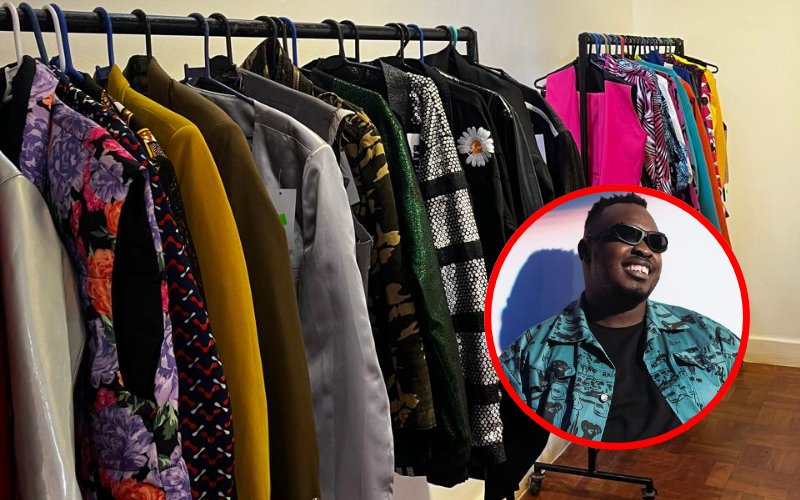
You have certainly admired those striking ensembles that command attention in music videos, electrifying live performances, and high–gloss photo shoots.
The meticulously styled looks, perfectly harmonised colours, thoughtfully curated themes, and expertly tailored designs often appear almost surreal.
Some seem sculpted from pure imagination, bold, dramatic and unforgettable.
But behind the glitz and glamour, a quiet revolution is reshaping how these statement pieces live beyond the spotlight.
Brian Babu, a top Kenyan stylist and the force behind Culture to Closet, is giving garments a second life.
Instead of letting once-iconic pieces gather dust in closets or end up in landfills, he handpicks, restyles, and reintroduces them to new audiences.
“Over the years, I realised so many pieces were simply not being used,” Babu said during his inaugural fashion pop-up in Westlands, Nairobi.
“Rather than letting them sit in storage or disposing of them, I felt it was more meaningful to allow them to find new homes. These clothes deserve a reality beyond the stage. They deserve new families and new stories.”
Babu, an acclaimed stylist behind Sauti Sol, Kodong Klan, among other top figures, further reveals that the process is deliberate.
Every item is assessed for quality, fabric integrity, timelessness, and adaptability.


“Only the best makes the cut,” he adds.
According to Global Fashion Agenda, humanity generates up to 2.3 billion tonnes of municipal solid waste annually, a tally that includes everything from food to electronics to textiles.
This is the equivalent of a garbage truck full of clothing being incinerated or sent to a landfill every second.
In essence, landfills are burdened with fabrics that take decades to decompose, releasing harmful emissions and toxins into the soil and air.
According to Babu, this reinforces the need for stylists to extend the lifecycle of clothing, to lower carbon emissions and reduce strain on natural resources.
“As a stylist, the process never really stops,” he explains.
“Almost every week, there is something new: a fresh purchase, a new design, or another production. That is why it’s important to be conscious of how much you are acquiring and producing, so that these pieces don’t simply accumulate and get discarded.”
This, he adds, might be one of the most significant transformations in modern styling.
“We have to think about this very much. It’s an important part of the cycle of clothes. Just making sure that beyond you selling kind or beyond producing the garment, you make sure the garment just doesn’t get disposed of anymore.”
“Culture to Closet is evolving toward sustainability. Its core value is ensuring produced items don’t go to waste or sit forgotten; instead, it gives existing pieces renewed purpose so people can appreciate them without always needing to create or consume more,” Babu says.