



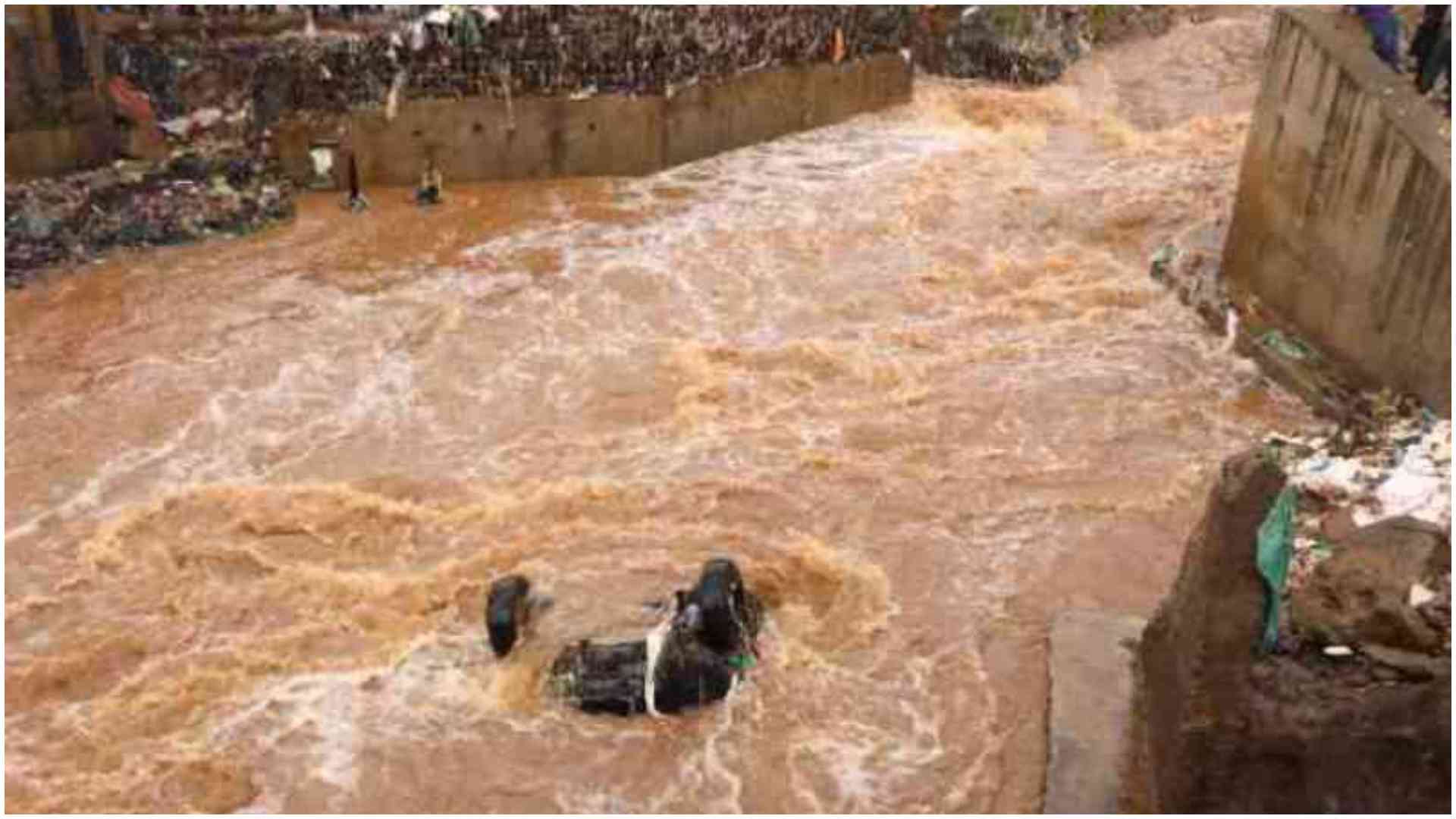
The nightmare began on a calm evening when torrential rains suddenly pounded the city, turning roads into raging rivers and sweeping away vehicles, homes, and lives.
The following morning, the aftermath was enormous as rescue teams scoured through Nairobi, Ngong, and Mathare rivers in search of trapped people and bodies.
While many caught up in the deluge managed to survive, scores others were not so lucky – they were either marooned in the floods or swept away.
The moving video image of a young mother aptly captured the desperation most city residents faced while trying to navigate their ways back home amid raging floods.
The woman was rescued, gasping for air and clinging to life, but the space on her back, where her infant had been securely strapped just moments before, was empty. The floods had claimed a victim who had not even begun to walk.
She is not alone in her grief. Across the capital, the death toll has climbed past 40, with dozens more still missing, their names whispered by frantic relatives who have not heard a voice since the skies opened up.
Some parents in flood-prone areas were forced to collect their children from schools in risky zones. Veteran Bongo Flava singer Nyota Ndogo was among those affected, as rising floodwaters around the country left her worried about her daughter, who was in another location.
In a social media video, Nyota Ndogo is seen happily hugging her daughter after a safe reunion. She revealed that the sudden emergency call from the school caught her off guard. Struggling to figure out how to reach her daughter amid the floods, she reached out to media personality and friend Willy M Tuva for help.
“Today we were suddenly told to pick up the children from school because the water is flooding the area. I was confused and didn’t know how to start my journey to Nairobi — how would I reach my child with these floods along the way?” she told The Nairobian.
The centre of this tragedy has now shifted from the flooded riverbanks to the cold corridors of the Nairobi City Mortuary. Outside the gates, the air is thick with the sound of muffled sobs as families arrive.
Man-made
In the city, the rain may be a natural phenomenon, but the pile of bodies in the morgue is a man-made catastrophe, the final, lethal price of living on the wrong side of the city’s inequality.
While condoling the bereaved families, President William Ruto described the situation as a national tragedy that has led to loss of life, displacement and destruction of property and livelihoods.
He directed the release of relief food from the country’s national strategic reserves to support families displaced by the floods.
In addition, the government will cover hospital bills for those injured and receiving treatment in public health facilities, while humanitarian support will be extended to households facing displacement. The national government, he added, is working closely with the Nairobi City County Government and other county administrations to ensure a coordinated response.
At the same time, the President noted that the floods highlight the need for long-term solutions to recurring urban flooding. According to the President, the Nairobi River Regeneration Programme will remain central to efforts aimed at restoring river ecosystems, improving drainage systems and reducing flood risks in the city.
Kenya’s climatic pattern is defined by two rainy seasons, the most significant being the long rains that typically occur between March and May. These rains are essential for agriculture, replenishing water resources and sustaining ecosystems across the country.
However, the onset of the season does not always strictly follow the calendar. In some years, rainfall begins earlier than expected, sometimes as early as February, altering the hydrological dynamics of many urban areas.
According to the Kenya Meteorological Department, the current rains came earlier. The early onset is being linked to the Madden–Julian Oscillation, a tropical atmospheric pattern known to intensify rainfall activity across equatorial regions, including East Africa.
While such climatic variations are part of natural weather cycles, their impacts are often amplified in cities where infrastructure planning and land management have not adequately accounted for extreme rainfall events.
In recent years, the consequences of heavy rainfall in Nairobi have become increasingly visible and, at times, tragic. Flooding has repeatedly disrupted transportation, damaged property and endangered lives.
Engineer John Mativo, the former Managing Director of Kenya Electricity Transmission Company (Ketraco), says the current flooding challenges reflect how urban growth has outpaced the assumptions used in earlier infrastructure planning.
As a young graduate engineer in 1990, he worked on calculations for the volume of storm water expected to pass under a proposed bridge near Athi River – estimates that were based on catchment size, land use, projected rainfall and debris accumulation.
“When you compare the assumptions we made in 1990 about urban growth and environmental use with the reality today — more hard surfaces, environmental degradation and increased waste — it becomes clear we are not living sustainably,” Mativo says. “Flooding is now a reality we must confront.”
Water plazas
According to surveyor and planner Kyalo Muema, the problem is not about unpredictable nature, but the way urban environments are planned and engineered to manage water storms and waterways.
“Flooding in cities like Nairobi is rarely just a natural disaster,” Muema says. “In many cases, it reflects gaps in planning, inadequate drainage infrastructure and a failure to integrate accurate spatial data into urban development.”
Comparisons with other cities reinforce this point. Several African cities have invested heavily in storm water management and urban planning systems that prioritise drainage and environmental protection.
For instance, Kigali, Cape Town and Casablanca have strengthened land-use regulations, improved drainage systems and implemented integrated flood-management strategies.
Globally, cities such as Singapore, Rotterdam and Tokyo demonstrate how advanced planning can significantly reduce urban flooding. Singapore, for example, operates an extensive network of canals, reservoirs and underground drainage tunnels designed to efficiently channel storm water through the city, while Rotterdam has pioneered innovative water plazas capable of temporarily storing excess rainwater during storms.
Muema notes that these examples demonstrate a crucial point: flooding in urban environments is not inevitable. “Cities around the world receive equal or even higher rainfall than Nairobi, yet they rarely experience the kind of disruption we see here,” he explains. “The difference lies in planning, engineering standards and consistent professional oversight.”
In Nairobi, persistent flooding is largely the result of structural and planning deficiencies that have accumulated over decades of rapid urban expansion. Many roads lack adequate drainage infrastructure, and existing channels are often undersized, poorly maintained or completely absent.
Effective urban drainage systems are designed to collect and channel surface runoff quickly into designated waterways. In many parts of the city, however, storm water accumulates faster than it can be discharged, leading to large pools of water on roads and low-lying areas.
The problem is compounded by sewer and storm water lines that were originally designed for a much smaller population and far lower levels of urban development.
Sakaja explanation
Architect and urban development expert Alfred Omenya has been studying Nairobi’s flooding for years. He now paints a picture of systemic failure stretching back decades but one that current leadership has failed to arrest.
“Even high-end areas like Kilimani now flood. And every year, it gets worse,” Omenya said. “Our drainage infrastructure is the same while the run-off has been increased several times because of housing developments.”
In a series of interviews after the latest devastating floods, Governor Johnson Sakaja offered several reasons why he is not responsible, arguing that the county lacks the financial resources to tackle the problem. A full overhaul of the drainage system would cost Sh25 billion, far beyond what the county can raise through parking fees and land rates.
“We receive an equitable share of Sh1.7 billion a month, Sh1.5 billion goes to salaries and Sh200 million goes to the assembly and finances to cover drainage expansions, market construction and buying new cars,” he said.
Nevertheless, topography also plays a role. Certain parts of the city have nearly equal elevation levels, meaning water lacks a natural gradient for drainage. Without engineered slopes and drainage pathways, rainwater accumulates on the surface rather than flowing efficiently toward rivers or drainage basins.
“In a properly surveyed city, infrastructure is designed around precise elevation data,” Muema explains. “When roads, culverts and drainage channels are not aligned with the natural terrain, water simply has nowhere to go.”
Buffer zones
Another major concern is the limited involvement of qualified professionals during the planning, design and supervision of infrastructure projects. Urban development is ideally a multidisciplinary process involving surveyors, civil engineers, planners, hydrologists and environmental experts.
Encroachment on river reserves and natural drainage corridors has also worsened the situation.
Rivers and seasonal streams require adequate buffer zones to accommodate increased water flow during heavy rainfall.
However, rapid urban growth and unregulated development have led to the construction of buildings and other structures within natural floodplains. These encroachments restrict water flow and reduce the capacity of rivers to handle storm runoff, causing water to spill into surrounding areas.
To address the problem effectively, Muema insists that Nairobi must begin with accurate spatial mapping of its terrain and infrastructure systems.
“You cannot manage what you have not measured,” he says. “Comprehensive topographical surveys are the foundation of any sustainable drainage strategy.”