



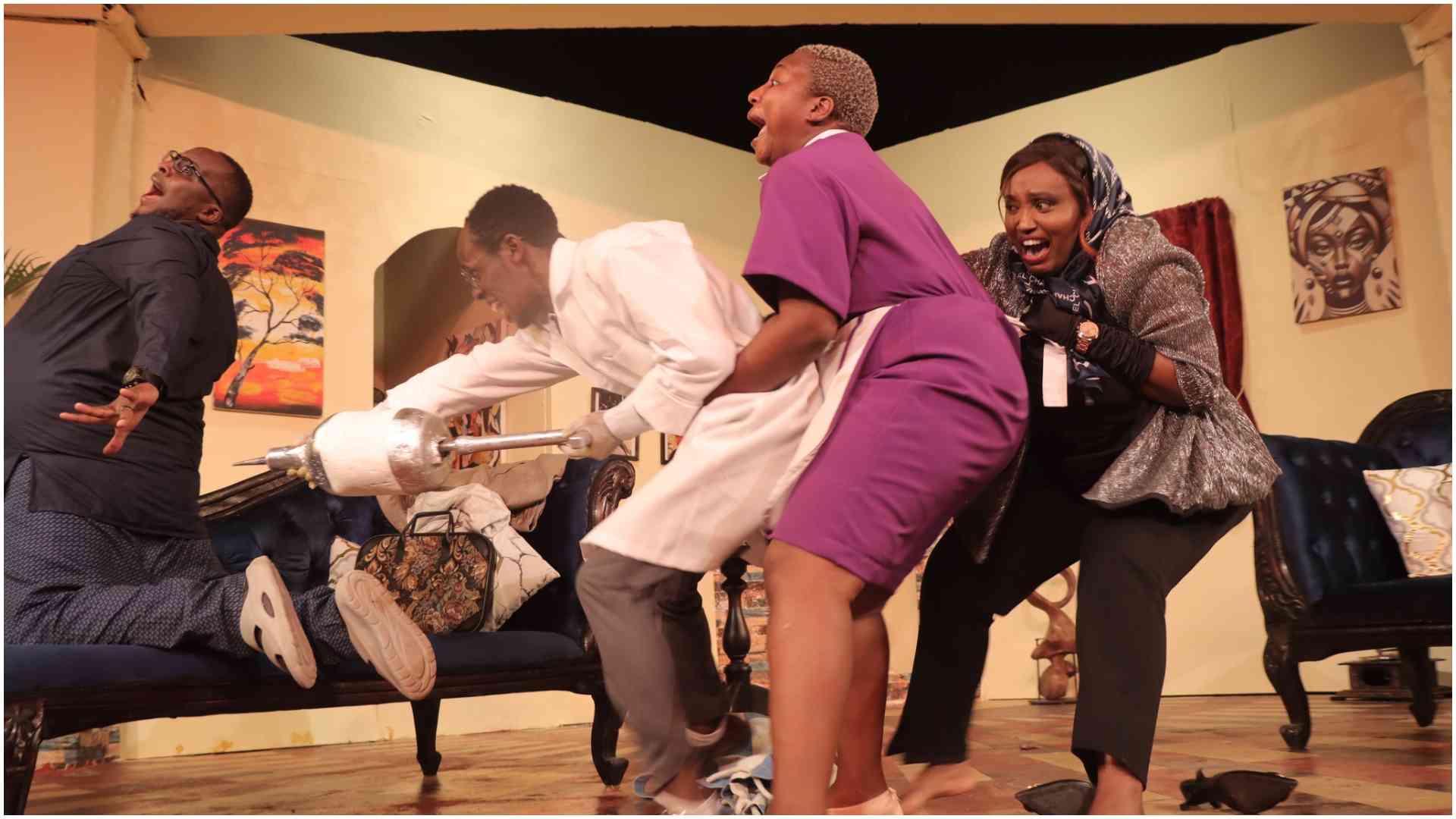
A staging of Mgonjwa Mwitu focuses on the problem of fake doctors exploiting vulnerable patients and the scandals that presently go on in the health sector. The play is brought on stage by the Nairobi Performing Arts Studio from March 26 to 29 at the Kenya National Theatre.
The production is an adaptation of the 17th-century French playwright Molière’s La Malade Imaginaire, written in 1673. The story, however, has been adapted for a contemporary Kenyan audience, scripted by Gadwill Odhiambo.
“It has been completely updated and is now set in 2026 Nairobi”, Director Stuart Nash explains.
Odhiambo recently adapted Molière’s satirical play, Les Précieuses Ridicules (The Pretentious Young Ladies), and renamed it Vienyeji Promax, which was staged in 2025. He has also adapted other Molière plays: Mstinji, Sirano Wa Begeraki, and Mtakatifu Bonoko. He won the Best Adaptation award at the Kenya Theatre Awards for Sirano Wa Begraki in 2025.
Mgonjwa Mwitu revolves around Agani (played by Ben Tekee), who is a wealthy hypochondriac obsessed with his imaginary illnesses. He is manipulated by doctors Pagoni (played by Pish Kago) and Feruzi (played by Mavin Kibicho), who exploit his medical fears for financial gain. Agani marries off his daughter Angelica (Ntinyari Karani) to a budding doctor, Thomas Dafrosi (played by Dominic Mutemi), but she is in love with an artist, Clinton (played by Ted Munene). Exploring the themes of false doctors, fraud, greed, love and death, the play also stars Wakio Mzenge, Cosmas Kirui, Mary Mwikali, Elvis Kiarie, and Terry Ng’ang’i.
Nash explains that the idea for Mgonjwa Mwitu came about from conversations and research around everyday experiences that rarely make their way onto the stage. Even though it is a very serious topic, he says that he wanted to also make it funny.
“From our research, it is an issue which many people have experienced, but it has not been addressed in a play before, so we thought it would be an interesting angle to explore,” he says.
Nash believes that medical quacks seem to be quite rampant in everyday life. That, in fact, public response to the production’s publicity has reinforced just how widespread the problem is. Since they released the poster and commercial, they have received so many comments from people saying they have experienced this issue, and some of them in the last few days, making it a very common contemporary issue.
While the doctors appear in Molière’s original play, this production pushes their portrayal further. The doctors in Mgonjwa Mwitu have made them more comical and more extreme.
The exaggeration was meant to make the production a comedy. Nash gives a gist of one of the comical scenes that shows one of the ‘doctors’ trying to inject a ‘concoction’ into the patient with a massive syringe.
“It was a combination of the original play coupled with real-life experiences…but exaggerated. The reinterpretation blends the source material with lived experience,” he says.
He continues: “The adaptation mostly deals with the extreme lengths these fake doctors will go to scam people out of their money to great comic effect.”
This will be Mgonjwa Mwitu’s rerun since its premiere on stage at the Alliance Française Nairobi in 2024, where it was warmly received. Other than reinventing the production, the team chose to build on what worked.
Nash hopes that audiences leave the theatre reflecting on and questioning the systems around them. What may intrigue audiences most, he believes, is how closely the story mirrors real life.
“I think the audience will find it intriguing how relatable the show is with the scandals that go on in the health sector today. I think everyone knows someone who’s been cheated by a fake doctor,” he says.