



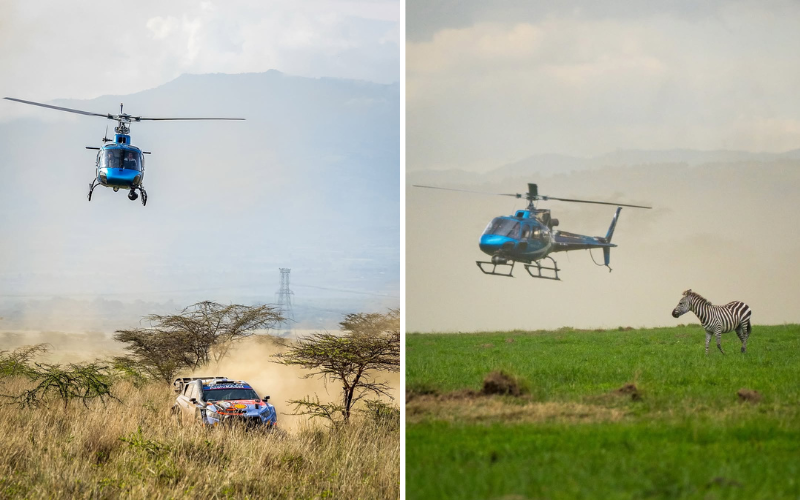
The roar of engines echoes across the Naivasha plains as rally cars tear through the unforgiving terrain.
At Miti Mbili, the famous natural staging of the Safari Rally, cars literally take to the air, much to the delight of thousands of fans who braved the muddy affair, and sometimes the dust, to catch a piece of the action.
But while fans’ eyes are fixed on the ground, another spectacle unfolds above, the legendary exploits of William Dyer, the Tropic Air helicopter pilot whose aerial manoeuvres have become as entrenched in Kenya’s sporting spirit as the rally itself.
Dyer dips low, his Airbus H125, registered as 5Y-BXE, skimming the treetops to trace the rally cars’ paths with unmatched precision. One moment, he is banking hard into a turn, the next, he is hovering dramatically to mirror the adrenaline below, all the while coordinating his moves with the filming crew operating a Cineflex camera system mounted on the nose.
As a young boy, Dyer watched the old Safari Rally cars zoom through the countryside with a sense of pride before the event went off the World Rally Championship radar. However, the return of the rally to Kenya five years ago as part of the WRC has seen a large number of fans show up each year, as evidenced by heavy traffic on the Naivasha South Lake Road last week.
While he no doubt saw the crowds from the air, Dyer could not fully comprehend the fans’ rollercoaster of emotions, but he has certainly become a household name among followers of the high-adrenaline event.
“It’s obviously a great privilege to be part of the Safari Rally providing the view from the sky,” he tells the Sunday Standard in an interview. “It’s certainly one of the better jobs to be involved in the WRC, and we at Tropic Air are thrilled with the response from fans throughout Kenya.”
In filming the rally, Tropic Air dispatched the Airbus H125, a high-capability machine described by the company as “the best in its field with superior performance in extreme environments”.
The helicopter, well suited for low-level flying, has an endurance of up to 3.5 hours, or in comparison, about the time it takes for a commercial jet to fly between Nairobi and Johannesburg, South Africa.
Dyer describes the other helicopter model in the fleet, the H130, as a great aircraft for carrying passengers on sightseeing tours but one that does not quite have the agility required for the filming job, especially with fast-moving rally cars in extreme terrain.
“The helicopter we use for the filming doesn’t compare to any other aircraft for the job. It’s a very manoeuvrable aircraft with a lot of power and not many aircraft would be able to do the job in the hot climate and relatively high altitude,” he says.
To the fans, Dyer’s manoeuvres seem effortless, but behind these moves is a well thought out plan that includes mental and physical preparation before demanding flight events like the Safari Rally. The safety of his crew, drivers and fans is paramount and cannot be compromised for any thrill the rally brings.
Besides getting enough rest, Dyer, who has flown for the company for 10 years, maintains discipline by setting personal limitations and sticking to them. In any case, four days in the field should be enough to afford the filming crew perfect chances for the iconic shots that are beamed worldwide.
“Safety always comes first and you just can’t become complacent whilst flying,” says Dyer.
“At the end of the day, the safety of the people on the ground as well as your own crew is always more important than the shot. You have to pick your opportunities to get more dynamic and there just happen to be plenty of those on the Safari Rally.”
Dyer grew up in a family of pilots in Laikipia, his grandfather being the pioneer in the family who flew different types of fixed-wing aircraft in Kenya, from the old 1920s era aircraft to more modern ones in his later years. He was still flying at the age of 80. For young Dyer, taking to the air came naturally.
That upbringing in remote parts of Kenya shaped his perspective on flying and adventure, highlighting that the best part of flying is how accessible places can be and how it is both a luxury and an unmatched tool in supporting ground operations and adventure.
“I was lucky to be around aviation from such a young age and, as many little children would be, I was hooked on the idea straight away,” says the pilot, who trained both in Kenya and the United States.
At Nanyuki Airfield, Dyer had an instructor known as Mike Kibe and, being Kibe’s only student, Dyer was allowed full use of the aircraft and the incredible northern Kenya landscape, flying into short dirt airstrips. This offered him a unique training environment that he would later put to good use. In America, he trained at larger schools in and out of controlled, busy airports which had far more regulations to follow.
“You come out of flight school thinking you know everything, but what you learn from experienced pilots around you is what makes you a safer and more proficient pilot. All lessons were incredibly memorable and I was also lucky to be surrounded by years of experience in my family,” he says.
Despite his prowess with helicopters, Dyer has had considerable experience with fixed-wing aircraft like the Cessnas at Tropic Air and jokingly says he must remind himself that the latter cannot hover like helicopters.
Still, he says many of the disciplines needed to fly the two types of aircraft are the same, though helicopters require more coordination. “It’s just a lot of training and, again, to never become complacent,” he says.
With Tropic Air having a variety of aircraft, it is possible for a pilot to go straight into the captain’s seat of the small four-seater Cessna 182 after the initial training. After building up experience and sitting in the co-pilot’s seat in the Cessna 208 Caravan, one is then released on his own as captain.
“Such confidence comes from great company training. You are only released when both you and the training captains are comfortable that you can do your job safely,” he says.
Are you thinking of becoming a helicopter pilot one day? Dyer has a word for you: “It is not an easy or cheap career to pursue. Joining the military is a great way of getting trained up and building valuable flying experience. You need to be determined to succeed.”
In the meantime, Dyer will keep flying, exploring new places and learning new skills.