



World Poetry Day, held every year on March 21, celebrates poetic expression and was first recognised by UNESCO in 2000.
We spotlight five poets who are pushing the boundaries of the craft in diverse ways.
Maxie Daniel
“… I want to tell her I am sorry; I want to hold her close, but how when she wronged a man the moment she became a woman.” – A Woman, by Maxie Daniel.
On World Poetry Day, Maxie Daniel hosted the second annual World Poetry Day Gala and Awards at Baraza Media Lab in Kisumu, an event she built to celebrate poets who are often overlooked due to bureaucracy and gendered challenges such as sexual harassment in the arts.


The event started as a gala in 2022 and evolved into an award show in 2025. It grew from her desire to provide publicly recognised awards for poets and now includes six categories decided by audience nominations and votes.
Her path into the world of words began in 2003 through her mother, a talented but unpublished writer who encouraged her to perform from a young age.
Though she paused at times, Maxie returned to poetry in 2016 and fused spoken word with music and dance. This year marks her tenth anniversary in the craft, with her poetry book titled Scars That Healed Not available at Lolwe Books in Kisumu and Nuria Bookstore in Nairobi.
Her poetry tackles feminism, gender justice, political accountability, self-love, and the complexities of adult healing.
“Poetry is a conversation starter. I want to comfort the afflicted and confront the comfortable,” she says.
A. Amari
“You bloom in your own time. Just like the moonflower blooms at night, singing an ode to the moonlight.” – A Time to Bloom, by A. Amari.

A. Amari organises poetry concept shows such as The Night of the Moonflower, Kanga Kisses, and Matatu Beats that explore themes of growth, love, African identity, and societal norms.
The moonflower, which blooms only at night, symbolises childhood conditioning, societal expectations, and the journey toward authentic selfhood. Through interactive performances, she blends poetry, music, and wellness.
“Poetry is my release; I write to process emotions. It helps me understand myself and others, and sometimes I just write for fun,” she says.
Her work revolves around nature, questions the status quo, examines womanhood and identity, and encourages reflection and healing.
A. Amari says she translates complex topics like human rights and environmental issues into accessible art. She also offers joy and reflection in a world filled with anxiety and conflict.
Umutoni Poet
“I am learning that becoming does not arrive gently.
It breaks you in places
you once called home,
then rebuilds you
into someone you barely recognise,
yet somehow,
finally understand.” – Becoming, by Umutoni.
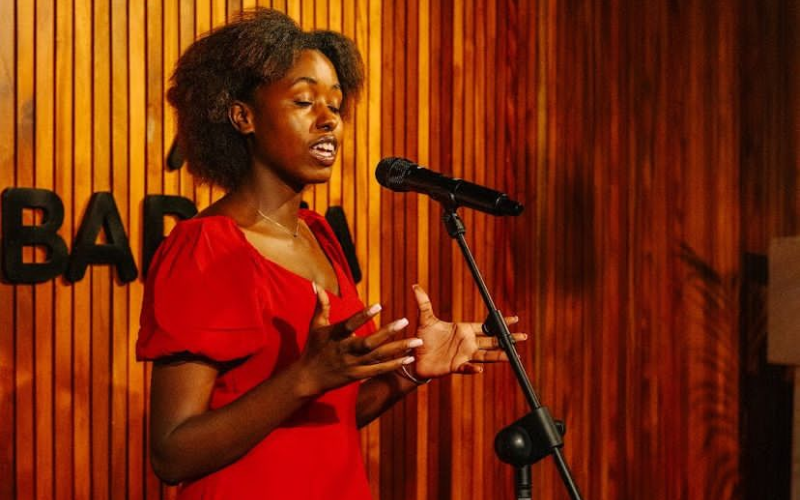
Umutoni says that, for her, poetry started as scattered thoughts, unfinished sentences, and emotions she did not have the courage to express.
She was never the loudest person in the room or the one who could easily explain her feelings. She first wrote when she felt overwhelmed or when she struggled to make sense of unnamed emotions.
“I noticed that every time I wrote, I felt lighter because my problems finally had somewhere to exist outside of me,” she says.
“Poetry chose me during vulnerable moments, and I embraced it during clearer times. It is where I am the most honest, raw, and real. It became part of who I am,” she shares.
Her poetry explores unspoken emotions, identity, self-discovery, inner conflict, healing, growth, and inner battles. It also tackles duality, such as strength and vulnerability, confidence and self-doubt, and faith and questioning.
“It allows me to be open, honest, and expressive in ways the world doesn’t always facilitate,” she says.
Scar Poetry
“And still we celebrate firsts.
Still, we clap when a woman breaks through a glass ceiling that should not exist.
Still, we act as if one success is proof that the system works.
But progress is not proven by exception.
It is proven by repetition.
By the day a woman does something and no one thinks to count it.
By the time a girl rises, it is ordinary.
By the time we stop saying ‘despite being a woman’ and simply say ‘leader’.” – The Grief of Being First, by Scar Poetry.

Scar Poetry’s work is themed around life, identity, womanhood, faith, empathy, and the human experience. She shares that by reading poems, she is able to better articulate her feelings.
“I think poetry sees us in all our moments and what it means to be human. It holds the memory for us,” Scar Poetry says.
Spontaneous the Poet
“Listen, you’re not crazy when your mind wanders; you’re the next brilliant idea that the world awaits.” – Listen, by Spontaneous the Poet.
Her poetry explores human rights, gender justice, mental health, governance, democracy, and social justice.

Spontaneous the Poet is also a co-founder of Female Poets Kenya, a female-led spoken word initiative that began in January 2023 after the tragic loss of a poet. \
The collective has 106 members and aims to empower women poets in Kenya through artistry, healing, and economic opportunity.
“It aims to become the country’s leading community of female spoken word artists, thriving artistically, economically, and mentally, and to build a resilient community of female poets,” she says.