



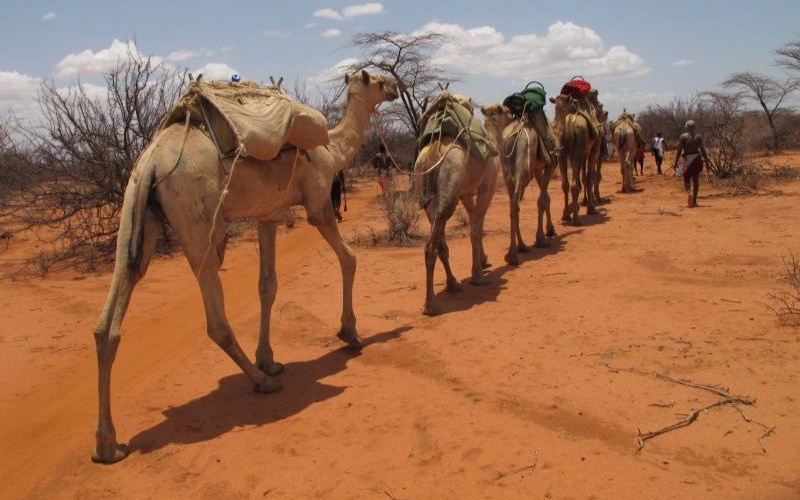
In the drylands of northern Kenya, in Isiolo and on the edge of Samburu and Laikipia, survival is not struggle. It is knowledge, memory, and a quiet relationship between people, animals, and land. The road here does not announce itself. It thins, from tarmac to gravel and then to memory.
Then the dust rises. Not in protest or anger, but as if in recognition. It lifts gently behind hooves and tyres, curling into the air like a quiet greeting, the kind reserved for those who have come far enough to understand that this land does not reveal itself all at once.
From a distance, it looks empty. Yet it stands still long enough before the silence begins to speak.
In the vast grazing lands of Samburu and Laikipia, a line of cattle appears. Slow, deliberate, unhurried. Behind them, a herder walks with a stick in hand, his eyes scanning the horizon with a focus that feels older than he is.
Somewhere further back, a woman adjusts the beads around her neck, balancing beauty and weight with the ease of someone who has done this all her life.
And just like that, the illusion breaks. This is not emptiness. This is a place that knows how to survive.


Here, distance is not measured in kilometres. It is measured in endurance.
You feel it in the way the land stretches without apology, wide and uncompromising. The wind, when it comes, carries more dust than relief.
Every movement has intention. I learned this when I walked with a herder for a while and began to see what the untrained eye misses.
Simon Lemayian, the herder, does not just move cattle. He reads the land, scanning the terrain as he does so. A slight shift in the wind, thinning of grass, the behaviour of goats—none of these are small observations. They are decisions, survival mechanisms.
“Rain passed here,” he says at one point, pointing to a patch of ground that, to me, looks no different from the rest. I look again. Still nothing.
However, to Lemayian, it is obvious. As we trek further, the cattle slow down, bunching together as if in quiet agreement. The herder pauses—not impatiently, not forcefully. He waits. There is no rush. Time, like everything else here, is negotiated.
In the distance, a group of women emerges, their silhouettes steady against the harsh light. Their beadwork catches the sun, small, deliberate bursts of colour in an otherwise muted landscape. They walk with purpose, containers in hand, heading toward a water source that is neither guaranteed nor close.
Water here is not taken for granted. It is planned for. One of the women laughs as she passes, a soft, unexpected sound that cuts through the stillness. It lingers briefly before the wind carries it away.
Perhaps that is the first lesson this land offers a first-time visitor: survival and joy are not opposites. They exist side by side, each making the other possible.

By midday, the heat has settled into my bones. The kind that does not just sit on your skin, but presses inward, demanding acknowledgement. I begin to understand why movement here is slow, measured, intentional. Nothing is wasted—neither energy, effort, nor time. Even silence has purpose.
A delicate relationship
As I tag along with Lemayian, I am eager to learn the stories of the land.
Later, under the thin shade of an acacia tree, the herder beckons for us to sit and rest.
The cattle seem in tandem with Lemayian’s move. They rest nearby, their breathing steady, their presence grounding. There is no dramatic moment, no grand declaration—just quiet coexistence between human, animal, and land. It is here that the realisation settles.
For a moment, I am lost for words as I listen to the herder’s tales of the land and his ancestors, who have lived here the longest. “What we often call harsh is, in truth, precise. This land does not allow carelessness, nor does it forgive easily,” he says.
Lemayian reaches for a traditional belt fastened at his waist, fetches his engoti—a calabash flask—and a calabash cup, pours some liquid into it, and hands it over to me (I pray it isn’t blood), before drinking from it himself.
“My people have an outstanding relationship with the land—with the animals, the seasons, and with each other,” he says.
As the sun slowly descends, the landscape softens. The dust, once sharp and restless, now glows golden in the fading light. The same path I had arrived on now feels different. Not because it has changed, but because I have.
And at this moment, I realise: nothing here is accidental—not the movement, the waiting, or the intervals of silence. Everything belongs.