



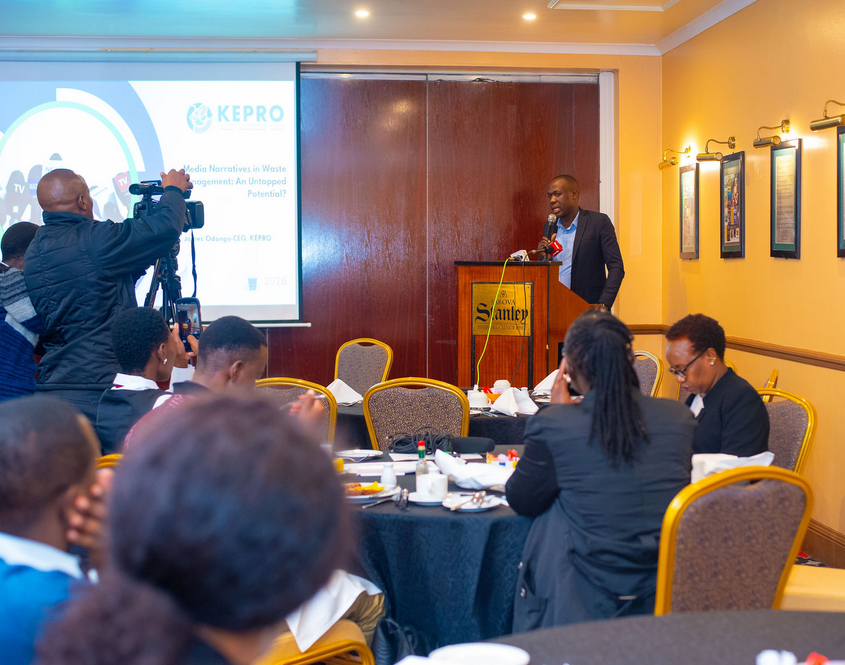
Kenya Extended Producer Responsibility Organization [KEPRO] trains journalists on waste management rules in Kenya
The Kenya Extended Producer Responsibility Organization [KEPRO] has held a media engagement in Nairobi aimed at strengthening public understanding of Extended Producer Responsibility enforcement and the role of journalists in promoting accountability in environmental practices.
The meeting, held at Sarova Stanley Hotel, brought together stakeholders from government, industry and the media.
It focused on improving awareness of the Extended Producer Responsibility (EPR) framework and its enforcement, as well as highlighting the importance of accurate reporting in supporting Kenya’s shift towards a circular economy.
KEPRO Chief Executive Officer James Odongo said the organisation continues to support producers in meeting their regulatory obligations while contributing to improved waste management systems in the country.
He noted that since its establishment in 2021, KEPRO has expanded to become the country’s largest Producer Responsibility Organisation in the non-hazardous packaging sector, supporting more than 1,400 member companies and operating across all 47 counties.
He added that the organisation has held more than 700 awareness forums and mobilised over KES 300 million to support recycling and recovery initiatives.
According to Odongo, with the gazettement of the Extended Producer Responsibility Regulations, 2024, enforcement has now been fully operational under the oversight of the National Environment Management Authority.
He explained that compliance requires producers to register with the authority, obtain licences, join a Producer Responsibility Organisation, and declare packaging volumes through Monthly Volume Declarations.
These declarations are used to determine EPR fees that fund waste collection, recycling and recovery. He warned that non-compliance may attract regulatory sanctions and possible disruptions to business operations.
“EPR should not be viewed solely as a regulatory obligation, but as an opportunity to drive innovation, resource efficiency, and long-term sustainability,” he said.
“The media plays a pivotal role in shaping this narrative and ensuring that both businesses and consumers are informed and accountable.”
A panel discussion at the event explored the relationship between media, policy and industry in promoting environmental accountability. Participants included representatives from NEMA, the Association of Media Women in Kenya and the Kenya Association of Manufacturers, among others. The discussions centred on the need for responsible journalism, improved access to information and stronger collaboration between stakeholders.
NEMA representative Eng. Bonface Mamboleo said many cases of non-compliance arise from limited awareness rather than deliberate disregard of the regulations. He urged the media to help clarify EPR requirements and address misconceptions, including the belief that EPR is a tax. He said EPR is a framework that requires producers to take responsibility for their products beyond the point of consumption, including the management of post-consumer waste.
Queenter Mbori of AMWIK said the media has a responsibility to shape public understanding and called for more consistent and solutions-oriented reporting on environmental issues.
She stressed the need to simplify complex topics such as EPR while maintaining accuracy and balance, and encouraged collaboration between media and institutions to sustain public engagement.
Georgina Wachuka of KAM said the manufacturing sector is increasingly adopting circular economy practices, including innovations in packaging and refill systems. However, she pointed to ongoing challenges related to policy clarity and implementation, and called for continued engagement, clear guidelines and capacity-building to support compliance and industry growth.
The engagement also underscored Kenya’s broader environmental efforts, including progress since the Kenya Single-Use Plastic Bag Ban 2017, which has driven increased private sector participation in responsible waste management and sustainable packaging.
Journalists who attended the session said they are committed to promoting informed and responsible reporting on EPR and sustainability issues, including raising awareness on waste management and supporting accountability across the value chain.
The forum concluded with a networking session aimed at strengthening ongoing collaboration between the media and stakeholders in advancing Kenya’s circular economy agenda.