



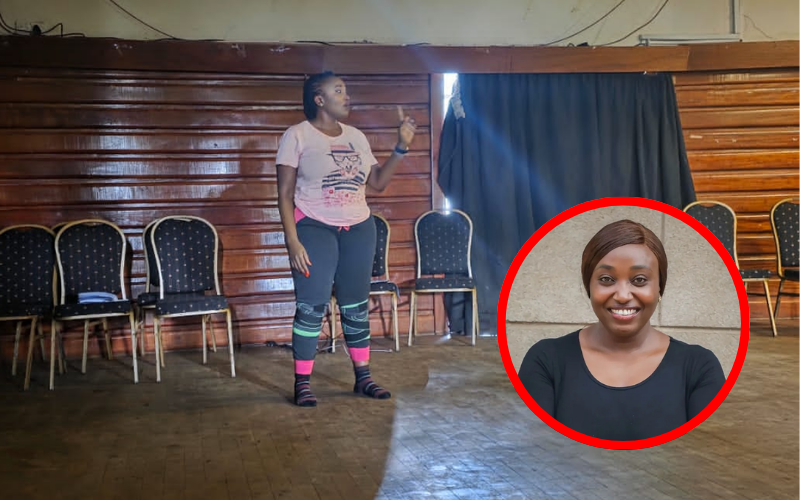
The monologue piece 1982 ni Mimi is set during the historical 1982 coup attempt. Performed by Mwikali Mary and written and directed by Wakio Mzenge, it will be staged at Cheche Gallery, Kenya Cultural Centre, on March 27 to mark World Theatre Day.
Rather than focusing on powerful figures or the state response, the piece turns away from dominant narratives and instead fictionally reimagines the coup through the lives of those who never made it into the history books.
The story unfolds over the six hours of the coup attempt and how they altered the life of a woman portrayed by Mwikali.
She interprets “Mimi” as the people who never made headlines, yet directly felt the effects of the coup.
A first-time solo performer, Mwikali also embodies three additional characters: two women from different periods in time and a lawyer observing her husband.
“I’m representing the ordinary person whose life ended, whose marriage ended, or whose way of making a living ended. It is about remembering and creating awareness about the people who were affected, but whose stories were never told,” she says.
Mwikali recalls knowing that Mzenge was writing a piece for World Theatre Day and had her in mind for it, though she did not expect the performance to be as emotionally demanding as it has turned out to be. She describes it as intense work, shifting between multiple characters with deeply layered storylines.
In staging this historical fiction, she says she does not feel pressured to make the audience see things from her characters’ perspectives.
“It is about being authentic and true to the character, and I hope the story teaches, influences, and touches someone,” she adds.
Mzenge shares that the father of her children was born on July 30, 1982. His father, who was serving in the Air Force at the time, was unable to see his newborn son due to duty. This moment became her entry point into the story.
It shifted her focus away from political narratives toward the intimate, often disregarded experiences of ordinary people, reclaiming voices that have long been silenced.
“1982 ni Mimi is not a character but an assertion of ownership and a demand for justice. It speaks through a woman who, though still alive, lost her life in the aftermath of Hezekiah Ochuka’s six-hour presidency,” she says.


Though fictional, the story raises questions about how many other stories remain untold.
“Through this lens, the play seeks to illuminate the quiet, often invisible lives that were forever altered in ways history has yet to fully acknowledge,” Mzenge explains.
She notes that one of the key challenges as a director has been guiding Mwikali through the character’s shifting emotional states. The performer moves across different historical periods and physical spaces, sometimes suspended between them. The task, she says, is to ground these transitions in truth so that each shift, however abrupt, remains human.
Mzenge hopes the production will spark curiosity and empathy, prompting audiences to reflect on which stories have been left out, who gets remembered, and how those silences persist.
“There is a human cost to history far beyond what is documented. If the performance lingers, if it stirs discomfort, compassion, and a need to question, then it has done its work,” she says.