

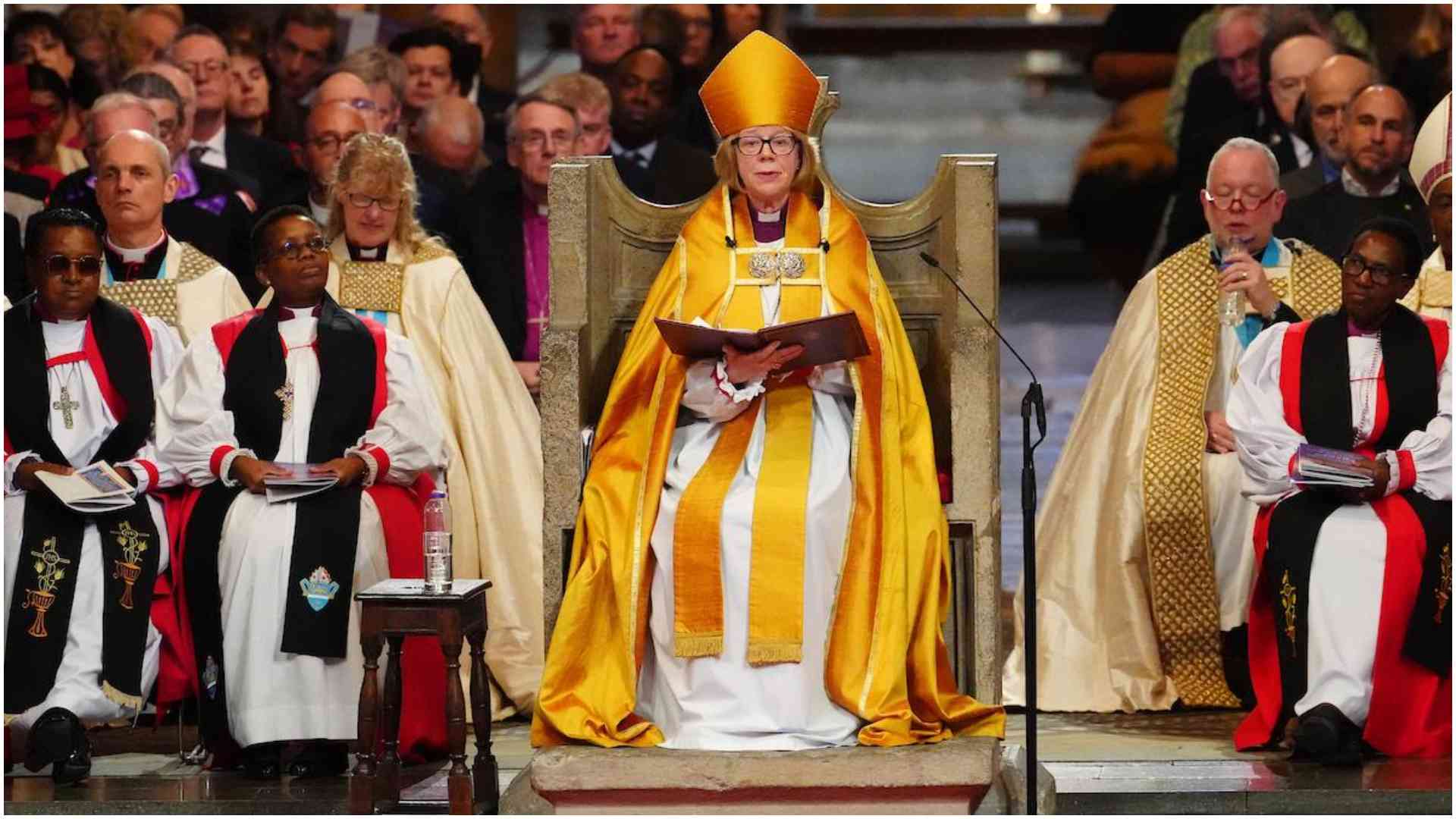
Sarah Mullally was installed as thefirst female Archbishop of Canterbury (Photo courtesy/Archbishop of Canterbury/ Lambeth Palace)
A centuries-old tradition was rewritten in a powerful and symbolic ceremony at Canterbury Cathedral, as the 106th Archbishop of Canterbury, Sarah Mullally, was formally installed, becoming the first woman ever to hold the revered position.
The historic service drew Anglican primates and representatives from across the globe, underscoring the international significance of the moment. It was not just a ceremonial transition of leadership but a defining shift in the evolution of the Church of England.
In her inaugural sermon, Mullally struck a tone of hope and renewal, calling on the global church to rise to the spiritual and social demands of a changing world.
“Our world today needs the love, healing and hope that we find in Jesus Christ,” she said. “I continue to pray that we renew our confidence in this good news and recommit ourselves to sharing the joy of the Gospel.”
She envisioned a more inclusive and outward-looking church, one that transcends traditional boundaries.
“A church for the whole nation and for the world,” she declared, “which looks for ways of joining with people of all faiths and none in acts of service that will transform.”
The 90-minute installation ceremony blended deep tradition with modernity and inclusivity. It began with Mullally knocking three times on the cathedral’s west door, a ritual symbolising humility and service, before being welcomed inside by local schoolchildren.
Among the high-profile attendees were William, Prince of Wales, and Catherine, Princess of Wales, alongside UK Prime Minister Keir Starmer. Their presence reflected both the religious and national significance of the occasion.
Just weeks before her installation, Mullally met King Charles III at Buckingham Palace, where she formally paid homage to him in his role as Supreme Governor of the Church of England, a constitutional link between church and state that remains central to British identity.
Mullally’s rise to the top of Anglican leadership marks a profound milestone in a church that only began ordaining women as priests in 1994 and consecrating female bishops in 2014. Her appointment, announced last October, signals how far the institution has come and how quickly it is evolving.
Reflecting on her journey, Mullally acknowledged the weight of the moment.
“As I look back over my life, I could never have imagined the future that lay ahead, and certainly not the ministry to which I am now called,” she said.
Beyond England, her role carries global significance. As spiritual head of the Anglican Communion, a worldwide fellowship spanning tens of millions of believers, Mullally now stands at the helm of a diverse and complex faith network.