



A duo exhibition, Let There Be Light, which opened on March 16 and is on view until April 26 at the HOF Gallery in Kibera, showcases 40 works by Jimmy Kitheka and Edgar Keng’ara.
It explores different forms of light, such as moonlight, lamplight, bulb light, headlight and street light, to dive into themes of memory, identity, security, guidance and reflection.
Kitheka’s focus is on the external qualities of light while Keng’ara’s is on its symbolic and internal meanings. The exhibition is curated by Jamey Ponte and Santana Sino.
Working in oil on canvas, Kitheka’s body of work uses light to create nostalgia for rural and urban experiences. He portrays ordinary scenes where light is used, such as walking to a nearby shop at night. In this sense, light represents security and memory.


Where Shadows Rest is an oil on canvas painting; moonlight and lights from other houses reflect inside one home. On the wall, there is a mask referencing the Kamba community, and another mask stands on a table representing another African tribe.
In The Sitting Pillar, a woman is depicted gracefully seated and knitting, surrounded by layers of fabric. Behind her hangs an image of a Luo elder. The piece is a part of his ongoing Pillars of Identity series, in which he incorporates African sculptures, masks and photographic references to examine themes of culture and belonging.
In each exhibition, he explains, he tests ideas that may later become the main theme or style of the next one. He experimented with light and shadow through two pieces in a duo exhibition with Patrick Mukabi titled From Dust to Form, hosted at the Ardhi Gallery last year.

He received positive responses from the two pieces, A Game Like This and Dreamcatcher, which encouraged him to continue developing the concept.
The Kipande I and Kipande II are two small works; one’s medium is charcoal, and the other is sanguine, depicted as blurred portraits inspired by older identity cards, like his grandfather’s.
Kitheka presents some of his works, such as these two, on textured yellow paper created using a sanguine pencil sourced in Italy. The medium produces warm tones that evoke a vintage aesthetic, which are reminiscent of aged photographs. The reddish and yellow hues tell a story of memory and personal history.
“I want to remind people of the things we lose when time goes by. Some memories remain with lights. Don’t lose the memories even as you end up in other places,” he says.
Edgar Keng’ara’s works were created during a period of introspection; therefore, his works examine themes of guidance and spiritual awareness. Light, in his approach, is about internal awareness of the direction of life.

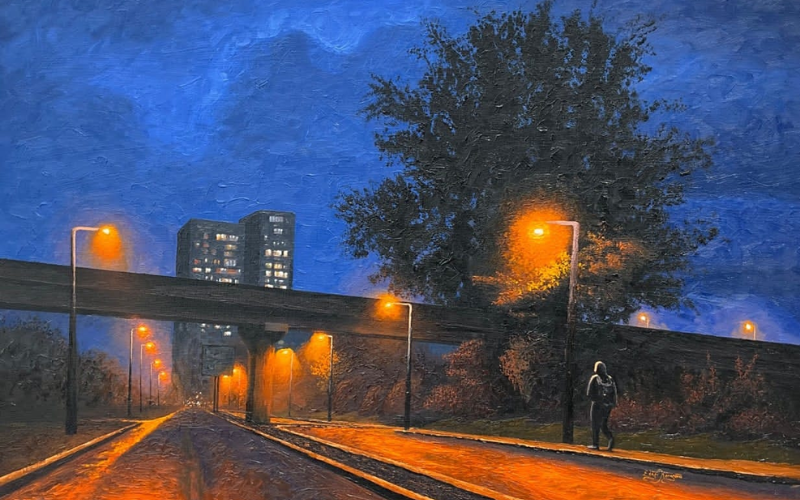
In Walking Faith, an oil painting on canvas, it is a night scene along a highway illuminated by headlights and distant building lights. The building represents formal employment. The artwork shows the expectations placed on individuals from a young age to pursue education, get a job, and build a future.
“I came to realise that while we are given advice by other individuals, the person makes the decisions alone and will feel their impact alone,” says Keng’ara.
The artwork named Brother’s Keeper shows a young boy carrying a smaller sibling along a rain-soaked path at night, holding a lantern that illuminates their way. The potholed road suggests a challenging environment. Here, light symbolises support, while the older boy guiding the younger shows the ways in which people rely on one another.
The piece, Brush with Fame, is set outside the gallery; the painting depicts three figures in conversation at night, with their reflections in a nearby pool of water.
The setting recalls his brief interaction that actually took place with a veteran visual artist that he admires. The artwork examines the fleetingness of unexpected opportunities when one is not prepared for them.