



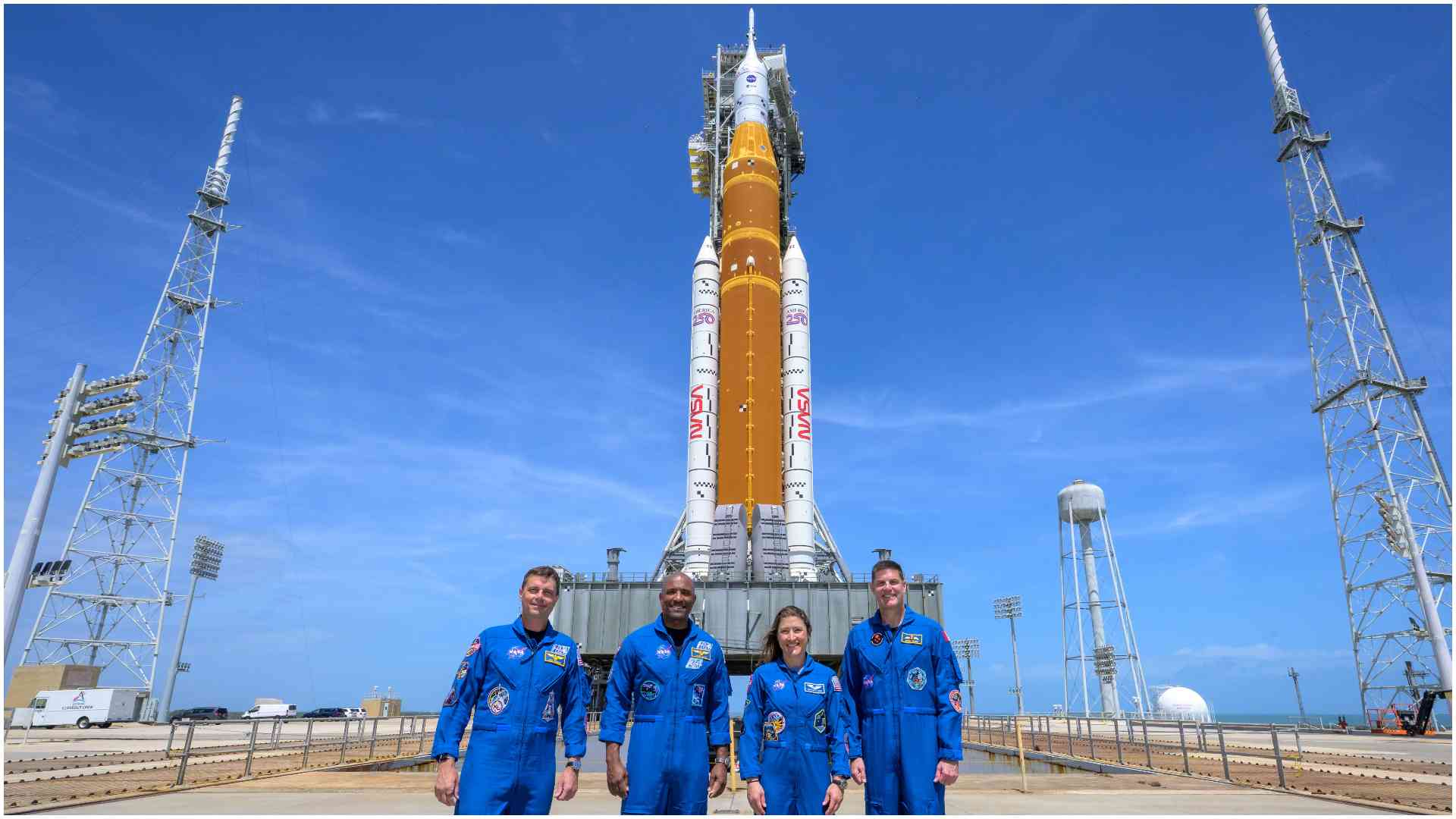
Humanity has officially returned to deep space with the launch of Artemis II, sending four astronauts on a historic lunar flyby that marks the first crewed mission beyond Earth’s orbit in over 50 years.
Lifting off from Kennedy Space Center under bright skies, the towering 32-storey Space Launch System (SLS) rocket roared into orbit after a morning of careful fueling with liquid hydrogen and oxygen.
Tens of thousands gathered along Florida’s coast to witness the long-awaited launch, a defining moment for NASA as it seeks to return humans to the Moon and eventually reach Mars.
The crew Reid Wiseman, Victor Glover, Christina Koch, and Jeremy Hansen embarked on the nearly 10-day mission that will take them around the Moon without landing, echoing the path of Apollo 8 in 1968. Their journey also marks several milestones, including the first woman, first person of color, and first non-American to fly on a lunar mission.
“On this historic mission, you take with you the heart of this Artemis team, the daring spirit of the American people and our partners across the globe, and the hopes and dreams of a new generation,” launch director Charlie Blackwell-Thompson said, according to CNN. “Good luck, Godspeed Artemis II. Let’s go.”
The mission has been years in the making, plagued by delays, technical challenges, and cost overruns. Earlier tests had revealed a dangerous hydrogen leak, forcing engineers back to the drawing board. But this time, more than 700,000 gallons of fuel were loaded without incident. Additional technical concerns including a communication issue with the rocket’s flight termination system and a temperature irregularity in Orion’s abort system were resolved before liftoff.
Once in orbit, the astronauts began a series of system checks aboard the Orion capsule, testing life-support, navigation, propulsion, and communication systems. After one to two days in high Earth orbit, the spacecraft will execute a crucial translunar injection burn, propelling it toward the Moon.
During the journey, the crew will travel farther from Earth than humans have in decades. As commander Wiseman noted shortly after launch, “We have a beautiful moonrise, we’re headed right at it,”
The spacecraft will loop behind the Moon on a free-return trajectory, using lunar gravity to swing back toward Earth with minimal fuel. After several days in deep space, Orion will re-enter Earth’s atmosphere at speeds exceeding 40,000 kilometers per hour before splashing down in the Pacific Ocean.
Beyond the technical milestones, Artemis II represents a broader vision. The mission is a stepping stone toward establishing a sustained human presence on the Moon, with ambitions of building a lunar base and eventually sending astronauts to Mars. As astronaut Koch previously explained, the Moon could serve as both a proving ground and a “Rosetta Stone” for understanding the formation of other solar systems.
For many, the mission also carries symbolic weight. “There are a lot of people who don’t remember Apollo… This is their Apollo,” NASA science chief Nicky Fox said earlier this week.