



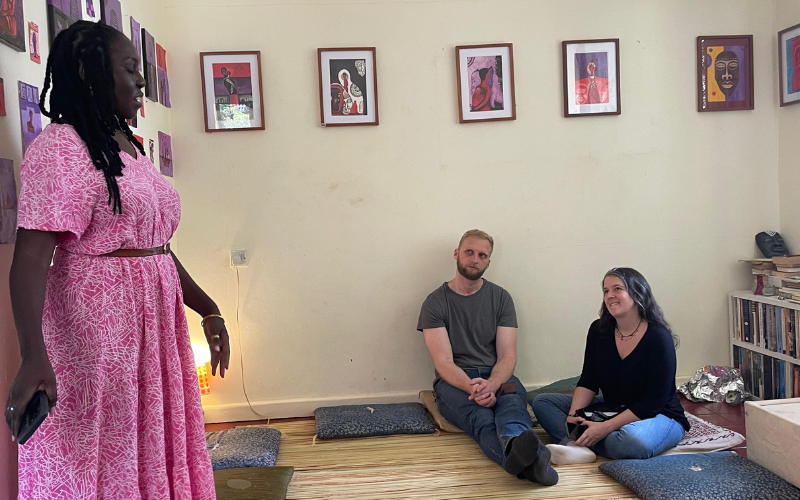
Curator and artist Joy Mala explores how scent can be used in multisensory exhibitions through olfaction arts. She led a workshop on perfume making and the architecture of scent on March 28 at the Contemporary Image Centre (CIC) in Nairobi.
It was the second in her series, and it follows an earlier exhibition titled Between Signals at the Nairobi Contemporary Arts Institute, where she began developing approaches outside of visual experiences.
Mala describes scent as a medium that challenges linear ways of viewing. Her curatorial approach, she explains, is to guide the flow of the experience, even though scent’s very nature is immersive and uncontrolled as it enters the body.
“When I curate a scent workshop, I compose atmospheres, emotions, and internal responses triggered by smell,” she says.
Her background in analytical chemistry informs the process. She understands scent not only artistically but also structurally, through how it behaves at a molecular level, including how it evaporates and interacts with receptors. This knowledge helps participants understand perfume as science and art.


“Scent bypasses intellectual interpretation and transforms into feeling. Chemistry is a bridge to further discovery, and I hope to host some science-intensive sessions in the future,” she says.
The workshop room was set up with good ventilation, soft lighting, a neutral background smell, and intimate seating arrangements. The room must feel safe for sensory exploration. She says these choices help reduce sensory fatigue and allow participants to stay focused.
“Curating an experience felt through smell requires attention to airflow, pacing, and sensory fatigue. I design moments of pause, neutral resets, and gradual escalation,” she expounds.
A short introduction of the chemical process is a part of the session, intentionally included to honour the complexity of scents people easily knows and interact with in day-to-day life.
The session began with breathing exercises to sharpen the sense of smell. Attendees smelt single notes, then learned about top, heart, and base notes while in isolation. Each person chose a memory or feeling and selected a few notes to blend. They adjusted their mixtures slowly until they arrived at a final scent, which they named and wrote about.

The materials were prepared in advance and diluted for safety. These included fruity esters, floral elements like linalyl acetate, woody and resinous bases, neutral carriers, blotter strips, and glass vials. She says no prior knowledge was needed, as her role was to provide structure while leaving space for personal direction.
As the session continued, participants developed a shared way of describing scents as they smelt each other’s creations and built it into a collective dialogue.
“Cultural background influenced how scents were perceived. A note that feels comforting in one culture feels medicinal or foreign in another. This diversity enriches the collective experience,” Mala says.
Her work explores memory, healing, perception, and the blurred line between objective chemistry and subjective experience. She is also interested in how scent can function as a decolonial gesture that reclaims knowledge systems that are forgotten in cultures or left out of formal art spaces.
She uses scents familiar in our environments, such as eucalyptus, pilau masala, fenugreek, ripe mango, rosemary, incense, red earth, and lantana flowers.

“I incorporate these locally resonant notes to invite participants to reference things available to them. These cultural contexts give olfaction profound meaning,” she says.
Some attendees created scents linked to nostalgia and comfort, others created unfamiliar ones, and some experimented with new scents. She noticed that scent unlocks memories people did not expect to revisit, and it brought vulnerability.
She explains that smell accesses the limbic system directly, so participants choose scents tied to childhood, home, love, or grief.
“Compared to visual art, audiences respond to scent more viscerally and sometimes more emotionally. It bypasses intellectual critique and goes straight to feeling,” she observes.
Challenges included over-blending, while others struggled to describe what they were sensing. Still, she believes that participants do not need knowledge of perfumery or art theory, only curiosity.

Preserving scent-based artworks is complex; for now, she suggests archiving as formulas, written reflections, or recreated compositions.
“Since scent is invisible and ephemeral, documenting it is also a curatorial challenge. We rely on writing, naming, and reflection to preserve what cannot be photographed,” she expresses.
At the end of the session, she views scent as a way of understanding how breath ties people to the surroundings and to each other. In this sense, she hopes participants leave with the knowledge that scent can be used for grounding, creativity, and care.
Mala is looking into future collaborations with sound designers, sound healers, chefs, and herbalists, stating that olfactory art thrives when it is interdisciplinary.
“As curators begin to embrace multisensory approaches, scent will be understood as a powerful medium capable of redefining how we experience art and ourselves,” she notes.