



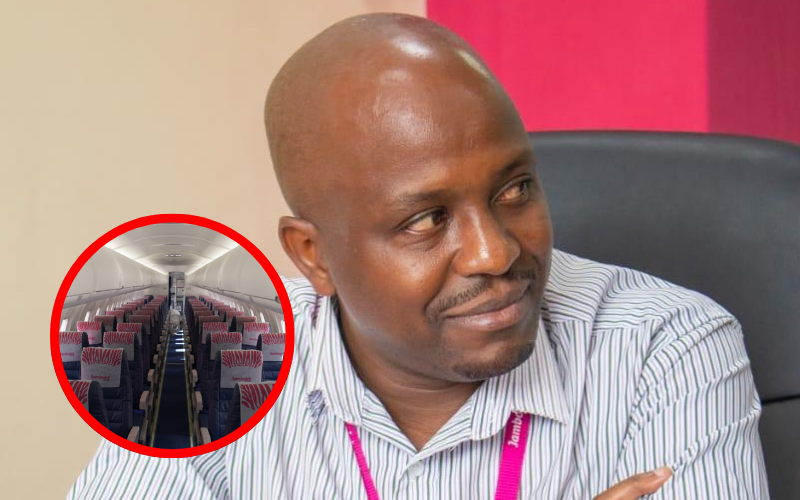
Simon Mwangi still remembers the first time he stepped onto an aircraft. It was June 2003, and he was neither a frequent traveller nor an aviation insider.
He had been working near Wilson Airport, watching planes come and go, drawn to the rhythm of an industry then accessible to only a few.
“Apparently, it was also the first time that I boarded an aircraft,” he tells TNX Africa. “I used to work next to Wilson airport, and I would admire people who worked in the aviation industry.”
More than two decades later, Mwangi is an in-flight services manager at Jambojet, part of a generation of aviation professionals who have witnessed, and helped shape, the democratisation of air travel in Kenya.
His journey tracks closely with the industry’s own evolution, from an elite mode of transport to an increasingly accessible, experience-driven service sector.
“When I started flying as a cabin crew 23 years ago, the emphasis was on how you present yourself, communication skills, customer service skills,” he says. “You also had to meet certain physical and grooming standards.”
At the time, the perception of cabin crew leaned heavily on appearance and hospitality. That has since shifted significantly.
“The role today is far more skill-driven and operationally focused,” Mwangi says.
Today, Africa’s skies are busier than ever.
Passenger demand on the continent rose 9% in early 2025, more than double the global average, according to IATA data. Kenya recorded 12.83 million commercial air passengers in 2024, a 5.1% increase on the previous year, with long-term forecasts pointing to 345 million African passengers annually by 2043.
At the centre of this expansion is a growing domestic market and the low-cost model that helped build it. But within that ecosystem, the cabin crew role has become more technical and operational.
“Cabin crew are no longer just service providers, they are safety professionals, brand ambassadors, crisis managers and customer service champions,” Mwangi says.
Airlines are placing greater emphasis on emotional intelligence, adaptability and problem-solving as passenger demographics evolve. In Kenya, the rise of low-cost carriers has introduced a new category of traveller, many of them flying for the first time, fundamentally changing the cabin dynamic.
According to data commissioned by Jambojet, the shift is significant.
“In 2024 we did a survey and noted that 44 percent of our passengers were first time flyers,” Mwangi says. “This means that almost half of our passengers were unfamiliar with the cabin environment.”


For cabin crew, this translates into a more attentive and intuitive approach to service. First-time flyers may hesitate to ask questions, misunderstand safety instructions or feel overwhelmed, requiring a careful balance between guidance and reassurance.
“It is important to read situations well and provide support without overwhelming them,” he explains. “As a crew you also have to offer clear guidance, reassurance and sometimes repeated instructions.”
Over the past decade, low-cost carriers have reshaped aviation markets across Africa, lowering ticket prices and expanding domestic connectivity. In Kenya, this has opened up air travel to students, small business owners and families who would previously not have considered flying.
“I remember when we first started Jambojet, our slogan was now you can fly and our fares were Sh1,900,” Mwangi says. “In the past flying used to be for the rich and elite in society but now we even have children going to and back from school by air.”
But as access widens, expectations are rising too. Passengers are no longer satisfied with simply getting from one point to another.
“Passengers are now looking for a more holistic personalised experience as they travel. They expect cabin crew to have more emotional intelligence and be responsive to their needs.”
That expectation has pushed airlines to rethink in-flight service. Small gestures, once considered optional, are now part of a broader loyalty strategy. Mwangi cites examples from his own experience: celebrating anniversaries, birthdays and graduations onboard. Last year alone, the airline marked 63 such occasions.
For him, these moments are central to how airlines differentiate themselves in a competitive market.
“Passengers are now not only buying seats but are investing in an experience,” he says. “It is the small human interactions that passengers remember most.”
Drawing on international experience, Mwangi stepped into informal leadership roles, mentoring colleagues and helping standardise operations during high-pressure situations, marking his transition from cabin crew to management.
“That prepared me very well for a managerial role where you are required to be selfless in leadership,” he says. “It allowed me to move from executing service to shaping it.”
Today he oversees teams of cabin crew, focusing on consistency, training and culture.
Looking ahead, he expects technology and data to define the next phase of aviation, with digital tools already transforming booking, check-in and inflight communication.
“The cabin crew role will move beyond service delivery to shaping the passenger experience. Tech literacy will become one of the requirements,” he says.
For someone who once watched planes from the ground, the view from 30,000 feet has changed dramatically. But the core of the job, he suggests, remains grounded in human connection.
“We are not just delivering a service,” Mwangi says. “We are helping shape someone’s very first impression of air travel.”