



Audio By Vocalize
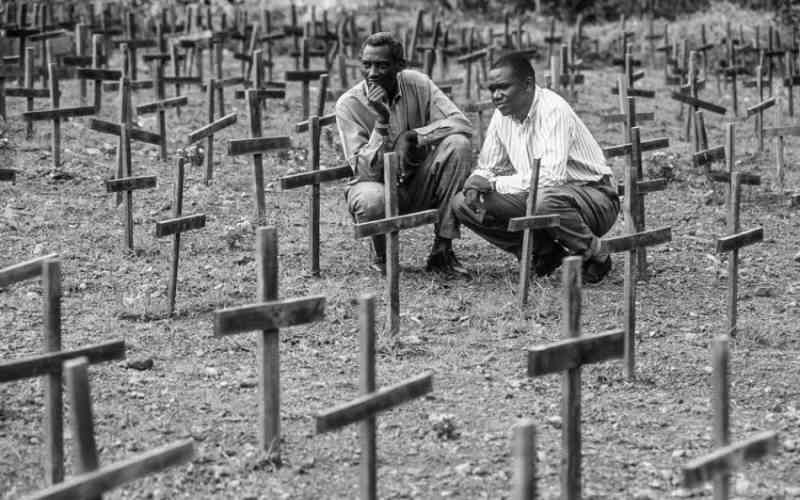
(L) Tutsi pastor Anastase Sambamungu and Hutu teacher Nyamutera Joseph at Rwanda cemetery where 6000 victims were buried. [Courtesy, World Vision]
The United Nations (UN) on Tuesday led the international community in commemorating the 32nd anniversary of the 1994 Rwanda genocide.
Solemn ceremonies were held in Kigali, New York, the UN Gigiri complex in Nairobi and in all Rwanda consulates. Diplomats, clergy, civil society, the Rwandan community in Kenya and other guests graced the memorial in Nairobi.
The ceremony was marked by renewed calls of “never again” as speakers reflected on one of the gravest atrocities in history. The genocide against the Tutsis left more than one million people dead in just 100 days.
Officially known as the International Day of Reflection on the Genocide Against the Tutsis in Rwanda, the event served as a remembrance of lives lost and a warning against the dangers of ethnic hate and division.
Speakers also drew attention to the fragile situation in eastern Democratic Republic of Congo, where ethnic tensions continue to pose a threat to peace and stability. They called for vigilance and prevention of mass atrocities, saying failure by the international community to act exacerbated the Rwanda genocide.
A moving testimony from Mr Serge Rwigamba, a survivor who lost 15 family members during the genocide, brought the audience to near tears. He recounted how perpetrators, emboldened by local administrators in Kigali, carried out coordinated attacks in his locality.
The testimonies, songs and poems at the Nairobi memorial highlighted the deep scars left by the violence and the enduring need for justice, healing and reconciliation across the region.
In a message delivered by Mrs Zainab Bangura, the Director General of the UN Office at Nairobi, UN Secretary General António Guterres acknowledged the failure of the international community at the time and urged renewed commitment to prevention.
“Thirty-two years ago, Rwanda endured a very difficult time. Entire families were erased. We mourn the victims and honour the survivors. We remember the international community’s failure to act to prevent the deaths,” he said.
Mr Guterres stressed the need to strengthen institutions that can detect and prevent early signs of mass violence. “We must strengthen institutions that help prevent mass atrocities. Let this day reaffirm our commitment to remember, to listen and to act,” he added.
Rwanda’s ambassador to Kenya, Ernest Rwamucyo, said the country continues to confront its painful past while making strides toward rebuilding and unity. “The genocide is our history and we must reckon with it. The journey of building from the ashes is not easy and requires resilience,” he said, adding that remembrance plays a critical role in ensuring such atrocities are never repeated.
Participants lit candles and held flowers in tribute to those who were killed.
“It was a failure of humanity…. We acknowledge the profound impact of the genocide. We reaffirm Kenya’s commitment to stand with Rwanda,” said Mr Dennis Mburu, the Deputy Director of the Africa Affairs at the Ministry of Foreign and Diaspora Affairs.
Besides formal judicial processes targeting high-profile genocide suspects in the courts, Rwanda has also turned to Gacaca courts, which are a community-led mechanism that brings suspects to justice while promoting reconciliation.
Support Independent Journalism
Stand With Bold Journalism.
Stand With The Standard.
Continue
→
Pay via
Secure Payment
Kenya’s most trusted newsroom since 1902
Follow The Standard
channel on WhatsApp
(L) Tutsi pastor Anastase Sambamungu
and Hutu teacher Nyamutera Joseph at Rwanda cemetery where 6000 victims were buried.
[Courtesy, World Vision]
The United Nations (UN) on Tuesday led the international community in commemorating the 32nd anniversary of the 1994 Rwanda genocide.
Solemn ceremonies were held in Kigali, New York, the UN Gigiri complex in Nairobi and in all Rwanda consulates. Diplomats, clergy, civil society, the Rwandan community in Kenya and other guests graced the memorial in Nairobi.
The ceremony was marked by renewed calls of “never again” as speakers reflected on one of the gravest atrocities in history. The genocide against the Tutsis left more than one million people dead in just 100 days.
Officially known as the International Day of Reflection on the Genocide Against the Tutsis in Rwanda, the event served as a remembrance of lives lost and a warning against the dangers of ethnic hate and division.
Speakers also drew attention to the fragile situation in eastern Democratic Republic of Congo, where ethnic tensions continue to pose a threat to peace and stability. They called for vigilance and prevention of mass atrocities, saying failure by the international community to act exacerbated the Rwanda genocide.
A moving testimony from Mr Serge Rwigamba, a survivor who lost 15 family members during the genocide, brought the audience to near tears. He recounted how perpetrators, emboldened by local administrators in Kigali, carried out coordinated attacks in his locality.
The testimonies, songs and poems at the Nairobi memorial highlighted the deep scars left by the violence and the enduring need for justice, healing and reconciliation across the region.
In a message delivered by Mrs Zainab Bangura, the Director General of the UN Office at Nairobi, UN Secretary General António Guterres acknowledged the failure of the international community at the time and urged renewed commitment to prevention.
“Thirty-two years ago, Rwanda endured a very difficult time. Entire families were erased. We mourn the victims and honour the survivors. We remember the international community’s failure to act to prevent the deaths,” he said.
Mr Guterres stressed the need to strengthen institutions that can detect and prevent early signs of mass violence. “We must strengthen institutions that help prevent mass atrocities. Let this day reaffirm our commitment to remember, to listen and to act,” he added.
Rwanda’s ambassador to Kenya, Ernest Rwamucyo, said the country continues to confront its painful past while making strides toward rebuilding and unity. “The genocide is our history and we must reckon with it. The journey of building from the ashes is not easy and requires resilience,” he said, adding that remembrance plays a critical role in ensuring such atrocities are never repeated.
Participants lit candles and held flowers in tribute to those who were killed.
“It was a failure of humanity…. We acknowledge the profound impact of the genocide. We reaffirm Kenya’s commitment to stand with Rwanda,” said Mr Dennis Mburu, the Deputy Director of the Africa Affairs at the Ministry of Foreign and Diaspora Affairs.
Besides formal judicial processes targeting high-profile genocide suspects in the courts, Rwanda has also turned to Gacaca courts, which are a community-led mechanism that brings suspects to justice while promoting reconciliation.
Stay informed. Subscribe to our newsletter
Follow The Standard
channel on WhatsApp
By Mark Oloo