

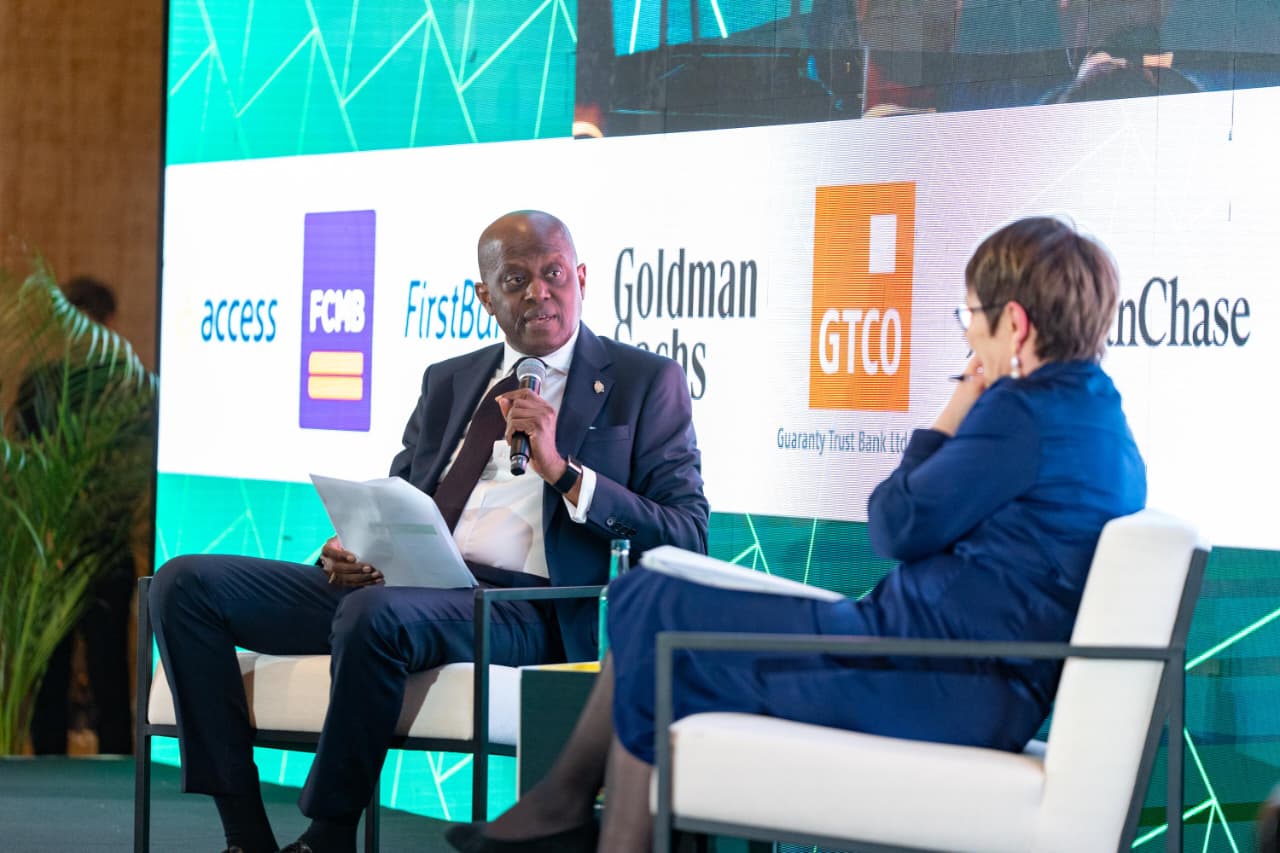
There is a particular kind of attention the rest of Africa pays when its largest economy makes a decisive move. On 17 March 2026, at The Peninsula London, Nigeria made that move.
The Africa Capital Forum, convened under the theme From Stabilisation to Capital Mobilisation, brought CBN Governor Yemi Cardoso onto the same stage as JP Morgan, IFC, Standard Chartered, and the European Bank for Reconstruction and Development. The room was filled with the kind of institutional investors whose capital allocation decisions shape the risk pricing of entire regions.
For those of us watching from Nairobi, Kigali, Addis Ababa, or Dar es Salaam, the temptation might be to file this under “Nigeria’s story.” That would be a misreading of what happened. What Nigeria presented in London was, in effect, a rewriting of the terms on which African sovereign ambition can be credibly presented to global capital. And that changes the calculation for every economy on this continent.
To understand why this forum carried weight, one must first reckon with what Nigeria has actually done over the past two years. The Tinubu administration’s reform agenda represents one of the most significant structural adjustments any African economy has attempted in a generation. These were foundational corrections, not technocratic adjustments. Each carried political cost and signalled a clear shift towards economic realism.
The removal of a decades-old fuel subsidy arrangement, which at its peak consumed an estimated $10 billion annually, was the first seismic shift. The short-term pain was real and viscerally felt by ordinary Nigerians. But the fiscal space it created, and the credibility it conferred with multilateral institutions and sovereign investors, cannot be overstated. This was the kind of politically brave decision that many African governments have talked about, and very few have implemented at scale.
The elimination of a multiple-tier exchange rate system that had become a mechanism for capital flight and distortion was equally consequential. The wide premium between the official and parallel markets, once a defining feature of Nigeria’s FX landscape, has been dramatically narrowed and at times virtually eliminated. FX market turnover has risen to levels not seen in over seven years. For any investor or exporter who had spent the previous decade navigating the opacity of Nigeria’s currency regime, this was not a minor adjustment. It was the restoration of price discovery.
Perhaps the most structurally significant of all the reforms is the banking recapitalisation. The CBN’s directive requiring commercial banks to increase their minimum capital thresholds significantly is not merely a regulatory exercise. It is the deliberate engineering of a financial system capable of intermediating the volumes of capital that a trillion-dollar economy requires.
Over 30 banks have reportedly met the enhanced requirements, and a striking 28 per cent of recapitalisation inflows have come from foreign investors. Nigeria’s banks, for all their regional ambitions, have historically been undercapitalised relative to the economies they serve. Recapitalisation forces consolidation, strengthens balance sheets, and positions the Nigerian banking system to absorb and deploy the kind of long-term, large-ticket financing that infrastructure, manufacturing, and export-oriented industries demand. This is the plumbing of a serious economy. Nigeria is building it in full view of the market.
The results are beginning to show in the data. Inflation has moved onto a corrective trajectory. Foreign reserves have been rebuilt to above $50 billion. When Governor Cardoso told the London audience that Nigeria’s reforms had bolstered shock resilience and confidence, he was pointing to measurable outcomes, not aspirations.
The Trillion-Dollar Ambition: Audacious, but Grounded in Logic
Nigeria’s stated target of a one-trillion-dollar economy by 2030 has attracted admiration and scepticism in equal measure. The Federal Government’s stated requirement of roughly 10 to 12 percent annual growth is, by any historical benchmark, ambitious. But the underlying logic deserves closer examination than the headline number typically receives.
Nigeria’s economy, even after rebasing, operates significantly below its productive potential. The oil sector has underperformed for structural and security reasons. But the non-oil economy, comprising fintech, agriculture, manufacturing, and a rapidly expanding services sector, has demonstrated growth dynamics that point to significant latent capacity.
GDP growth reached 3.4 percent in 2024, the strongest full-year performance since 2014, and continued to accelerate through the fourth quarter. The question has never been whether Nigeria possessed the underlying assets to build a trillion-dollar economy. The question has always been whether it had the institutional will to unlock them.
What the Africa Capital Forum demonstrated was that Nigeria has, for the moment, found an answer to that question, and that institutions of the calibre of JP Morgan, IFC, and the EBRD are willing to say so publicly. Risk pricing in frontier and emerging markets is substantially shaped by the perceived credibility of the reform narrative, not merely by the data alone.
When S&P’s lead Africa analyst publicly confirmed a positive outlook at the forum, and when IFC and UK Export Finance executives described Nigeria as “very investable,” those were not diplomatic courtesies. Those were signals with material consequences for capital flows. London, on 17 March, was a signal of considerable weight.
Why This Matters Now, Geopolitically
The significance of what Nigeria did in London must be placed within the context of a rapidly shifting global order. The dominant story across Western capitals in recent years has been one of strategic retrenchment. Industrial policy nationalism, supply chain reshoring, and the prioritisation of domestic constituencies over global development commitments are not temporary aberrations. They represent a structural recalibration of where Western capital and political attention are directed.
For Africa, the implications are serious and only beginning to be fully felt. Aid flows are under pressure. Concessional finance is harder to access. Development finance institutions face political constraints on their mandates. The West is not abandoning Africa, but it is demonstrably prioritising itself.
This is precisely the environment in which Africa must develop the capacity to mobilise capital on its own terms, from its own institutional architecture, and with its own compelling narrative. Nigeria, in stepping into this vacuum with a coherent reform story and a trillion-dollar aspiration backed by credible institutional sponsorship, is doing something with continental implications.
It is demonstrating that an African sovereign can walk into the most scrutinised financial markets in the world and make a case for long-term investment not based on humanitarian need, but on economic fundamentals, institutional reform, and growth potential. That is a different posture. It represents a maturation in how Africa engages global capital—and it matters deeply for every African economy seeking to borrow, attract investment, or issue sovereign debt on favourable terms.
An East African Reading
From this side of the continent, some lessons and opportunities deserve to be named clearly.
East Africa has its own reform stories. Kenya’s financial sector is among the most sophisticated on the continent, with capital market depth and mobile money infrastructure that is genuinely world-class. Rwanda’s governance model continues to attract investor attention disproportionate to its GDP. Ethiopia’s liberalisation of its telecoms and banking sectors signals a development state in transition. Tanzania’s natural resource endowment and improving regulatory environment represent a significant long-term proposition.
These are real credentials. But the region has a lot to learn from what Nigeria achieved in London: a single, coordinated, high-visibility mobilisation of a national economic narrative at the global level, anchored by the country’s most influential central bank and validated by tier-one global institutions.
Beyond the lessons, there are direct spillover effects that East African economies should be actively positioning to capture. A repricing of African sovereign risk, driven by Nigeria’s scale and visibility, lifts the floor for every African borrower. When the continent’s largest economy demonstrates that reform delivers confidence, it strengthens the hand of every finance minister making similar difficult choices.
The AfCFTA dimension is underappreciated. A Nigeria mobilising significant private capital for infrastructure, manufacturing, and financial deepening is not merely a domestic story. It is a potential demand driver for East African goods, a market for regional exports, and a critical partner in deeper economic integration.
A more financially sophisticated, higher-growth Nigeria is structurally good for Kenyan exporters, Rwandan service providers, Ugandan manufacturers, and Ethiopian logistics operators. The trade linkages are real, even where the institutional architecture to realise them remains incomplete.
What This Moment Means for the Continent
The Africa Capital Forum represents something important in its own right: a high-stakes convening at which Africa’s largest economy demonstrated the institutional capacity to tell its own story, on its own terms, to the most demanding audience in global finance—and to be taken seriously.
From the east, watching, there is cause for sober optimism. Nigeria is not finished. But it has begun, in earnest, in public, and at the highest table. And when Africa’s largest economy begins in earnest, the stakes are not Nigerian alone.
They belong to every African economy that has ever had to convince a sceptical investor that reform is real, that institutions matter, and that this continent’s growth story is worth more than a risk premium. If Nigeria sustains what it has started, the rest of Africa will not merely watch—it will be repriced alongside it.