

Audio By Vocalize
Five years ago, if you had told Catherine Obuchafu that worms could be a source of income, she would have laughed it off.
Today, however, she takes worms very seriously and gives the idea a confident thumbs-up. In fact, Catherine, together with a group of women, has built their livelihood around them.
The group rears worms through a practice known as vermicomposting.
Vermicomposting is the process of using earthworms to break down organic waste such as food scraps, vegetable peels, and other biodegradable materials into nutrient-rich compost.
In this process, worms feed on the waste and produce vermicast, a natural fertiliser that improves soil structure, enhances nutrient content, and promotes healthy plant growth.
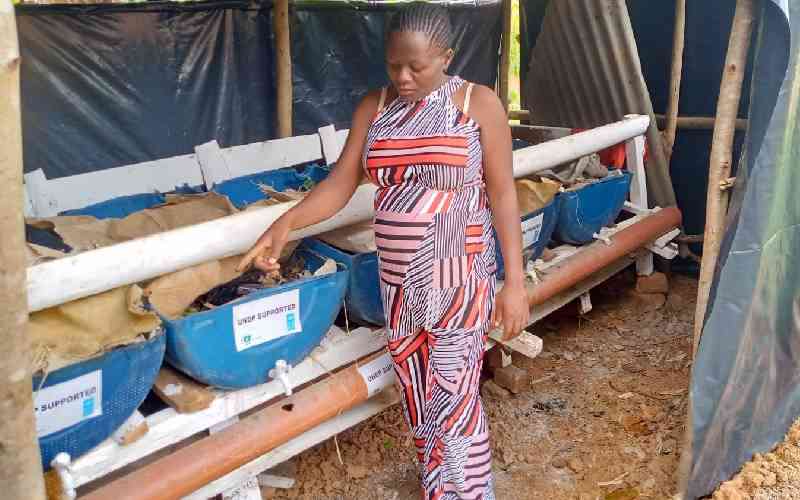
When Smart Harvest visited her rural home in Butere Sub-County, Kakamega County, Catherine was busy refilling an open food-bin container with vegetable scraps, fruit peels, and other household waste.
Unbothered by the pungent smell of the decomposing kitchen waste, she calmly fed the earthworms, which slithered through the moist compost.
“Honestly, how could I have known that worms were this important?” she said with a hearty laugh. “The most important thing is that I now have this knowledge. Information is indeed power.”
For many years, Catherine lived as a housewife, often struggling to earn even a small amount of money for her personal use. That changed when the Shinamwenyuli Youth Community-Based Organisation (CBO) engaged and picked women and youth groups in Butere and introduced them to the worm-farming venture.
She recalls, “We underwent rigorous training in conservation agriculture, including how to promote forest cover and implement land-use practices that are resilient to climate change and support improved livelihoods.”
Catherine and 290 other women and youth members say worms are easy and inexpensive to manage, as they thrive on readily available kitchen waste.
Zablon Indakwa, a CBO official, praises the vermicomposting project, saying it is empowering women and youths and providing them with income they can use at home. He explained that after training, women and youth groups are given special food-bin containers and a starter batch of worms to begin their vermicomposting venture.
“Considering the impact, where women and youths now have money in their pockets, and some have even invested in other income-generating projects, the vermicomposting project has emerged as one of the CBO’s key achievements,” Indakwa said.
The women and youth groups use the fertiliser on their own farms and also sell it for income. Catherine started by producing five litres, then increased to 10, and today she harvests more than 20 litres every week.
“I harvest worm juice and use it on my farm, and I also sell it to other farmers.
“Nowadays, the fertiliser is in high demand, and those who want it must place an order in advance,” she says. A 20-litre jerrycan costs between Sh4,000 and Sh7,000.
For Lydia Shiafu, the organic fertiliser has not only improved the soil and productivity of her farm but also reduced her reliance on commercial fertilisers.
She has saved a significant amount of money that she would have otherwise spent on commercial fertiliser.
“Where I used to get 10 bags, today I get more than 15. Nowadays, I make sure to store enough fertiliser for my farms and only sell the surplus once I have enough for my own use,” she shared.
Yet, Lydia recalls that when she first handled the worms, it was not a pleasant sight. After the training and seeing the benefits, she has now become a master of worm farming.
She explained, “After feeding on fruit and vegetable remains, the worms multiply rapidly.” It is their excretion that gives us the nutrient-rich worm juice, which we apply on our farms.”
Indakwa explained that the amount of fertiliser collected at any given time by the women depends on the size and number of food containers each of them has. He explained that the process is an environmentally friendly way to recycle household or farm waste while producing high-quality manure for crops.
They have been building the capacities of smallholder farmers, especially women and youths, to sustain orphaned agro-ecosystem crops and forestry production systems.
“Our key objective has been to promote women’s and youth participation, as well as civic engagement, in adopting sustainable land management practices and scaling up agroforestry, reforestation, and landscape restoration activities,” he said.
He explained that with the effects of climate change, such as prolonged droughts and floods, it is essential to adopt sustainable farming methods that do not worsen the problem. Since farming is a widely practised activity, promoting sustainable practices is the most effective way forward.
The farmers have also been encouraged to establish nurseries, where they raise seedlings before transplanting them to their farms.
Indakwa added, “We have planted 15,000 agroforestry seedlings both on and off the farm, distributed 100 vermibins, and provided 100 kg of red wiggler worms to the farmers. In addition, 200 conservation agriculture tools have been made available. They include seed drills, jembes, mulching, weeding, and composting bins.”
For the women and youths involved in the project, plans include expanding vermicomposting and rearing even more worms.
“In a week, I earn between Sh4,000 and Sh7,000. Within the next year, I aim to be earning at least Sh15,000 per week,” says Catherine.
Following the success in Butere, Indakwa shares that there are plans to roll out the project across all sub-counties in Kakamega as a sustainable farming enterprise targeting women and youth.
Support Independent Journalism
Stand With Bold Journalism.
Stand With The Standard.
Continue
→
Pay via
Secure Payment
Kenya’s most trusted newsroom since 1902
Follow The Standard
channel on WhatsApp
Five years ago, if you had told Catherine Obuchafu that worms could be a source of income, she would have laughed it off.
Today, however, she takes
worms very seriously
and gives the idea a confident thumbs-up. In fact, Catherine, together with a group of women, has built their livelihood around them.
The group rears worms through a practice known as vermicomposting.
Vermicomposting is the process of using earthworms to break down organic waste such as food scraps, vegetable peels, and other biodegradable materials into nutrient-rich compost.
In this process, worms feed on the waste and produce vermicast, a natural fertiliser that improves soil structure, enhances nutrient content, and promotes healthy plant growth.
When Smart Harvest visited her rural home in Butere Sub-County, Kakamega County, Catherine was busy refilling an open food-bin container with vegetable scraps, fruit peels, and other household waste.
Unbothered by the pungent smell of the decomposing kitchen waste, she calmly fed the earthworms, which slithered through the moist compost.
“Honestly, how could I have known that worms were this important?” she said with a hearty laugh. “The most important thing is that I now have this knowledge. Information is indeed power.”
For many years, Catherine lived as a housewife, often struggling to earn even a small amount of money for her personal use. That changed when the Shinamwenyuli Youth Community-Based Organisation (CBO) engaged and picked women and youth groups in Butere and introduced them to the worm-farming venture.
She recalls, “We underwent rigorous training in conservation agriculture, including how to promote forest cover and implement land-use practices that are resilient to climate change and support improved livelihoods.”
Catherine and 290 other women and youth members say worms are easy and inexpensive to manage, as they thrive on readily available kitchen waste.
Zablon Indakwa, a CBO official, praises the vermicomposting project, saying it is empowering women and youths and providing them with income they can use at home. He explained that after training, women and youth groups are given special food-bin containers and a starter batch of worms to begin their vermicomposting venture.
“Considering the impact, where women and youths now have money in their pockets, and some have even invested in other income-generating projects, the vermicomposting project has emerged as one of the CBO’s key achievements,” Indakwa said.
The women and youth groups use the fertiliser on their own farms and also sell it for income. Catherine started by producing five litres, then increased to 10, and today she harvests more than 20 litres every week.
“I harvest worm juice and use it on my farm, and I also sell it to other farmers.
Stay informed. Subscribe to our newsletter
“Nowadays, the fertiliser is in high demand, and those who want it must place an order in advance,” she says. A 20-litre jerrycan costs between Sh4,000 and Sh7,000.
For Lydia Shiafu, the organic fertiliser has not only improved the soil and productivity of her farm but also reduced her reliance on commercial fertilisers.
She has saved a significant amount of money that she would have otherwise spent on commercial fertiliser.
“Where I used to get 10 bags, today I get more than 15. Nowadays, I make sure to store enough fertiliser for my farms and only sell the surplus once I have enough for my own use,” she shared.
Yet, Lydia recalls that when she first handled the worms, it was
not a pleasant sight
. After the training and seeing the benefits, she has now become a master of worm farming.
She explained, “After feeding on fruit and vegetable remains, the worms multiply rapidly.” It is their excretion that gives us the nutrient-rich worm juice, which we apply on our farms.”
Indakwa explained that the amount of fertiliser collected at any given time by the women depends on the size and number of food containers each of them has. He explained that the process is an environmentally friendly way to recycle household or farm waste while producing high-quality manure for crops.
They have been building the capacities of smallholder farmers, especially women and youths, to sustain orphaned agro-ecosystem crops and forestry production systems.
“Our key objective has been to promote women’s and youth participation, as well as civic engagement, in adopting sustainable land management practices and scaling up agroforestry, reforestation, and landscape restoration activities,” he said.
He explained that with the effects of climate change, such as prolonged droughts and floods, it is essential to adopt sustainable farming methods that do not worsen the problem. Since farming is a widely practised activity, promoting sustainable practices is the most effective way forward.
The farmers have also been encouraged to establish nurseries, where they raise seedlings before transplanting them to their farms.
Indakwa added, “We have planted 15,000 agroforestry seedlings both on and off the farm, distributed 100 vermibins, and provided 100 kg of red wiggler worms to the farmers. In addition, 200 conservation agriculture tools have been made available. They include seed drills, jembes, mulching, weeding, and composting bins.”
For the women and youths involved in the project, plans include expanding vermicomposting and rearing even more worms.
“In a week, I earn between Sh4,000 and Sh7,000. Within the next year, I aim to be earning at least Sh15,000 per week,” says Catherine.
Following the success in Butere, Indakwa shares that there are plans to roll out the project across all sub-counties in Kakamega as a sustainable farming enterprise targeting women and youth.
Follow The Standard
channel on WhatsApp
By Nanjinia Wamuswa